How to Find the Nearest Nöbetçi Eczane (Night Pharmacy) Using Online Maps
Imagine waking up at 3:00 AM with a throbbing migraine or a child’s sudden fever, only to realize your local pharmacy’s shutters are bolted tight. I still remember my first winter in Istanbul, wandering through the freezing backstreets of Beşiktaş, desperate for basic painkillers and feeling utterly defeated by the dark storefronts. This guide solves that panic by teaching you exactly how to navigate Turkey’s rotating night pharmacy system using digital tools.
Understanding the Nöbetçi Eczane System in Turkey
In Turkey, pharmacies (known as Eczane) do not operate on a 24/7 basis like the supermarkets or convenience stores you might be used to back home. Instead, they follow a highly regulated and strictly enforced "duty" system. During regular business hours—typically 9:00 AM to 7:00 PM on weekdays and Saturdays—almost every pharmacy you see will be open. However, once the clock strikes 7:00 PM, or on Sundays and public holidays, the vast majority close their doors. To ensure the public still has access to medicine, a rotating selection of pharmacies is designated as the Nöbetçi Eczane, or "Pharmacy on Duty."
This system is organized by the local Chamber of Pharmacists in each province. They ensure that in every neighborhood or district, at least one or two pharmacies remain open all night until the following morning. For a veteran expat, the transition from being frustrated by this system to mastering it is a rite of passage. It requires a bit of foresight and the right digital tools, as the pharmacy that was open last Sunday will almost certainly be closed this Sunday. If you are managing chronic conditions, you might also want to look into Managing Chronic Illnesses: Diabetes, Hypertension, and Medication Supply to understand how these duty hours impact your long-term prescription needs.
The logic behind this system is rooted in Turkish labor laws and the desire to prevent monopolization, but for a foreigner, it can feel like a scavenger hunt when you are at your most vulnerable. The good news is that the "duty" pharmacy is required by law to be fully staffed and capable of filling any prescription, just like a daytime branch. They are also linked to the national health system, meaning if you have coverage like Health Insurance in Turkey: SGK Public System vs Private Coverage Explained, your discounts and records will still be accessible through their computers.
The Duty Roster: Why Your Local Pharmacy is Closed
The rotation is not random; it is a meticulously planned calendar. Each district (ilçe) has its own schedule. For example, if you live in a massive district like Çankaya in Ankara, there will be several duty pharmacies spread across different neighborhoods to ensure coverage. In smaller coastal towns, there might only be one for the entire village. This is why your favorite pharmacy next to your apartment is suddenly dark; it simply isn't their turn to serve the late-night shift.
When a pharmacy is on duty, they stay open from the moment the others close until 9:00 AM the next day. This 14-to-15-hour "extra" shift is grueling for the staff, so expect the pharmacists to be a bit tired, though they remain professional. Because of the limited number of open locations, these pharmacies can become quite crowded, especially during flu season or on Sunday afternoons. Understanding Pharmacies (Eczane) in Turkey: Prescriptions, Duty Hours, and Medications can give you a deeper look into what to expect during these peak times.
One thing many newcomers don't realize is that even if a pharmacy is "closed," they are required to post a list in their window. This list, usually a printed sheet of paper, shows the names, addresses, and phone numbers of the nearest pharmacies that are on duty that night. While this is a great fallback, trying to read a blurry printout through a glass window in the rain is not ideal, which is why online maps have become the gold standard for expats.
Identifying a Duty Pharmacy from the Window
If you find yourself on the street without a working data plan, look for the red "E" sign that hangs outside every pharmacy. Usually, these signs are turned off when the shop is closed. However, the Nöbetçi Eczane will have its sign illuminated, often with a flashing border or an additional "Nöbetçi" LED display. It acts as a beacon in the dark Turkish streets.
Inside the window of any closed pharmacy, you will see a sign that says "Nöbetçi Eczaneler." Underneath, you will find the addresses of the duty pharmacies for that specific date. If you are in a tourist-heavy area, these might even be accompanied by a small map. However, keep in mind that these lists are in Turkish. If you are struggling with the language, you might find it helpful to learn some Essential Turkish Phrases for the Doctor: Communicating Symptoms Effectively so you can at least explain your situation once you find the right door.
The physical list is a legal requirement, but it isn't always updated the second a change occurs. I once walked ten minutes to a pharmacy listed on a window, only to find it had moved its location six months prior. This is another reason why relying on real-time digital updates via your smartphone is significantly more reliable than the paper-on-glass method.
Using Online Maps to Find a Night Pharmacy
Finding a night pharmacy is much easier than it was a decade ago, thanks to the integration of local government data with major mapping platforms. However, not all maps are created equal. Depending on whether you are in the heart of Istanbul or a remote part of the Kaş peninsula, the accuracy of your search results may vary.
When you are feeling unwell, you don't want to be troubleshooting an app. Most expats default to Google Maps, which is generally excellent, but in Turkey, there are localized alternatives that sometimes have a "direct line" to the Chamber of Pharmacists’ database. If you have international health coverage like Cigna Global, they often provide their own portal for finding nearby clinics, but for a quick pharmacy run, the general public tools are usually faster.
Google Maps and Apple Maps: Pros and Cons
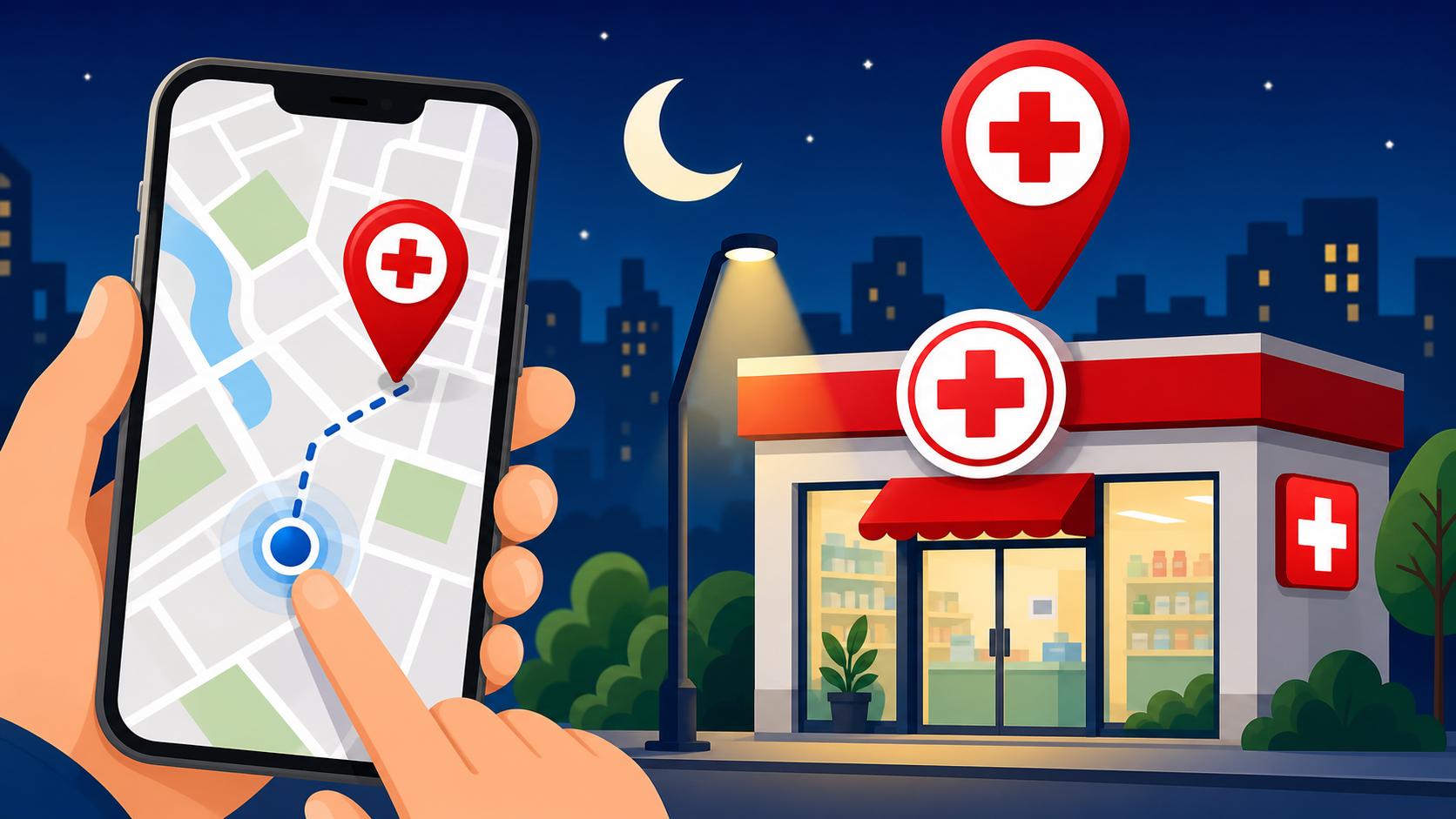
Google Maps is the most common tool used by foreigners in Turkey. To find a pharmacy at night, simply type "Nöbetçi Eczane" into the search bar. Google is smart enough to filter for businesses that are currently "Open Now." However, a word of caution: Google sometimes struggles with the specific "duty" status. It might show a pharmacy as "Closed" because its regular hours are over, even if it is actually the designated duty pharmacy for that night.
To bypass this, look for the "Live" or "On Duty" labels that have recently started appearing in search results for major Turkish cities. If you see a pharmacy that says "Open 24 hours" but only for today, that’s your target. Apple Maps has also improved significantly in Turkey, but it still lacks the deep "community-updated" feel that Google provides. If you are using an iPhone, double-check the result against a web search just to be safe.
The biggest pro of using Google Maps is the "Directions" feature. Since duty pharmacies are often tucked away in residential side streets to ensure geographic distribution, having a GPS guide you turn-by-turn is invaluable. This is especially true if you are relying on Taking Taxis in Istanbul: How to Use BiTaksi and Uber to Avoid Scams to get there, as you can simply show the driver the map on your screen.
Specialized Turkish Pharmacy Apps
There are several apps specifically designed for the Turkish healthcare ecosystem. One of the most popular is "Türk Eczacıları Birliği" (TEB) app or various third-party "Nöbetçi Eczane" apps available on the App Store and Google Play. These apps pull data directly from the official city rosters, meaning they are 100% accurate, unlike Google which relies partly on user reports and algorithms.
The interface of these apps is usually simple. You select your city (e.g., Istanbul), then your district (e.g., Kadıköy), and it generates a list of the pharmacies on duty that night. Most will have a "Yol Tarifi" (Get Directions) button that will export the coordinates directly into your preferred map app. This is the method I personally use because it eliminates the risk of showing up to a closed door.
For those who prefer not to download new apps, many municipalities (Belediye) have their own websites with a dedicated "Nöbetçi Eczaneler" section. For instance, if you live in Izmir, the Izmir Chamber of Pharmacists website is incredibly mobile-friendly and updated daily. It’s a good idea to bookmark these sites on your phone’s browser for emergencies.
Official Chamber of Pharmacists Websites (TEB)
The Turkish Pharmacists’ Association (TEB) is the governing body for all pharmacies in the country. Their regional branches (e.g., the Istanbul Eczacı Odası) are the ultimate source of truth. If Google Maps says one thing and the "Eczacı Odası" website says another, always trust the latter. These websites are the ones that actually set the schedule.
The data on these sites is organized by "Bölge" (Region). Even in the middle of the night, their servers are active and provide the name of the pharmacist on duty, their phone number, and a precise map link. If you are staying in a hotel, the concierge will almost certainly be using one of these official websites to help you. If you are an expat living long-term, getting familiar with these sites is as essential as knowing How to Register Your Address with the Local Sağlık Ocağı (Health Clinic).
| Method | Reliability | Ease of Use | Best For |
|---|---|---|---|
| Google Maps | High (80%) | Excellent | Quick searches and GPS navigation |
| Official TEB Website | Very High (100%) | Moderate | Verifying status during holidays/late night |
| Physical Window List | High (95%) | Low | When you have no phone data/internet |
| Local Belediye App | High (95%) | Moderate | Residents in major cities like Istanbul/Ankara |
Practical Tips for Your Late-Night Pharmacy Visit
Finding the pharmacy is only half the battle. Once you arrive at a Nöbetçi Eczane, the experience is slightly different than a daytime visit. Because they are the only ones open in the area, they often operate behind a locked door or a small service window (camekan) for security reasons. You might need to ring a bell to get the pharmacist’s attention.
The pharmacist will likely be working alone or with one assistant. If you don't speak Turkish, have your symptoms or the name of the medication written down or ready on your phone. If you are looking for specific vitamins or supplements that are hard to find in Turkey, you might find that iHerb is a better long-term solution, but for immediate relief, the local pharmacy is your only choice.
Essential Documents and Payments
When you go to a night pharmacy, don't forget your identification. If you are a resident, your Ikamet card (Foreigner ID) is necessary to process any prescriptions through the SGK or private insurance systems. If you are a tourist, your passport will suffice. Without an ID, they cannot enter your information into the "e-Nabız" system, which is the national health database. You can learn more about this in Using e-Nabız: Accessing Your Medical Records on the Ministry of Health App.
In terms of payment, almost all pharmacies in Turkey accept credit and debit cards, including international ones like Visa and Mastercard. However, it is always a "veteran move" to carry some Turkish Lira in cash, just in case their internet connection is down—a common occurrence during stormy nights in coastal regions.
Also, keep in mind that if you are using a prescription from a private hospital or an emergency room, the pharmacy will need to verify the code. Most prescriptions in Turkey are now digital; the doctor will give you a short alphanumeric code (e.g., AB123) which the pharmacist types into their system to see what was prescribed. Make sure you have this code saved in your phone or written clearly.
Safety and Transportation at Night
Turkey is generally safe, but wandering unfamiliar neighborhoods at 4:00 AM can be stressful. If the duty pharmacy is not within a five-minute walk, I highly recommend using a ride-sharing app or a taxi. If you are in a major city, Emergency Medical Care in Turkey: Dialing 112, Ambulances, and Triage is available, but for a simple pharmacy run, a taxi is the standard choice.
When you arrive, if the pharmacy looks closed but the red "E" sign is on, look for a small doorbell. Don't be shy about pressing it. Pharmacists often rest in the back room between customers. Also, be aware that "night" prices do not exist in Turkey—the price of the medicine is regulated by the government and remains the same whether it is 2:00 PM or 2:00 AM.
Medication and Language Barriers
The language barrier is often the biggest hurdle at a night pharmacy. While many pharmacists in upscale neighborhoods of Istanbul or Ankara speak some English, this is not guaranteed in more residential or conservative areas. Being prepared with a few key phrases can save you a lot of miming and confusion.
If you are looking for common over-the-counter (OTC) meds, remember that brand names are different here. You won't find Tylenol or Advil, but you will find their equivalents like Parol or Arveles. For a full list of what to ask for, check out Turkish Pharmacy Equivalents for Advil, Tylenol, and Common Painkillers.
Useful Turkish Phrases for the Pharmacist
- Nöbetçi eczane burası mı? (Is this the duty pharmacy?)
- Ateş düşürücü var mı? (Do you have something to reduce fever?)
- Ağrı kesici istiyorum. (I want a painkiller.)
- Reçetem var. (I have a prescription.)
- Bunun yan etkisi var mı? (Does this have side effects?)
- Günde kaç tane? (How many per day?)
If you have a complex allergy or a specific medical history, it might be worth having a translation app ready. Most pharmacists are incredibly patient and will try to help you using Google Translate if they have to. They are highly trained medical professionals in Turkey, often acting as a "first line" of medical advice for minor ailments like food poisoning or skin rashes.
Brand Name Equivalents and Supplements
If you are someone who relies on specific Western brands for supplements, you should know that the selection in Turkish pharmacies can be limited and expensive due to import taxes. This is where iHerb becomes a lifesaver for expats, allowing you to stock up on your preferred brands of Melatonin, Vitamin D, or Magnesium. However, for acute needs—like an antibiotic for a sudden UTI or a cream for an allergic reaction—you must rely on the local Eczane.
Be aware that Turkey has strictly increased regulations on antibiotics. You cannot buy them over the counter anymore. If you need an antibiotic, you must first visit an emergency room or a Finding Medical Care in Turkey: Public Hospitals vs JCI-Accredited Clinics to get a valid digital prescription. The pharmacist cannot and will not bypass this rule, even at 3:00 AM.
Health Insurance and Costs
One final thing to consider is how your insurance interacts with the night pharmacy. If you have a local private policy or are enrolled in the SGK, the system will automatically calculate your co-pay when the pharmacist enters your ID number. Usually, this is a very small amount (around 10-20% of the drug’s cost).
If you are using an international policy like Cigna Global, you will likely have to pay the full amount upfront and then submit the receipt for reimbursement. Make sure you ask for a "fatura" (official invoice) rather than just a simple "fiş" (cash register receipt), as international insurers often require the detailed invoice that includes the pharmacy's tax number and the breakdown of the medications.
Understanding Healthcare Budgeting: Understanding Copays, Tariffs, and Billing in Turkey can help you prepare for these out-of-pocket costs. Generally, medication in Turkey is significantly cheaper than in the US or UK, so even if you have to pay the full price at a night pharmacy, it is unlikely to break your budget.
Disclaimer
The information provided in this guide is for educational and informational purposes only and does not constitute professional medical or legal advice. While we strive to keep the details regarding Turkish pharmacy systems and regulations up to date for 2026, rules and digital tool availability can change frequently. Always consult with a qualified healthcare professional or a legal expert regarding your specific medical needs and residency requirements in Turkey. In the event of a life-threatening medical emergency, immediately dial 112 to reach Turkish emergency services.