Pharmacies (Eczane) in Turkey: Prescriptions, Duty Hours, and Medications
Wandering through the winding streets of Istanbul with a splitting headache only to find every pharmacy shuttered behind iron gates is a frustrating rite of passage for many expats. I once spent two hours in a rainstorm searching for an open shop because I didn’t understand the “Nöbetçi” system. This guide provides a deep dive into navigating Turkish pharmacies, prescriptions, and medications to ensure you never get caught off guard.
The Turkish Pharmacy Landscape: More Than Just a Drugstore
In Turkey, the pharmacy (Eczane) is a highly regulated, professional healthcare hub. Unlike in the US or parts of Europe, you won’t find a pharmacy tucked inside a massive supermarket next to the frozen pizza aisle. These are standalone establishments, usually owned and operated by a licensed pharmacist who has undergone rigorous medical training. This clinical focus means you get expert advice, but it also means you won’t be picking up a gallon of milk while you wait for your pills.
The Role of the Eczacı as a First Line of Defense
The pharmacist, or Eczacı, often serves as a primary healthcare consultant for locals. If you have a minor ailment like a skin rash, a cold, or a localized ache, many Turks will visit the Eczacı before even considering a doctor. I’ve often walked into my local shop in Kadıköy, showed the pharmacist a red patch on my arm, and walked out with a targeted ointment that cleared it up in days. They are knowledgeable about Healthcare in Turkey for Foreigners: Complete Expat Guide (2027) and can often tell you if your symptoms require an actual hospital visit.
However, as an expat, you must be aware that while they are highly trained, they are not doctors. They cannot perform invasive procedures or give official diagnoses for complex conditions. If you are using a premium international policy like Cigna Global, you might feel more comfortable heading to a private clinic first, but for the “everyday” stuff, your local pharmacist is your best friend. They can explain the nuances of local brands and help you find the Turkish Pharmacy Equivalents for Advil, Tylenol, and Common Painkillers that you might be used to back home.
Visual Cues and the Iconic Red E Sign
Every pharmacy in Turkey is mandated by law to look remarkably similar. Look for the illuminated red “E” sign hanging over the sidewalk. If the light is on, the shop is open. If it is blinking, it usually means it’s a duty pharmacy after hours. The interior is almost always white, clinical, and impeccably clean. You won’t see aisles of products; instead, most medications are kept behind the counter or in specific storage cabinets.
When you enter, it’s polite to say “Kolay Gelsin” (may it be easy for you), a standard Turkish greeting for anyone working. Even if your Turkish is limited, the pharmacists in major expat hubs like Nişantaşı or Konyaaltı often speak a fair amount of English. If they don’t, have your phone ready with a translation app or use the Essential Turkish Phrases for the Doctor: Communicating Symptoms Effectively to bridge the gap.
Understanding Duty Pharmacies: The Nöbetçi Eczane System
This is the part that trips up every newcomer. In Turkey, pharmacies do not keep their own individual hours based on business preference. They follow a strict municipal schedule. On weekdays, most pharmacies are open from 09:00 to 19:00. On Saturdays, they typically close at 13:00 or 14:00. On Sundays and public holidays, they are closed entirely—except for the “Nöbetçi Eczane” (Duty Pharmacy).
How the Roster Works and Why It Matters
The duty system ensures that at any given time, day or night, there is at least one pharmacy open in every district. However, “in every district” can be a broad term. In a dense area like Fatih, the duty pharmacy might be a five-minute walk away. In a sprawling suburb or a coastal village, it might be a twenty-minute drive. This system is non-negotiable. Even if the pharmacist is inside the shop doing inventory on a Sunday, they are legally prohibited from selling you a single aspirin unless they are the designated duty pharmacy for that day.
I learned this the hard way when my daughter developed a fever on a Sunday morning. I walked to three nearby pharmacies, all closed. I finally realized that the list of open pharmacies was taped to the window of the closed ones. This is the “old school” way of finding help. Every closed pharmacy is required to post a sign in their window listing the names, addresses, and phone numbers of the nearest duty pharmacies for that specific 24-hour cycle.
Finding the Nearest Open Pharmacy Digitally
While the paper sign in the window works, we live in 2026. Most expats now use apps or websites to find the Understanding Night Pharmacies (Nöbetçi Eczane): How the Roster Works schedule. The most reliable method is to search for “Nöbetçi Eczane” followed by your city name (e.g., “Nöbetçi Eczane Istanbul”). There are official websites managed by the Chamber of Pharmacists (Eczacı Odası) for each province.
You can also use Google Maps. If you search “Pharmacy” and filter by “Open Now,” it is generally accurate, but it is wise to call the number listed before you make the trek. Sometimes a pharmacy is listed as “open” but it’s actually the one from the previous night’s shift that just ended. If you have an emergency that can’t wait for a pharmacy search, you should be Calling 112 for an Ambulance: Dispatch Workflows and Language Support rather than driving around.
Navigating Prescriptions and the SGK System
The way prescriptions are handled in Turkey depends heavily on your insurance status. If you are an expat enrolled in the government system, you will be using the SGK Public System vs Private Coverage Explained framework. If you are a tourist or a digital nomad with private international insurance like Cigna Global, the process is slightly different but still straightforward.
Public vs Private Prescription Rules
For those with SGK, your doctor will usually issue an “e-Reçete” (electronic prescription). You don’t get a piece of paper; instead, you get a SMS code on your phone. You take this code and your Turkish ID (Ikamet) to any pharmacy. They enter the code, and the system shows exactly what the doctor ordered. The beauty of the SGK system is the “katılım payı” (co-pay), which is often remarkably low—sometimes just a few liras for standard medications.
If you are using private insurance or paying out of pocket, you might receive a physical paper prescription, especially from private hospitals. Make sure the doctor stamps and signs it clearly. If you have a policy like Cigna Global, you will typically pay the pharmacy upfront and then submit the receipt and the prescription copy for reimbursement. Always ask for a “fatura” (official invoice) and a “reçete örneği” (copy of the prescription) for your records.
The Electronic Prescription (e-Reçete) and e-Nabız
Turkey has digitized its health records through a system called e-Nabız. Every prescription you have ever been issued under the SGK or by a registered doctor is logged here. This is incredibly helpful because if you lose your SMS code, the pharmacist can often find your pending prescriptions just by using your 99-number (Foreigner ID).
It’s a good idea for every resident to learn about Using e-Nabız: Accessing Your Medical Records on the Ministry of Health App. Not only can you see your prescriptions, but you can also see the price the government paid and what your co-pay should be. This transparency prevents any confusion at the counter. If you find that a medication is out of stock, the pharmacist can use the system to tell you which nearby pharmacy last logged it in their inventory.
Over-the-Counter (OTC) Availability and Restrictions
One of the biggest shocks for expats is what you can and cannot buy without a prescription in Turkey. The rules changed significantly around 2018-2019, particularly concerning antibiotics and strong painkillers.
Turkish Equivalents for Common Medications
Most common ailments can be treated with OTC meds. If you need something for a headache, don’t ask for “Excedrin” or “Advil”; they likely won’t know the brand. Ask for the active ingredient (Ibuprofen, Paracetamol) or use the local brand names. For example, “Parol” is the ubiquitous paracetamol brand here, and “Arveles” is a very popular, strong painkiller (Dexketoprofen) used for everything from toothaches to menstrual cramps.
| International Brand | Turkish Equivalent | Common Use |
|---|---|---|
| Tylenol / Panadol | Parol / Minoset | Fever and mild pain |
| Advil / Motrin | Nurofen / Dolorex | Inflammation and pain |
| Aspirin | Coraspin / Aspirin | Blood thinning / pain |
| Zyrtec / Claritin | Allerset / Zaditen | Allergies |
| Imodium | Loperamid | Diarrhea |
| Gaviscon | Gaviscon (Same name) | Heartburn / Indigestion |
If you are looking for more specialized health products or specific high-dosage vitamins that aren’t available in the clinical setting of a Turkish Eczane, many expats turn to iHerb. While Turkish pharmacies carry vitamins, the selection can be limited to local brands like “Voonka” or “Orzax.” For those who are loyal to specific international organic brands, iHerb provides a reliable alternative, though you must be mindful of customs limits on supplements.
The Strict New Rules on Antibiotics
Gone are the days when you could walk into a Turkish pharmacy and buy Amoxicillin because you felt a sore throat coming on. Turkey now has some of the strictest regulations in Europe regarding antibiotics to combat antibiotic resistance. Buying Antibiotics in Turkey: Understanding Strict New Prescription Rules is a must-read for anyone who thinks they can self-medicate. You must have a doctor’s prescription. No exceptions.
This applies to both public and private pharmacies. The system is linked to the pharmacist’s license; if they sell an antibiotic without a corresponding electronic or paper script, they face massive fines or loss of their license. If you believe you have a bacterial infection, you need to visit a doctor or a local “Sağlık Ocağı” (Family Health Center) to get a formal evaluation and a prescription.
Foreign Prescriptions and Bringing Meds into Turkey
If you are moving to Turkey and have a chronic condition, you’re likely wondering if you can just bring your meds with you or use your home-country prescription at a local shop.
Refilling Foreign Scripts at a Local Eczane
Technically, a Turkish pharmacist cannot legally honor a prescription written by a doctor outside of Turkey. However, reality is often more nuanced. If you have a chronic medication—like blood pressure pills or asthma inhalers—and you show the pharmacist your empty box and a copy of your foreign prescription, they might sell it to you as a “reçetesiz” (non-prescription) sale at the full retail price.
This works for many maintenance drugs but will never work for controlled substances (like Xanax, Ritalin, or strong opiates). For those, you must see a Turkish psychiatrist or specialist. If you’re struggling with the transition, checking into Mental Health in Turkey: Counseling, Psychiatry, and Expat Support Systems can help you find a local doctor who can bridge your care and write the necessary Turkish scripts.
Customs and Legal Limits for Personal Use
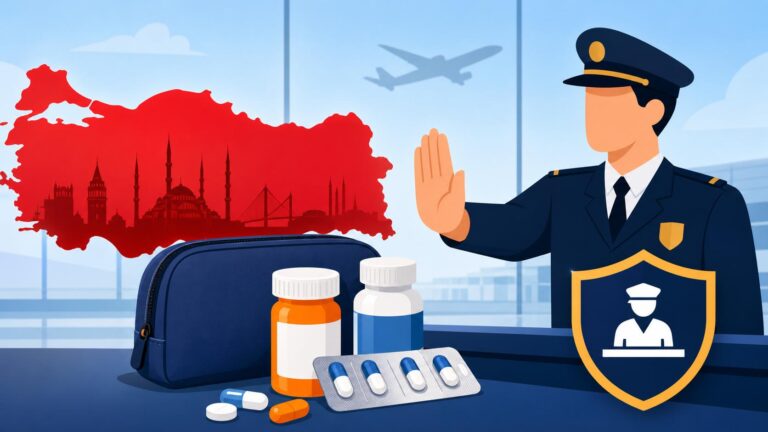
When entering the country, you are generally allowed to bring a three-month supply of your personal medications. You should always keep them in their original packaging and carry a translated copy of your prescription or a doctor’s note. This is especially critical for medications that are considered “red prescription” (controlled) in Turkey.
If you try to have medications mailed to you from abroad via courier, they will almost certainly be stopped at customs. Turkish law is very protective of its pharmaceutical industry and very wary of the illegal drug trade. It is almost always better to find a local equivalent or a local doctor to prescribe what you need rather than trying to ship it. For things like specialized protein powders or niche herbal teas not found in Turkey, iHerb is usually a safer bet for shipping, as they handle the “supplements” category differently than “medicine.”
Specialized Medications and Supplements
Navigating reproductive health and long-term wellness in a foreign country can be sensitive. Turkey is quite progressive in some areas of pharmacy care and more traditional in others.
Birth Control and Reproductive Health
Most birth control pills are available over-the-counter in Turkey. You don’t need a prescription for brands like Yasmin or Diane-35. You simply walk in, ask for them, and pay. Emergency contraception (the “morning-after pill”), such as Ella or Preven, is also widely available OTC and is usually kept behind the counter—you just have to ask.
However, if you are looking for specific hormonal treatments or IUDs, you will likely need to visit a gynecologist. For expats, finding Women’s Health Services: Accessing Birth Control and Routine Screenings is usually easy in the big cities, where private hospitals offer comprehensive packages. If you are covered by Cigna Global, these screenings are often part of your annual wellness benefits.
Vitamins and Supplements in Turkey
The supplement market in Turkey is growing but can be expensive due to import taxes on foreign brands like Solgar or Nature’s Bounty. You will find these in almost every Eczane, but be prepared to pay a premium. Many expats find that Are Dietary Supplements and Vitamins Expensive in Turkey? depends on where you shop.
Local brands are much more affordable and are of high quality, as they are regulated by the Ministry of Health. However, if you are looking for very specific things—like high-dose Vitamin D3/K2 drops, specific probiotics, or niche keto supplements—the local selection might feel sparse. This is where iHerb becomes a staple for the expat community. Many of us place a quarterly order to stock up on the specific brands we trust, keeping an eye on the €150 customs threshold to avoid excessive duties.
Essential Communication and Turkish Phrases
Walking into a pharmacy when you feel like death warmed over is hard enough without a language barrier. While many pharmacists speak English, the technicians might not.
Explaining Symptoms Simply
Don’t worry about perfect grammar. Use keywords. “Ağrı” (pain) is your most important word. Point to where it hurts and say the word. “Ateş” (fever) and “Öksürük” (cough) are also essential. If you have an allergy to a specific medication, say “Alerjim var” (I have an allergy) and show them the name of the drug.
If you are already on other medications, it is wise to show the pharmacist what you are taking to avoid drug interactions. They are very good at checking for this. If you are using a comprehensive plan like Cigna Global, you can often call their 24/7 telehealth line to get a doctor to explain your needs to the pharmacist over the phone if you’re really stuck.
Understanding Dosage Instructions
Once you buy your medicine, the pharmacist will usually write the instructions on the box. They use a shorthand that can be confusing.
- 1 x 1: One pill, once a day.
- 2 x 1: Two pills, once a day.
- 1 x 2: One pill, twice a day (usually morning and night).
- Tok Karnına: On a full stomach (after eating).
- Aç Karnına: On an empty stomach (before eating).
I always double-check by asking, “Yemekten önce mi, sonra mı?” (Before or after food?). They will usually circle the correct one on the box for you. If you’re dealing with children’s medicine, they will often give you a plastic syringe or spoon and show you the “ml” mark. If you’re unsure about anything, don’t leave until you are clear; Turkish pharmacists are generally very patient with expats who are trying to get it right.
Disclaimer
The information provided in this guide is for informational purposes only and does not constitute medical or legal advice. Regulations regarding medications and insurance in Turkey can change frequently. Always consult with a qualified healthcare professional or your insurance provider, such as Cigna Global, before making decisions about your health or medications. Check current customs regulations before importing supplements through services like iHerb.