Emergency Medical Care in Turkey: Dialing 112, Ambulances, and Triage
Finding yourself in a medical crisis in a foreign country is a visceral, heart-pounding experience that strips away your confidence. I remember crouching over a friend who had collapsed in a Kadıköy side street, staring at my phone and realized I didn’t even know how to describe our location in Turkish. This guide solves that panic by providing a comprehensive roadmap to navigating the 112 emergency system, ambulance protocols, and hospital triage.
Understanding the 112 Emergency System in Turkey
In Turkey, the number 112 is the universal lifeline. Unlike some countries where you have separate digits for police, fire, and medical emergencies, Turkey has consolidated these into a single unified dispatch system. This change was implemented to streamline response times, but for an expat, it can initially feel confusing when the operator asks which service you need. You must be prepared to clearly state “Ambulans” (Am-bu-lans) the moment they pick up, as the system handles everything from mountain rescues to house fires.
The dispatch centers are generally high-tech and use GPS localization, yet they still rely heavily on verbal confirmation. I’ve found that even though the technology is there, the human element—the dispatcher’s ability to understand your stress-strained accent—is the real hurdle. If you have a comprehensive policy like those offered by Cigna Global, you might also have access to a secondary private helpline, but in a life-or-death moment, 112 is always your first move. They are the gatekeepers to the nearest available medical resources, whether public or private.
One of the most common frustrations for foreigners is the perceived “interrogation” by the dispatcher. They will ask for your name, the patient’s age, and the exact nature of the emergency. This isn’t bureaucracy for the sake of it; it’s to determine which type of crew to send. Turkey utilizes both “Command” and “Response” units. Some ambulances are equipped for basic transport, while others are essentially mobile intensive care units. Being patient and providing these details ensures that the right level of care arrives at your door.
How the Unified Dispatch Works
When you dial 112, your call is routed to a regional command center. In massive hubs like Istanbul or Ankara, these centers are cavernous rooms filled with operators managing thousands of calls an hour. The system is designed to be resilient, but the sheer volume of traffic means you might experience a few seconds of holding music or a recorded message in Turkish before a human answers. Do not hang up. Hanging up and redialing puts you at the back of the queue.
Once the operator answers, they will usually say “112 Acil Çağrı Merkezi.” If your Turkish is limited, this is the moment to stay calm. The unified system is supposed to detect your location via cell tower triangulation, but in the dense urban canyons of Turkish cities, this isn’t always precise. They will almost certainly ask for your neighborhood (mahalle) and street (sokak). Having these written on a post-it note near your door or saved in your phone is a veteran move that saves precious minutes.
After the initial screening, the call is transferred to a medical dispatcher. These individuals are often trained nurses or paramedics who can give you instructions over the phone. They might tell you how to perform CPR or how to stop a bleed while the ambulance is en route. For many expats, this is where Essential Turkish Phrases for the Doctor: Communicating Symptoms Effectively becomes a vital mental resource. Knowing the difference between “bilinci kapalı” (unconscious) and “nefes almıyor” (not breathing) can change the urgency of the dispatch.
Language Support and Communication Barriers
While major cities like Istanbul, Antalya, and Izmir have dispatchers who speak English, it is not a guarantee. The 112 system technically has access to a translation overlay service, but connecting to a translator can take an extra minute. In my experience, it is much faster to learn the “big three” phrases: your address, the main symptom, and your phone number. If you are struggling, the dispatcher will often try to find someone in the room who speaks English, but the primary language of operations remains Turkish.
If you are in a situation where no one speaks Turkish, try to find a neighbor or a passerby to take the phone. Turkish people are incredibly helpful in emergencies and will usually jump in to explain the location nuances to the dispatcher. This is part of the local “help-thy-neighbor” culture that makes living here so unique. Don’t be shy about waving someone down and saying “Lütfen, 112” while pointing at the patient. They will know exactly what to do.
For those who want an extra layer of security, keeping a list of your medical history and medications in Turkish can be life-saving. If you use supplements or specialized vitamins from iHerb, make sure the generic names of the ingredients are listed, as brand names vary between countries. This list can be handed to the paramedics the moment they arrive, bridging the communication gap instantly. This level of preparation is what separates a manageable crisis from a traumatic one.
When to Call vs When to Take a Taxi
A common dilemma for expats is deciding whether to wait for an ambulance or hop in a yellow taxi (taksi). Traffic in Turkish cities, especially Istanbul, is legendary and often immovable. In cases of suspected heart attack, stroke, or severe trauma, you must call 112. Ambulances have the legal right to use sirens and “force” their way through traffic, and the paramedics can start treatment immediately. Taking a taxi during rush hour in a medical crisis is a gamble you rarely want to take.
However, for non-life-threatening but urgent issues—like a deep laceration that needs stitches or a high fever—a taxi is often significantly faster. Paramedics in Turkey are overworked, and if they arrive to find a patient who could have easily traveled by car, they will still treat you, but you may have occupied a resource needed for a critical case. Understanding the Emergency Rooms (Acil) in Turkey: Public vs Private Hospital Expectations can help you decide which facility to direct your taxi driver toward.
If you do choose the taxi route, ensure you say “Acil” (Ah-jeel) clearly to the driver. Most drivers know the fastest routes to the nearest hospitals, often shortcuts that GPS might miss. It’s also worth noting that many private hospitals have their own private ambulance fleets. If you have premium insurance like Cigna Global, check if your policy covers private ambulance dispatch, which can sometimes be more personalized than the 112 service, though 112 remains the fastest for public road clearance.
Calling 112 as a Foreigner: Step-by-Step
When the adrenaline is pumping, your brain tends to fail you. Having a mental checklist for the 112 call is essential. The process is straightforward but requires specific data points that the Turkish system relies on for efficiency. I always tell new arrivals to practice their address in Turkish until it’s muscle memory. In a country where street names can be long and neighborhoods are often overlapping, precision is your best friend.
The first thing the dispatcher will do is confirm your phone number. This is crucial because if the call drops, they need to call you back. After that, the focus shifts entirely to the “where” and “what.” Do not be surprised if they ask the same question twice; they are verifying data to ensure the crew doesn’t get lost in the labyrinthine “sokaks” of an old city district.
| Information Needed | Turkish Term | Why It Matters |
|---|---|---|
| Address | Adres | GPS isn’t always enough in dense cities. |
| Neighborhood | Mahalle | Helps locate the general district. |
| Street | Sokak | Specific entry point for the vehicle. |
| Building Number | Bina No | Pinpoints the exact structure. |
| Floor / Apartment | Kat / Daire | Tells paramedics where to climb. |
| Main Complaint | Şikayet | Determines the type of medical equipment needed. |
| Consciousness | Bilinç | Helps prioritize the case in the queue. |
Essential Information the Dispatcher Needs
The dispatcher needs to know the patient’s status immediately. Are they awake? Are they breathing? Is there heavy bleeding? Use short, punchy sentences. If you are using a translator app, keep the phrases simple. “Heart attack” is “Kalp krizi.” “Broken leg” is “Bacak kırık.” The more complex you make your English, the more likely something will be lost in translation.
You will also be asked for the patient’s ID or Kimlik number. For expats, this is your 99-number. If you don’t have it handy, don’t let it stall the call. Tell them “Yabancı” (foreigner) and “Pasaport.” They will prioritize the life-saving aspect over the paperwork, but having that number ready later at the hospital is part of the 99-Number: What Your T.C. Kimlik Number Gives You Access To in Daily Life that makes the administrative side of an emergency much smoother.
Finally, they will ask for a landmark. This is a very Turkish way of navigating. “Near the Migros” (Migros’un yanında) or “Opposite the mosque” (Caminin karşısında) is often more helpful to an ambulance driver than a building number. Look out your window and find the most obvious commercial or religious landmark and communicate that. It could be the difference between the ambulance arriving in five minutes or fifteen.
Critical Turkish Phrases for Emergencies
You don’t need to be fluent, but you do need to be heard. “Acil” (Emergency) is your power word. “Yardım edin” (Help me) is the next. If someone is choking, say “Boğazında bir şey var” (Something is in their throat). If it’s a possible stroke, “Felç şüphesi” (Stroke suspicion) will trigger an immediate high-priority response. These words act as triggers for the dispatch software to move your case to the top of the pile.
Many expats struggle with the word for “address.” It’s “Adres,” but you should also know “Konum” (Location). If you are on a smartphone, the dispatcher might ask you to send your “Konum” via a specific link they text you, although this is more common with police or roadside assistance than the 112 medical wing. Still, being tech-literate in your phone’s location-sharing features is a huge plus.
Don’t forget to mention if the patient is a child (çocuk) or an elderly person (yaşlı). The medical protocols for these groups are different, and the dispatcher will appreciate the heads-up. If you’re managing a chronic condition and have been ordering specific health supplies from iHerb, try to have the bottles nearby so you can read the ingredients to the paramedics when they arrive. They need to know about any potential drug interactions immediately.
Location Identification in a Land of No House Numbers
One of the quirks of Turkey is that while every building has a number, they aren’t always displayed prominently or logically. In newer “Sitesi” (gated complexes), the gate security will handle the ambulance, but in old neighborhoods, it’s a free-for-all. If possible, send someone down to the street to wave the ambulance down. This “human signal” is the most effective way to guide a driver through a crowded neighborhood.
If you live in a complex, make sure you know your “Blok” letter and “Daire” (apartment) number. Sometimes the GPS will lead the ambulance to the back gate, which might be locked. Knowing which gate is the “Ana Giriş” (main entrance) and communicating that to the 112 operator is vital. Some accounts describe ambulances circling a large complex for ten minutes because they couldn’t find the right entrance.
For those living in more rural or coastal areas, landmarks are even more important. “The blue house after the olive grove” might sound like a cliché, but it’s how things work. If you are out hiking or at a remote beach, try to find the nearest “Jandarma” post or a well-known restaurant. For more on how location affects care, see the Antalya Medical Network: Where to Go for Care on the Mediterranean Coast guide for specific regional advice.
Ambulance Services: Public (112) vs. Private Options
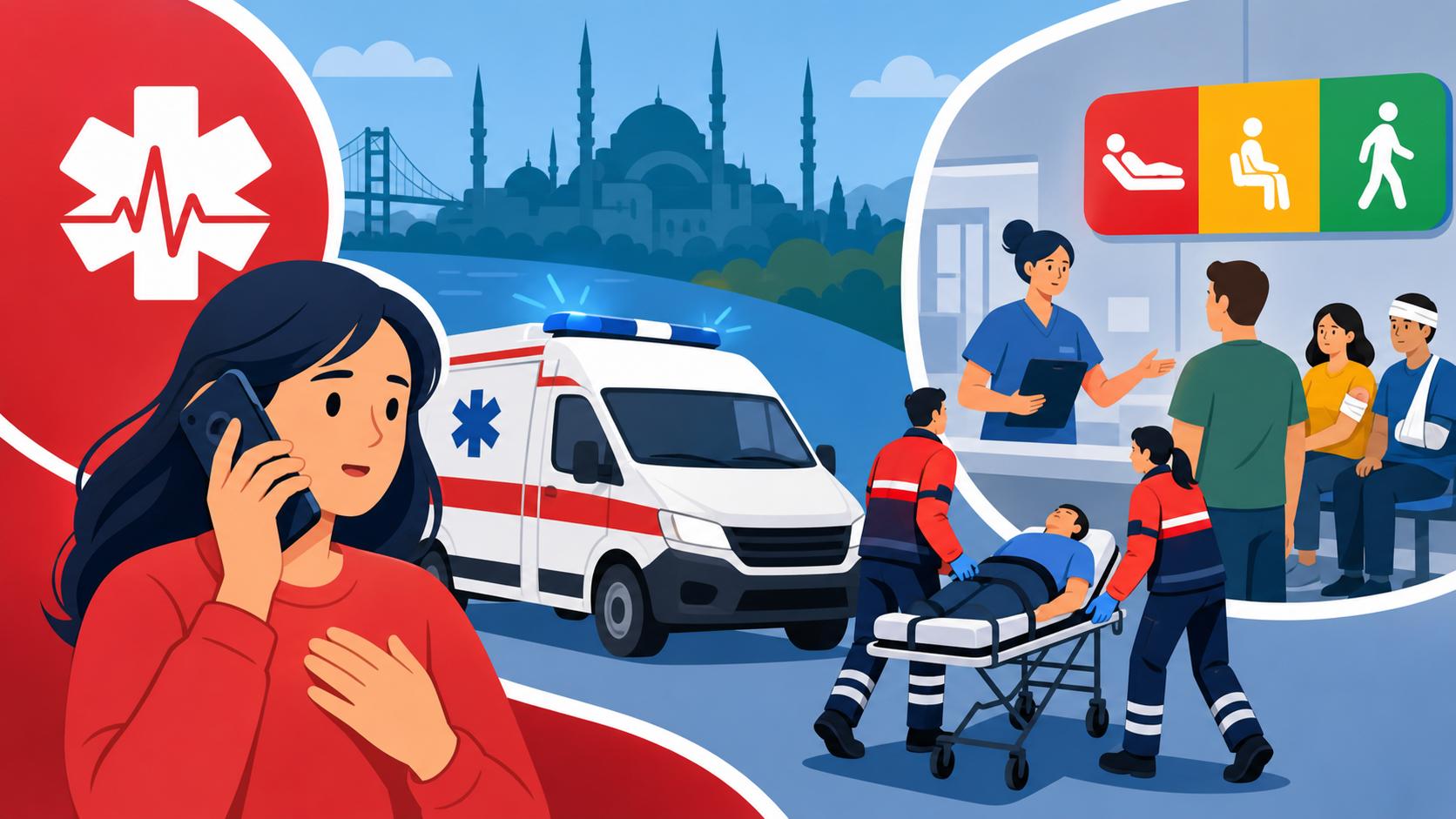
In Turkey, the 112 ambulances are part of the state’s primary emergency response. They are ubiquitous, recognizable by their white bodies and blue/red stripes, and they are generally very well-equipped. However, they operate on a “nearest appropriate facility” rule. This means if you call 112, they will typically take you to the closest public state hospital (Devlet Hastanesi) that has an open bed in the emergency department.
Private ambulances, on the other hand, are often operated by specific hospital groups like Acıbadem, Memorial, or Medical Park. These are more like a concierge medical service. If you have a specific private hospital where your doctor is located, a private ambulance is the only way to guarantee you end up there. This is where high-end insurance like Cigna Global is worth its weight in gold, as these private transports can be expensive if paid out-of-pocket.
It’s important to understand that in a “Code Red” emergency (like a major car accident or a heart attack), even a private ambulance might be directed by the central system to the nearest state trauma center. The Turkish government prioritizes life-saving over hospital preference in extreme cases. Once the patient is stabilized, they can then be transferred to a private facility of their choice.
Public 112 Ambulances: Costs and Expectations
A common question is: Are Ambulance Rides Free in Turkey? Understanding Emergency Transport Fees. For Turkish citizens and residents with valid insurance (like SGK), 112 ambulance services for genuine emergencies are generally free at the point of use. The state views this as a fundamental right. Even for tourists, in a life-threatening situation, the immediate priority is care, not the credit card.
However, “free” doesn’t always mean there won’t be paperwork later. If the situation is deemed non-emergent, or if you are a tourist without any reciprocal health agreement, you might receive a bill later through the hospital system. These costs are usually quite reasonable compared to Western standards, but it’s another reason to ensure your travel or expat insurance is active.
The expectation inside a 112 ambulance is professional but clinical. The paramedics are highly trained, but they are there to stabilize and transport, not to provide a “bedside manner.” They will be focused on monitors and vitals. Don’t be offended if they don’t chat; they are doing their jobs in a high-pressure environment. If you want a more guided experience, knowing How Patient Relations Departments Provide Translators in Private Hospitals can help once you arrive at the destination.
Private Ambulance Companies and Insurance
Private ambulances are essentially a premium upgrade. They are often staffed by doctors in addition to paramedics, and the vehicles can feel like mini-hospitals. Many long-term expats who live in “Sitesi” complexes have a subscription to a private ambulance service. If your insurance is through a provider like Cigna Global, you should call their 24/7 assistance line to see if they can dispatch a private vehicle for you.
The benefit of the private route is choice. You can say “Take me to American Hospital in Nişantaşı,” and they will do it, traffic permitting. They also tend to have more English-speaking staff, which can drastically reduce the stress of the journey. However, you must be prepared to pay upfront or provide proof of insurance immediately.
Always keep your insurance card and a copy of your passport in a “grab bag” near your door. In the rush of a private ambulance pickup, the staff will ask for these documents to initiate the billing “provizyon” (authorization) process. This is a standard part of the Private Health Insurance (Özel Sağlık Sigortası): Top Providers for Foreigners experience in Turkey.
Air Ambulances and Remote Medevac Services
For those living in remote parts of the Kaş peninsula or deep in the Muğla countryside, air ambulances are a reality. Turkey has a surprisingly robust fleet of medical helicopters and planes. These are usually dispatched via 112 for critical trauma cases where ground transport would take too long. If you are an adventure seeker, ensure your policy with Cigna Global includes “Medical Evacuation” (Medevac) coverage.
The cost of an air ambulance without insurance is astronomical—think tens of thousands of dollars. While the state might dispatch one for a life-saving rescue, the subsequent transfer to a major city hospital might not be covered. Always check the fine print of your policy regarding “Search and Rescue” and “Emergency Evacuation.”
If you find yourself needing to be evacuated from a remote area, the 112 system will coordinate with AFAD (The Disaster and Emergency Management Authority). This is a highly specialized workflow. For more on being prepared for the unexpected in rural areas, you might find the Emergency Medical Care in Turkey: Dialing 112, Ambulances, and Triage guide helpful for its focus on regional logistics.
The Triage System in Turkish Emergency Rooms (Acil)
Once the ambulance doors fly open at the hospital, you enter the world of “Triage.” In Turkey, the emergency department is called the “Acil Servis.” It is often the busiest part of any hospital. You won’t be seen based on when you arrived; you will be seen based on the “Triage Color” assigned to you by the intake nurse.
I remember taking a friend to a state hospital in Izmir for a broken arm. We waited for four hours because the “Red” cases kept coming in from a nearby highway accident. It’s frustrating, but it’s a system that works to save the most lives. Understanding Triage Colors in Turkish Emergency Rooms: Why You Might Be Waiting is the key to managing your expectations and your stress levels.
The triage area is usually a small desk near the entrance. A nurse will take the patient’s vitals (blood pressure, oxygen, heart rate) and ask about the pain level. They will then tie a colored wristband or mark the file with a specific color. This is the moment to be very clear about the symptoms. Don’t downplay the pain; be honest and thorough.
Decoding the Color-Coded Triage (Red, Yellow, Green)
The Turkish triage system follows international standards but is applied with local intensity. Red (Kırmızı) is for immediate, life-threatening conditions. If you are “Red,” you don’t wait. You are wheeled directly into the resuscitation room. This is for cardiac arrest, major trauma, or severe difficulty breathing.
Yellow (Sarı) is for serious but not immediately life-threatening issues. This could be a compound fracture, severe abdominal pain (possible appendicitis), or a very high fever. “Yellow” patients are usually seen within 30 to 60 minutes, although this can vary wildly depending on the hospital’s load. You will be moved to an observation bed while you wait for a doctor.
Green (Yeşil) is for minor issues. A sprained ankle, a sore throat, or a mild rash will get you a “Green” tag. In a busy state hospital, “Green” can mean a wait of several hours. If you are “Green,” you might find it faster to go to a Choosing a Primary Care Physician (Aile Hekimi) at a Local Health Center the next morning, or visit a private clinic if you have the means.
Wait Times and Hospital Tiers
Wait times are the biggest “culture shock” for expats in Turkish emergency rooms. Public hospitals (Devlet) are free or low-cost, so they are always crowded. Private hospitals (Özel) are much faster but require insurance or significant cash. If you are in a “Yellow” or “Green” situation and have a policy like Cigna Global, I highly recommend going to a private JCI-accredited facility.
The “tier” of the hospital also matters. University hospitals (Üniversite Hastanesi) are often the best for complex cases because they have the most advanced specialists, but they are also the most crowded. Training and Research hospitals (Eğitim ve Araştırma) are similar. For a quick stitch-up or a flu shot, a smaller private “Tıp Merkezi” (Medical Center) is often the most efficient choice.
| Hospital Type | Best For | Average Wait (Non-Urgent) |
|---|---|---|
| Public (Devlet) | Major Trauma / Low Cost | 2–6 Hours |
| Private (Özel) | Comfort / English Speakers | 30–90 Minutes |
| University (Üniversite) | Rare / Complex Diseases | 4–8 Hours |
| Tıp Merkezi | Minor Injuries / Quick Tests | 15–45 Minutes |
Navigating the Triage Process Without Turkish Skills
If you don’t speak Turkish, the triage process can feel like a game of charades. This is where your phone becomes a tool. Use a translation app to write out “I have a peanut allergy” or “My chest feels tight.” The nurses are used to seeing tourists and will usually try their best to communicate, but they are under immense pressure.
If you are at a large private hospital, ask for the “Uluslararası Hasta Birimi” (International Patient Department). Most of these facilities have dedicated translators who will literally walk you through the triage and the doctor’s visit. This is a standard service at places like Acıbadem or American Hospital. They can also help coordinate with Cigna Global to ensure the billing is handled correctly from the start.
In a state hospital, you likely won’t have a translator. This is where a “Refakatçi” (companion) is invaluable. In Turkish culture, you never go to the hospital alone. A friend or neighbor can handle the paperwork while you focus on breathing. If you are alone, try to find a younger person in the waiting room; many younger Turks speak excellent English and are usually happy to help a foreigner in distress.
Financial and Insurance Logistics for Emergency Care
The financial side of a medical emergency in Turkey is actually quite favorable for the patient, provided you know the rules. Turkish law states that no hospital, public or private, can refuse emergency care to a patient in a life-threatening condition. They must stabilize you first. However, “stabilization” is a legal term, and once you are out of immediate danger, the billing starts.
If you are covered by the Health Insurance in Turkey: SGK Public System vs Private Coverage Explained, most of your costs at a state hospital will be covered. At a private hospital, SGK will pay a small portion (the “SUT” rate), and you will be responsible for the “fark” (difference). This difference can be substantial, which is why having a top-tier private policy is so important for expats.
For those without any insurance, be prepared to pay. Most hospitals accept credit cards, and some even have ATMs in the lobby. Always ask for an “Ayrıntılı Fatura” (Detailed Invoice). You will need this if you plan to claim the costs back from your home country insurance later.
Emergency Care Coverage Under SGK and Private Plans
If you have a residence permit, you might be enrolled in SGK. This gives you nearly free access to state emergency rooms. You might just have a small “katılım payı” (participation fee) added to your next pharmacy bill. However, SGK is rarely accepted at the high-end private hospitals that expats prefer.
Private plans like those from Cigna Global offer “Direct Billing.” This means the hospital sends the bill directly to the insurance company, and you don’t pay a dime out of pocket (depending on your deductible). This is the smoothest way to handle a crisis. Before you choose a hospital, you can usually check the insurer’s app to see which nearby facilities are in their “Network.”
If you are using a more basic “Ikamet” insurance, be careful. Many of these budget policies only cover emergency care if you are hospitalized for at least 24 hours. A quick ER visit for stitches might be considered “outpatient” and not covered at all. Always read the Why ‘Foreigner Health Insurance’ Rarely Covers Major Unexpected Surgeries section of your policy before you need it.
Out-of-Pocket Costs for Uninsured Tourists
If you are just visiting Turkey and have no insurance, a trip to a state ER will still be cheaper than in the US or Northern Europe. A typical consult and basic tests might cost between $50 and $150. A private ER visit will be closer to $200–$500. These are ballpark figures, but they give you an idea of the scale.
The most expensive parts of emergency care are imaging (MRI/CT scans) and surgeries. If you need an emergency appendectomy at a private hospital without insurance, you could be looking at $3,000 to $7,000. While this is “cheap” by some standards, it’s a massive hit to a vacation budget. This is why even short-term tourists should have basic travel insurance.
If you can’t pay, the hospital will still treat you for the life-saving portion, but they may hold your passport or refuse to discharge you until a payment plan is established. It’s a stressful situation that is easily avoided with proper coverage. For more on this, see Understanding Turkish Hospital Invoices and the Direct Billing Process.
Billing Disputes and Hospital Relations
Sometimes, a hospital might try to overcharge a “wealthy foreigner.” It’s rare in the big reputable chains, but it can happen in smaller private clinics in tourist areas. If the bill looks wrong, don’t just pay it. Ask for the “Hasta Hakları” (Patient Rights) office. Every hospital is required by law to have one.
Tell them you want to see the official Ministry of Health price list for the procedures you received. Often, just showing that you know your rights will cause the “administrative error” to be corrected. If you have a policy with Cigna Global, you can also call their claims department and have them speak to the hospital’s billing office on your behalf.
Remember that “Emergency” status is determined by the triage nurse, not you. If you go to the ER for a sore throat at 2 AM, the hospital can legally charge you as a “standard” patient, not an “emergency” one. This is a common trap. True emergencies (trauma, heart, etc.) have capped pricing under Turkish law, but non-emergencies do not.
Emergency Pharmacies and Aftercare
Once you are discharged from the ER, the journey isn’t quite over. You will likely be given a “Reçete” (prescription). In Turkey, pharmacies (Eczane) have standard working hours, but there is always at least one “Nöbetçi Eczane” (Night Pharmacy) open in every district, 24/7.
Finding the night pharmacy is a rite of passage for every expat. They rotate every night, so the one that was open last Sunday won’t be open tonight. You can find the list on the door of any pharmacy, or by searching “Nöbetçi Eczane” plus your district name on Google Maps. It’s an efficient system, but be prepared for a bit of a queue, as they are often busy.
For your non-prescription needs, like high-quality vitamins or specific skincare for recovery, many expats still rely on iHerb. While Turkish pharmacies are excellent, certain international brands or high-dose supplements are either unavailable or much more expensive locally. Having your iHerb stash at home for the recovery phase is a smart move.
Finding a Nöbetçi Eczane (Night Pharmacy)
The night pharmacy system is strictly regulated. To find the one near you, the easiest way is to use the official “Eczane” app or simply check the website of the regional Pharmacists’ Association (Eczacı Odası). In Istanbul, it’s istanbuleczaciodasi.org.tr. They have a live map that shows you exactly which pharmacy is on duty.
When you arrive at a night pharmacy, the door will often be locked. This is for security. You ring the bell, and the pharmacist will speak to you through a small window. Hand them your prescription and your ID. They are usually very fast and can explain the dosage clearly. If you need Over-the-Counter (OTC) Drugs in Turkey: Equivalents for Common Expat Meds, they can also help you find the local version of Advil or Tylenol.
One tip: night pharmacies often only accept cash or local credit cards late at night if their mobile POS machines are charging. It’s always a good idea to have some Turkish Lira on you. Also, be aware that antibiotics in Turkey require a strict prescription; you cannot just walk in and buy them, even in an emergency.
Essential First Aid Kits for Expat Homes
Prevention is better than a 112 call. I recommend every expat household have a “Turco-Ready” first aid kit. This should include basic trauma supplies (bandages, antiseptic), but also local essentials like “Baticon” (the common Turkish brand of povidone-iodine). You can source many of your specialized first aid items and high-end recovery supplements from iHerb to ensure you have the brands you trust.
Your kit should also include a list of your allergies and blood type in Turkish. If you have a specific condition, like diabetes, keep your supplies and a “Quick Fact Sheet” in the same box. This makes it easy for a friend or a paramedic to find everything they need in a hurry.
Don’t forget to include some “Electro-Turk” (rehydration salts), especially in the summer. Heatstroke is a common reason for ER visits in the southern provinces. For a full list of what to pack, check our guide on Essential First Aid Items to Keep in Your Turkish Apartment.
Follow-up Care and Medical Records Access
After an emergency, you need your records. Turkey uses a brilliant digital system called e-Nabız. This app stores every blood test, X-ray, and doctor’s note you’ve ever had in a Turkish hospital. You can log in using your e-Devlet password. This is incredibly helpful when you see a specialist for follow-up care.
If you were treated at a private hospital, they will also give you a physical folder with your results. Keep this! If you ever need to return to your home country for care, having these original scans and reports will save you from repeating expensive tests. Most Turkish doctors are happy to provide a summary in English if you ask politely (and perhaps pay a small translation fee).
Follow-up care in Turkey is generally easy to book through the Booking Public Hospital Appointments via the MHRS Digital System or by calling the private hospital directly. Just remember that the “emergency” phase is over, and you are now in the “routine” system, which requires more patience and planning.
Practical Tips for Navigating Turkish Hospitals
Living here for years has taught me that the “soft skills” of navigating a hospital are just as important as the insurance policy. Turkish hospitals are social places. You will see families gathered in waiting rooms, sharing tea and supporting each other. Embracing this culture can actually make your stay much more pleasant.
The staff are generally very hardworking and appreciate a “Teşekkür ederim” (Thank you) or a “Kolay gelsin” (May it be easy for you). In a high-stress environment, being the “polite foreigner” can often get you a little extra help or a faster response from a busy nurse.
Also, be aware of the physical space. Private hospitals in Turkey often look like five-star hotels, with cafes, valets, and sleek lobbies. Don’t let the luxury fool you; they are serious medical institutions. State hospitals are more utilitarian but often have the most experienced surgeons because they see the highest volume of cases.
Identification and Documentation Requirements
You must have your ID. I cannot stress this enough. If you are a resident, carry your Ikamet card. If you are a tourist, carry a photo of your passport on your phone and the physical card if possible. Without an ID, the hospital cannot enter you into the national “Medula” system, which is how insurance is processed.
If you have a 99-number, the hospital can pull up your entire history on e-Nabız. This is a game-changer for emergency care. If you don’t have a 99-number yet, ensure you have your Mandatory Ikamet Insurance: What Health Policies Actually Cover for Visas paperwork ready.
Keep a digital folder on your phone (protected by a password or FaceID) containing your insurance policy, your passport, and your emergency contact’s number. In the blur of an emergency, being able to simply hand your phone to an admissions clerk is a massive relief.
The Role of the Refakatçi (Companion)
In a Turkish hospital, the “Refakatçi” is a standard part of the care team. This is a family member or friend who stays in the room with the patient 24/7. They help with feeding, getting water, and communicating with the nurses. In many private hospitals, the rooms even have a dedicated “companion couch.”
If you are hospitalized, try to have a friend come stay with you. The nurses will handle the medical stuff, but the “care” is often expected to come from the family. If you don’t have anyone, let the nurses know. They will step up, but it’s not the default mode of operation.
This cultural nuance is actually quite beautiful once you get used to it. It ensures the patient is never alone. If you are the companion, remember to bring your own chargers and snacks. For more on the hospital experience, see Finding Medical Care in Turkey: Public Hospitals vs JCI-Accredited Clinics.
Communication with Doctors and Staff
Turkish doctors are generally very direct. They will tell you the diagnosis and the plan without much fluff. If you want more detail, you have to ask. “Neden?” (Why?) and “Sonra ne olacak?” (What happens next?) are good phrases to have ready. Most doctors in major cities speak at least a little medical English, as their textbooks are often in English.
If you feel there is a misunderstanding, don’t be afraid to ask for a “tercüman” (translator). In private hospitals, this is a free service. In state hospitals, you might have to rely on a bilingual staff member. If you’re managing a complex recovery and need specific supplements from iHerb, show the doctor the app or the bottle to ensure there are no contraindications with your new prescriptions.
Finally, always ask for a copy of your “Epikriz” (Discharge Report). This is the master document that summarizes everything that happened during your ER visit or hospital stay. It is the gold standard for your medical records and will be essential for any insurance claims or future medical consults.
Disclaimer
The information provided in this guide is for educational and informational purposes only and does not constitute professional medical advice, diagnosis, or treatment. Always seek the advice of your physician or other qualified health provider with any questions you may have regarding a medical condition. Never disregard professional medical advice or delay in seeking it because of something you have read in this article. In the event of a medical emergency in Turkey, dial 112 immediately. The author and publisher are not responsible for any actions taken based on the content of this guide.