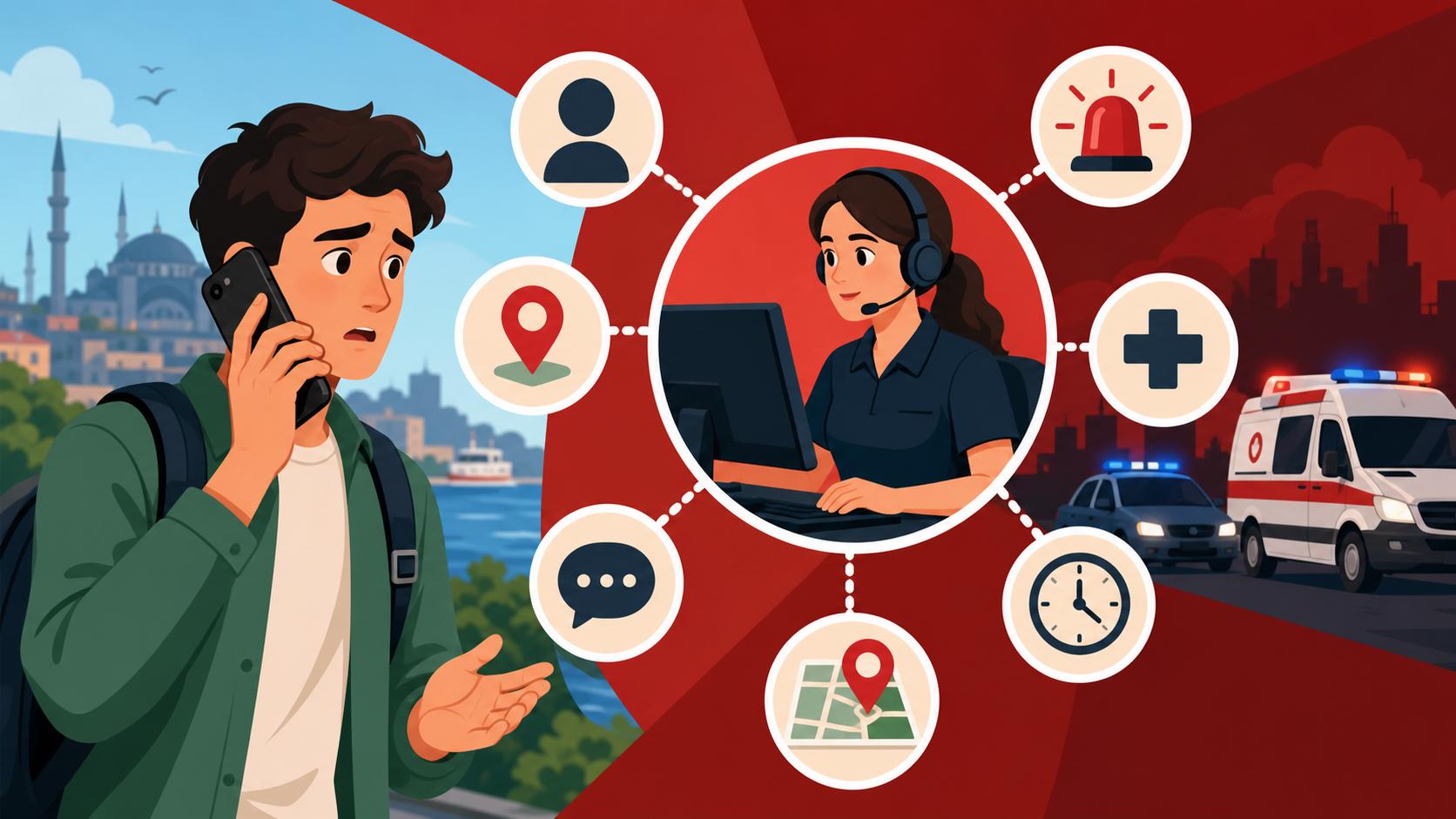
Calling 112 as a Foreigner: What Details the Dispatcher Will Ask You
Standing in a foreign kitchen when a medical crisis strikes is a specialized kind of terror that no guidebook truly prepares you for. I remember my first winter in Istanbul, staring at my phone as a friend struggled to breathe, realizing my three months of Duolingo had utterly deserted me. This guide breaks down exactly what happens when you dial 112, ensuring you can navigate the dispatcher's questions with confidence and get help fast.
The Architecture of a 112 Call in Turkey
When you dial 112 in Turkey, you are connecting to a unified emergency system that handles police, fire, and medical requests. Unlike the fragmented systems of the past, the modern 112 centers are staffed by trained professionals who are often medical technicians (ATT) or paramedics themselves. This means the person on the other end isn't just a clerk; they are assessing the severity of your situation from the first second they hear your voice.
You should expect the tone to be brisk and highly efficient. To a newcomer, this can sometimes feel dismissive or impatient, but it is actually a sign of professional triage. They are filtering out the noise to get to the "Golden Hour" facts. If your Turkish is shaky, the system is designed to route you to a translation service, though this can add a minute to the process. Staying calm is your primary job, as panic is the biggest barrier to a dispatcher getting the data they need to send an ambulance.
For many of us living here long-term, having a backup plan like comprehensive private coverage from Cigna Global provides an extra layer of peace of mind, especially when navigating which hospital the ambulance might take you to. However, in the heat of the moment, 112 is your universal lifeline, regardless of your insurance status. Knowing the flow of their questions will keep you from freezing up.
Pinpointing Your Location: The Adres Tarifi Nightmare
The most critical piece of information—even more important than the medical condition—is where you are. In Turkey, addresses are not always as simple as a number and a street name. The dispatcher will ask for your "Adres tarifi," or a description of your location. They will want the Mahalle (neighborhood), the Sokak (street), and the Bina Numarası (building number).
However, in many older districts or winding coastal towns, GPS can be unreliable. You will likely be asked for a "Bilinen bir yer" or a well-known landmark. This could be a specific mosque, a large supermarket chain like Migros, or even a well-known pharmacy. I learned the hard way that knowing the name of the "Eczane" on the corner is often more helpful to an ambulance driver than the actual street name.
If you are calling from a residential complex (Site), make sure you know the gate number or the specific block (Blok). If the complex has security, mention that they are aware of the emergency. This ensures the guards are ready to open the gates immediately. If you have moved recently, ensure you have completed your Address Registration (Nüfus): The Most Critical Post-Arrival Step for Foreigners to avoid any confusion about your legal residence during an emergency check.
Describing the Medical Situation and Triage
Once they know where to go, the dispatcher will ask, "Hasta ne durumda?" (What is the patient’s condition?). This is where they determine the Triage Colors in Turkish Emergency Rooms: Why You Might Be Waiting. They are looking for specific indicators of life-threatening conditions. Be prepared to answer questions about consciousness, breathing, and severe bleeding.
If the patient is unconscious, say "Bilinci kapalı." If they are not breathing, say "Nefes almıyor." Be ready for follow-up questions like the age of the patient and any known chronic illnesses. The dispatcher needs to know if this is a cardiac event, a traumatic injury from a fall, or perhaps an allergic reaction. This is also why Essential Medical Turkish: Vocabulary for Explaining Symptoms to Doctors is such a vital resource to study before you actually need it.
While you wait for help, you might be instructed on how to perform basic first aid. Keeping a well-stocked kit with essentials ordered from iHerb—such as high-quality bandages, antiseptic, and basic monitors—can bridge the gap between the call and the ambulance's arrival. The dispatcher will stay on the line if the situation is "Red Code" (Kırmızı Alan), providing instructions until the team arrives at your door.
Identification and the 99 Number
In Turkey, everything administrative revolves around your identification number. The dispatcher will almost certainly ask for the "T.C. Kimlik Numarası." As a foreigner, this is your The 99-Number: What Your T.C. Kimlik Number Gives You Access To in Daily Life. If you have your residence permit (Ikamet), have that number ready. If you are a tourist, your passport number will suffice, but it may take a moment longer for them to log it into the system.
Do not worry if you don't have your physical card on you. The number is what matters. This number allows the emergency team to pull up your records in the Using e-Nabız: Accessing Your Medical Records on the Ministry of Health App system once you reach the hospital. It tells them your blood type, your allergies, and your previous surgeries, which can be life-saving if you are unable to communicate.
If you are calling for someone else, the dispatcher will ask for your name and phone number as well. This is so the team can call you back if they cannot find the entrance to your building. Make sure your phone is not on "Do Not Disturb" mode after you hang up. Often, the ambulance crew will call you directly when they are a block away to ask you to wait by the door or the street corner to flag them down.
| Required Detail | Turkish Equivalent | Why It Matters |
|---|---|---|
| Neighborhood | Mahalle | Narrows down the dispatch zone significantly. |
| Landmark | Bilinen bir yer | Helps drivers navigate "last mile" GPS errors. |
| ID Number | Kimlik No (99…) | Links the patient to their electronic health records. |
| Consciousness | Bilinç Durumu | Determines the urgency and triage color code. |
| Phone Number | Telefon Numarası | Allows the crew to call for specific entry instructions. |
Understanding Language Support and the Translation Hub
It is a common fear among expats that they won't be understood. Turkey’s 112 system has made massive strides in this area. If you start speaking English, the dispatcher will usually recognize this and may ask you to wait ("Bekleyin") while they patch in an English-speaking operator or a translator. This is part of the Calling 112 for an Ambulance: Dispatch Workflows and Language Support infrastructure that has been modernized over the last few years.
However, the connection isn't always instantaneous. It is wise to learn a few "anchor phrases." Saying "Yabancıyım, İngilizce biliyor musunuz?" (I am a foreigner, do you know English?) can trigger the routing process faster. If you are in a pinch, you can also use a translation app, but be careful—medical terms can sometimes be mistranslated in ways that cause confusion.
If you have a Turkish neighbor or friend nearby, don't be afraid to hand them the phone. Local "Adres Tarifi" is a cultural art form that involves describing the color of the building, the type of tree in front, and which bakkal (small grocer) is nearest. Even with the best intentions, a veteran expat might still struggle with these hyper-local details that a native speaker can convey in ten seconds.
What Happens When the Ambulance Arrives
In Turkey, the arrival of the "Ambulans" is only the beginning of the process. You will be assessed on-site. If the situation is not life-threatening, they may suggest you go to a Sağlık Ocağı (Health Clinic) or take a taxi to the hospital. If they do transport you, you generally do not get to pick which hospital you go to. They will take you to the nearest facility that has an available bed in the required department (e.g., Cardiology or Trauma).
This is a point of confusion for many. You might have Private Health Insurance (Özel Sağlık Sigortası): Top Providers for Foreigners and want to go to a specific JCI-accredited private hospital. While you can request this, the paramedics are legally obligated to stabilize you at the closest capable facility. Once stabilized, you can arrange a transfer to a private hospital of your choice, often facilitated by your insurance provider like Cigna Global.
Be aware that you should have your shoes on and a small bag ready with your passport, residence permit, and any current medications. The "112" public ambulances are generally free for true emergencies, but it is wise to understand Are Ambulance Rides Free in Turkey? Understanding Emergency Transport Fees to avoid surprises regarding follow-up care or private ambulance transfers.
Preparing Your "Emergency Script" Before the Crisis
The best time to prepare for a 112 call is when you are perfectly healthy. I recommend writing down your "Emergency Script" and taping it to the inside of your front door or the side of your fridge. This script should include your full address (including the landmark), your 99 number, and the 99 numbers of your family members.
Include a list of any major allergies or chronic conditions in Turkish. For example, "Alerji: Penisilin" or "Diyabet." If you take specific supplements or medications, keep a list or the bottles themselves in a clear bag. Ordering a dedicated medical organizer from iHerb can help keep these supplies visible and ready for the paramedics to grab as they wheel you out.
Finally, make sure you know which of your neighbors are usually home. In Turkish culture, neighbors are often the "first responders" and will be more than willing to help flag down the ambulance or sit with your children while you head to the hospital. Building these social bridges is just as important as knowing the phone number for Emergency Medical Care in Turkey: Dialing 112, Ambulances, and Triage.
Post-Emergency: Navigating the Paperwork
After the adrenaline fades, you will be faced with the administrative side of a medical emergency. If you were taken to a public hospital, your Health Insurance in Turkey: SGK Public System vs Private Coverage Explained will handle much of the cost, provided you are enrolled. If you are a tourist or using private insurance, you will need to gather the "Epikriz" (discharge report) and all invoices for reimbursement.
Make sure the hospital records your ID correctly. Errors in the 99-number can lead to massive headaches when trying to claim insurance or update your Long-Term Care and Preventive Medicine: Checkups and Vaccinations records. If you feel there were language barriers that led to a misunderstanding in your care, you can later use the Using e-Nabız: Accessing Your Medical Records on the Ministry of Health App to see exactly what was written in your file and request corrections if necessary.
Living in Turkey is an adventure, but being prepared for the "what-ifs" makes that adventure sustainable. By understanding the dispatcher's workflow and having your details ready, you turn a potential catastrophe into a manageable situation. Stay safe, keep your kimlik handy, and remember that even in the busiest districts of Istanbul or the quietest corners of Fethiye, help is only three digits away.
Disclaimer
This guide is provided for informational purposes only and does not constitute professional medical or legal advice. Emergency protocols and government regulations in Turkey can change without notice. Always verify current procedures with the official Turkish Ministry of Health or your legal residency consultant. In a life-threatening emergency, always dial 112 immediately.