Are Ambulance Rides Free in Turkey? Understanding Emergency Transport Fees
Finding yourself or a loved one in a medical crisis while living in a foreign country is one of the most paralyzing experiences an expat can face. I vividly remember the panic I felt when a close friend collapsed in a small cafe in Istanbul, and my mind went blank on whether I should call a taxi or wait for an ambulance. This guide clarifies exactly when you pay, how much it costs, and how to navigate the Turkish emergency transport system without financial surprises.
The 112 System: Public Emergency Services in Turkey
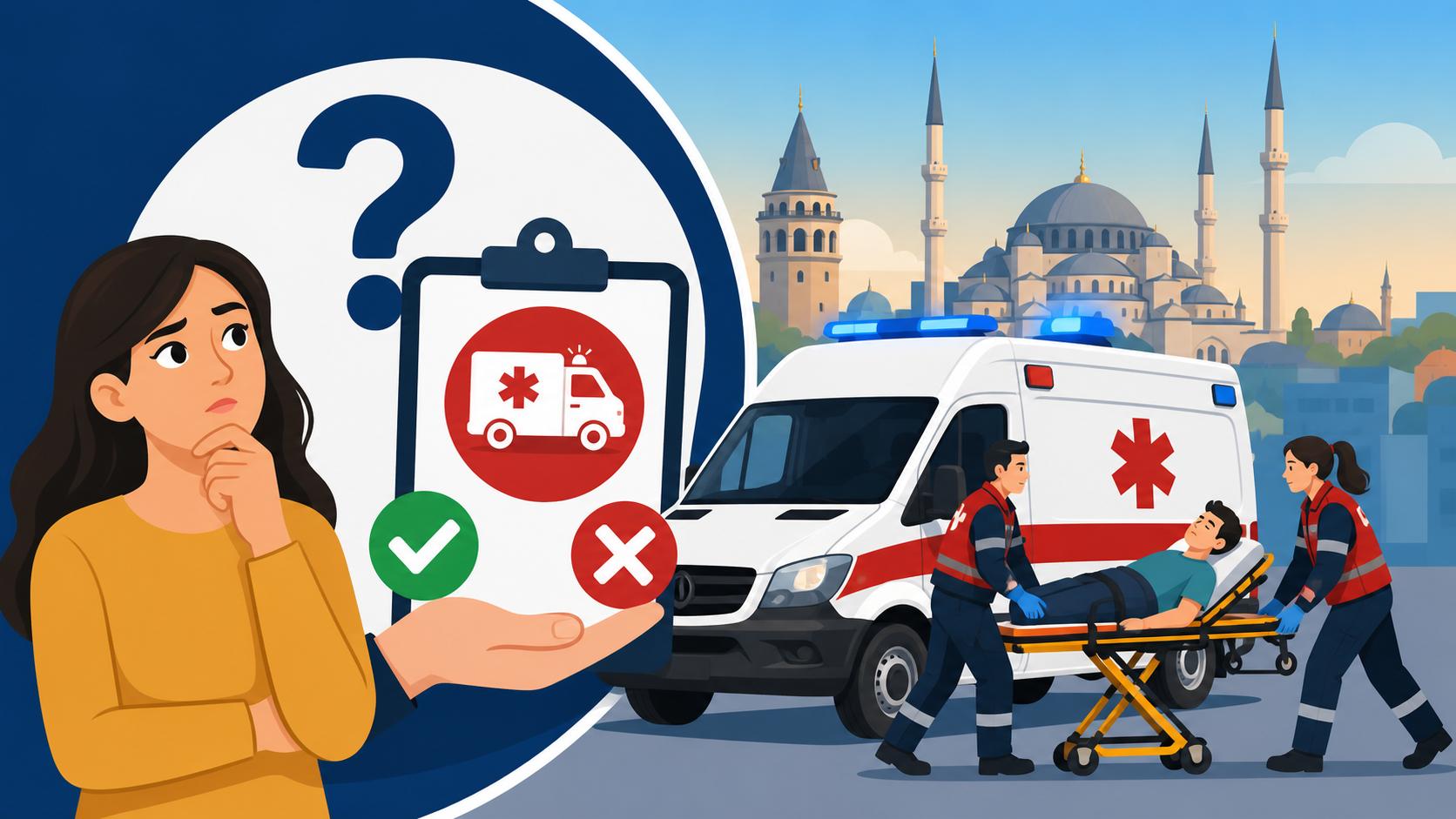
The first thing every foreigner needs to know is that Turkey operates a unified emergency number: 112. Whether you need the police, the fire department, or an ambulance, this is the number to dial. The public ambulance service, often referred to as the 112 Acil (Emergency), is managed by the Ministry of Health. These vehicles are recognizable by their white bodies and blue/red stripes, and they are strategically stationed throughout cities and rural areas.
Is 112 Really Free for Foreigners?
The question of whether these rides are free is a bit of a "yes, but" scenario. For Turkish citizens and foreign residents enrolled in the SGK system, emergency ambulance transport via the 112 system is generally free of charge. If you are a resident and have been paying your premiums, you should not be handed a bill at the end of a 112 transport to a state facility. Understanding Health Insurance in Turkey: SGK Public System vs Private Coverage Explained is the foundation for knowing how these public costs are absorbed by the state.
However, if you are a tourist or an expat without any form of Turkish residency or insurance, the situation is slightly different. While the ambulance crew will never demand payment on the spot—their primary directive is "life-saving first"—the Ministry of Health does technically have a tariff for services provided to "uninsured foreign nationals." In practice, many tourists find that they aren't billed for the ride itself if the situation was a genuine life-threatening emergency. But as the system becomes more digitized, the likelihood of a bill being linked to your passport number for later payment is increasing.
When to Call 112 vs. Taking a Taxi
In Turkey, there is a cultural tendency to use taxis for minor injuries or non-life-threatening issues to avoid the wait times of a 112 dispatch. You should only call 112 for true emergencies: chest pain, severe breathing difficulties, heavy bleeding, or unconsciousness. If you call an ambulance for a minor fever or a sprained ankle, you might be taking a vital resource away from someone else, and in some cases, the dispatcher might even advise you to find your own way to a hospital.
When you do call, the dispatchers are trained to triage your situation. You can find more details on how these calls are handled in our guide on Calling 112 for an Ambulance: Dispatch Workflows and Language Support. If your situation isn't critical, you might find that the 112 ambulance takes longer to arrive, especially in high-traffic cities like Istanbul or Ankara. In these instances, a taxi or a private car is often the faster route to the nearest "Acil" (Emergency Room).
Private Hospital Ambulances: Costs and Billing
While the state 112 system is the default for most, many expats prefer the facilities of international-standard private hospitals. Groups like Acıbadem, Memorial, and Medical Park maintain their own fleets of highly advanced ambulances. These are essentially mobile intensive care units, often staffed with English-speaking doctors or paramedics. Unlike the state 112 system, private ambulance services are almost never free.
Why Private Facilities Charge for Transport
When you call a private hospital directly for an ambulance, you are initiating a commercial service. These hospitals charge for the "call-out" fee, the medical staff on board, the medications used during transport, and a per-kilometer mileage fee. They operate independently of the government’s 112 dispatch unless they are specifically contracted for overflow. If you are specifically looking for Finding Medical Care in Turkey: Public Hospitals vs JCI-Accredited Clinics, you should assume that any ambulance provided by the private facility will come with a price tag.
Private ambulances are often used for "inter-facility transfers"—for example, moving a patient from a small local clinic to a major surgical center. In these cases, the cost is calculated based on the distance and the level of support required (Standard vs. Cardiac/Intensive Care). It is always a good idea to ask for an estimated cost if the patient is stable enough to wait, though in a true emergency, the priority is always the transfer.
Price Ranges for Private Ambulance Services in 2026
In 2026, the costs for private ambulance transport have adjusted with inflation. For a standard city-wide transport within Istanbul or Antalya, you can expect a base fee ranging from 2,500 TL to 6,000 TL, plus mileage. If a doctor is required to be on board for a critical patient, that fee can easily double.
Many expats choose to carry comprehensive international insurance like Cigna Global to ensure these costs are reimbursed. Having a policy from Cigna Global often allows for direct billing with major private hospitals, meaning you won’t have to pay these high fees out-of-pocket during a stressful medical event. Without such coverage, you will likely be asked to settle the ambulance bill at the hospital's "Taburcu" (Discharge) or "Vezne" (Cashier) desk before the patient is released.
| Service Type | Provider | Estimated Cost (2026) | Coverage |
|---|---|---|---|
| Emergency Transport (Red Triage) | 112 (Public) | Free for SGK/Residents | Generally covered by state |
| Routine Transport (Non-Emergency) | 112 (Public) | 1,500 – 3,000 TL | Usually billed to the patient |
| Private Hospital Ambulance | Private Groups | 2,500 – 10,000+ TL | Out-of-pocket or Private Insurance |
| Air Ambulance (Helicopter) | Ministry of Health | Free for life-saving | Strictly for critical rural cases |
| Private Air Ambulance | Specialist Firms | $5,000 – $20,000+ | High-end International Insurance |
Insurance and Emergency Transport
The complexity of "free" versus "paid" almost always comes down to your insurance status. Turkey has become very strict about residency requirements, and having the right paperwork is the difference between a zero-balance invoice and a massive bill.
Does SGK Cover Ambulance Fees?
If you have been living in Turkey for more than a year and have enrolled in the Social Security Institution (SGK), you are entitled to the same emergency rights as a Turkish citizen. This includes free 112 ambulance transport to state hospitals. If the 112 ambulance takes you to a private hospital because it is the nearest facility, the SGK will still cover the emergency stabilization costs, but the hospital might try to charge "differential fees" once the patient is stable. You can read more about these potential costs in our article on Healthcare Budgeting: Understanding Copays, Tariffs, and Billing in Turkey.
It is important to note that SGK does not cover private ambulance fleets unless there is a specific, pre-approved medical necessity that the state could not provide. If you call a private hospital's private line, you are stepping outside the SGK umbrella for that specific transport.
Private Health Insurance and International Policies
For many expats, the basic insurance required for the residency permit (Ikamet) is quite limited. While it meets the legal requirement, it often has low caps on emergency transport. This is why many veteran residents upgrade to Private Health Insurance (Özel Sağlık Sigortası): Top Providers for Foreigners or maintain a policy from Cigna Global. These premium plans usually include "Emergency Medical Evacuation" and "Road Ambulance" as standard features with much higher coverage limits.
When you have a high-end policy, the private hospital will coordinate with your insurance provider. However, you should always keep a digital copy of your insurance card on your phone. In the heat of an emergency, being able to show the paramedics or the hospital admissions staff that you are covered by Cigna Global can speed up the administrative side of your care significantly.
Critical Practical Advice for Expats
Navigating the mechanics of an ambulance ride is one thing; surviving the logistical hurdles is another. From language barriers to hospital protocols, there are several "real-world" factors that determine your experience.
Triage Colors and Waiting Times
When an ambulance delivers you to the hospital, you aren't seen on a "first-come, first-served" basis. Turkey uses a very strict triage system. If you arrived via ambulance but are classified as "Green" (non-urgent), you might wait for hours while patients who arrived in private cars but are "Red" (critical) are seen first. Understanding Triage Colors in Turkish Emergency Rooms: Why You Might Be Waiting will save you a lot of frustration during the process. An ambulance ride does not guarantee immediate physician attention if your condition is deemed stable upon arrival.
Preparation and Communication
One of the biggest hurdles is the language barrier. While many doctors speak English, the ambulance technicians and the 112 dispatchers might not. It is incredibly helpful to have a list of your medications and allergies written in Turkish. I also recommend keeping a small "emergency kit" at home with basic supplies you might need while waiting for help. Many expats use iHerb to stock up on high-quality first aid supplies, electrolytes, and basic diagnostic tools like thermometers or pulse oximeters that might not always be available in the local "Eczane" in the exact brand they prefer. Using iHerb ensures you have familiar medical essentials on hand before a crisis occurs.
Furthermore, make sure your address is clearly registered and that you know how to describe your location. Turkish addresses can be notoriously confusing for GPS systems. Having a pre-written "address card" near your door that you can read over the phone—including nearby landmarks—is a life-saver. For those who want to be fully prepared, learning Essential Turkish Phrases for the Doctor: Communicating Symptoms Effectively is a wise investment of time.
The Role of Air Ambulances
In specific regions, particularly along the rugged Mediterranean coast or in the remote mountainous east, the Ministry of Health operates a fleet of helicopter and plane ambulances. For life-threatening emergencies where road transport is impossible, these are provided free of charge by the state to anyone on Turkish soil. However, these are strictly for medical necessity as determined by 112 doctors. You cannot "request" an air ambulance because you want to get to Istanbul faster. Private air ambulance services do exist for medical repatriation to your home country, but these are extremely expensive and typically only used by those with top-tier travel insurance or international plans like Cigna Global.
To further ensure your home is ready for any medical event, consider setting up a dedicated health shelf. Stocking it with supplements and first aid items from iHerb can bridge the gap during recovery after an emergency. Whether it's high-grade Vitamin C or specialized bandages, having these items ready means one less trip to the pharmacy when you are already feeling under the weather.
Important Disclaimer
The information provided in this guide is for general informational purposes only and does not constitute medical or legal advice. Healthcare regulations and emergency service fees in Turkey are subject to change by the Ministry of Health and the Social Security Institution (SGK). While we strive to keep this data current, always verify coverage details with your specific insurance provider or a qualified legal professional. In a life-threatening emergency, always dial 112 immediately regardless of your financial or insurance status.