The Metrobus Etiquette: Surviving Istanbul’s Intense Rush Hour Crowds
Standing on the platform at Zincirlikuyu, you feel the collective breath of five hundred people as a Metrobus approaches. I remember my first week in Istanbul, frozen in terror as a sea of commuters surged forward without a hint of hesitation. This guide breaks down the survival tactics and unwritten etiquette needed to conquer Istanbul's most intense transit system.
Understanding the Beast: What is the Istanbul Metrobus
The Metrobus is not just a bus; it is the circulatory system of Istanbul, a 52-kilometer line that stretches from the far western suburbs of Beylikdüzü on the European side all the way to Söğütlüçeşme on the Asian side. It operates in its own dedicated lane in the middle of the D-100 highway, meaning it flies past thousands of cars stuck in the city’s notorious traffic. For many, it is the only way to remain punctual in a city of 16 million people.
However, the efficiency comes at a cost. The Metrobus is legendary for its density. At peak hours, you aren't just a passenger; you are part of a human Tetris game. Understanding the mechanics of the system is the first step toward reclaiming your sanity. Before you even set foot on a platform, make sure you have read up on How to Buy, Register, and Reload an Istanbulkart for Public Transport to ensure your card is topped up and ready for the journey.
The Route and Station Logic
The line is surprisingly simple, yet the transfer points are where the chaos lives. Major hubs like Zincirlikuyu, Cevizlibağ, and Yenibosna act as massive funnels for the Metro and Marmaray systems. If you are living in a managed apartment from a provider like Blueground, you likely have the luxury of being near a major transport hub, but that doesn’t mean the walk to the platform will be quiet.
The Metrobus fleet consists of high-capacity articulated buses. Some are newer and air-conditioned, while others feel like relics of a past era. Regardless of the model, they all follow a "closed system" logic. Once you pass through the turnstiles, you are in the Metrobus zone. The beauty of this system is its 24/7 operation, making it the reliable friend of the late-night worker or the early-morning traveler.
The Payment and Refund System
One of the most common mistakes new arrivals make is ignoring the "iade" (refund) machines. The Metrobus charges a tiered fare based on the number of stops you travel. When you tap your card at the entrance, the system deducts the maximum possible fare. To get your change back, you must tap your card again on the yellow machines located outside the turnstiles after you exit the bus.
If you are just starting your journey and learning the ropes, check out Living in Turkey as a Foreigner: The Ultimate Starter Guide (2027) for more tips on navigating daily logistics. Failing to use the refund machines can turn a cheap commute into a surprisingly expensive habit over a month.
Rush Hour Realities: When to Ride and When to Hide
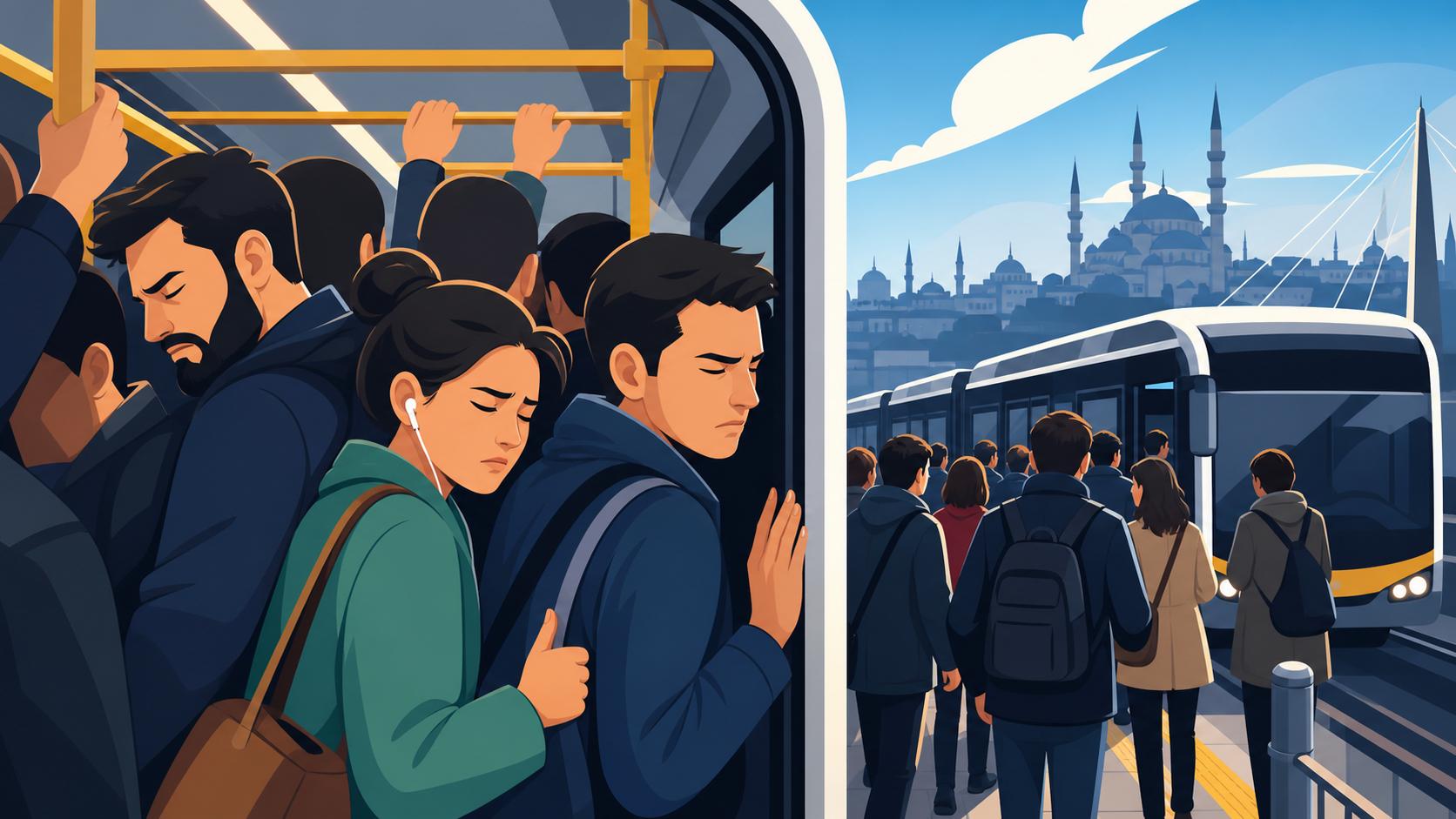
The Istanbul rush hour is not a mere sixty minutes; it is a multi-hour endurance test. Generally, the most intense periods are 7:30 AM to 9:30 AM and 5:30 PM to 8:00 PM. During these times, the platforms become so crowded that security guards often have to manage the flow of people onto the escalators. If you can avoid these windows, do so.
If you must travel during peak hours, your mindset needs to shift. You cannot wait for a "half-empty" bus; it simply does not exist. You have to be prepared to stand, often in very close proximity to others. I’ve spent many mornings pressed against a window, watching the sunset over the Bosphorus Bridge, which is arguably the only romantic part of the experience.
The Zincirlikuyu Bottleneck
Zincirlikuyu is the center of the Metrobus universe. It is where the European and Asian sides meet, and where the M2 Metro line connects. The walk from the Metro to the Metrobus platform can take ten minutes of brisk walking through underground tunnels. At peak times, these tunnels become a river of people.
To stay sane during these long walks and waits, many expats use noise-canceling headphones ordered from Amazon Turkey to create a sensory bubble. Staying connected is also vital, especially if you need to check Google Maps for delays. I highly recommend using an e-sim from Airalo to ensure you have a steady data connection even when the station Wi-Fi fails under the weight of thousands of users.
Strategic Waiting and Boarding
There is a specific art to where you stand on the platform. The buses stop at designated spots, and the crowd tends to cluster near the entrances and exits of the platform. If you walk toward the far ends of the platform, you might find a slightly thinner crowd and a better chance of squeezing onto a bus.
When the bus arrives, the doors open, and a simultaneous eruption of people occurs. People exiting and people entering often collide. The "unwritten rule" is to let people off first, but in the heat of a 6:00 PM Zincirlikuyu rush, this rule is often ignored. You must be firm but polite. Use your shoulders to hold your space, and move with the flow rather than against it.
Survival Tactics for Boarding and Riding
Once you are on the bus, the challenge shifts from entry to positioning. The biggest mistake is staying near the door. If you stay by the door, you will be constantly pushed and prodded by every person entering and exiting at the next twenty stops. Move to the middle of the aisle as quickly as possible.
The middle of the bus is often slightly less crowded and provides more handrails to hold onto. The Metrobus can be jerky, especially when the driver has to brake suddenly in traffic. If you aren't holding onto a rail, you will end up in the lap of a stranger. This is a common part of Commuting in Istanbul: Mastering the Metro, Metrobus, Marmaray, and Ferries that every resident eventually gets used to.
Handling the Personal Space Deficit
In many Western cultures, personal space is a bubble of at least an arm’s length. In the Istanbul Metrobus, that bubble is non-existent. You will be touching shoulders, bags, and arms with strangers. The key is to remain calm and avoid unnecessary eye contact, which can be seen as confrontational in such tight quarters.
If you find the lack of space overwhelming, consider alternative routes. Sometimes taking a slightly longer path via the Taking Taxis in Istanbul: How to Use BiTaksi and Uber to Avoid Scams can be a necessary mental health break, though you will likely be traded for sitting in traffic rather than standing in a crowd.
The Exit Strategy
Getting off the bus is a maneuver that requires early planning. If your stop is approaching, start moving toward the door at least one stop in advance. You will need to navigate through a wall of people. The magic phrase here is "Pardon, inecek var" (Excuse me, someone is getting off).
If you don't speak up, the crowd will assume you are staying on, and they won't move. A firm, clear voice is necessary. If you are struggling with the language, refer to our guide on Social Etiquette in Turkey: Greetings, Removing Shoes, and Hospitality Norms to understand the polite way to assert yourself in social spaces.
Unwritten Rules of Metrobus Etiquette
While the Metrobus can feel like a lawless wasteland, there are deep-seated cultural norms that still apply. Witnessing these small acts of kindness is often what makes the experience bearable. For instance, the younger generation is generally expected to give up their seats for the elderly, the disabled, and pregnant women.
If you are sitting and an older person boards, it is highly recommended to offer your seat. You will often hear the phrase "Buyurun" (Please, take it). Even if they refuse, the gesture is noted and respected. This is a core part of Daily Life & Culture: Religion, Social Etiquette, and Making Friends that helps you integrate into the local fabric.
Backpacks and Belongings
One of the greatest sins on the Metrobus is wearing a large backpack on your back. In a crowded bus, a backpack effectively takes up the space of a second person and hits everyone you turn toward. The etiquette is to take your bag off and hold it at your feet or in front of your chest.
Not only does this show respect for others, but it is also a vital safety measure. Pickpockets operate in crowded transit hubs, and a bag on your back is an easy target. I always keep my valuables in a zipped internal pocket. If you are carrying shopping bags from a trip to a mall or deliveries from Navigating the PTT Postal System and Private Courier Deliveries (Kargo), try to keep them as compact as possible.
Noise and Mobile Phone Use
While Istanbul is a loud city, the Metrobus has a certain "commuter silence." People do talk, but loud, booming phone conversations are generally frowned upon. Most people are either staring out the window, scrolling through their phones, or trying to catch a five-minute nap.
If you must take a call, keep it brief and quiet. This is especially true in the "quiet" residential areas where the bus passes. If you are traveling with children, be mindful of the space. While Istanbul is incredibly kid-friendly—see Best Areas in Istanbul for Families with Young Children and Strollers—the Metrobus can be a stressful environment for little ones.
Comparing Istanbul Transit Options
To help you decide when to brave the Metrobus and when to look elsewhere, consider this comparison of the major transit arteries.
| Feature | Metrobus | Metro (M2 Line) | Marmaray |
|---|---|---|---|
| Speed | High (Bypasses Road Traffic) | Highest | Consistent |
| Coverage | Broad (East-West Axis) | Central Istanbul Hubs | Intercontinental |
| Crowd Level | Extreme at Peak | High | Moderate to High |
| Operation | 24 Hours | 6 AM – Midnight (Weekdays) | 6 AM – Midnight |
| Best For | Crossing the Bridge Fast | Shopping & Business | Long Distance Travel |
Safety and Practical Considerations
Safety on the Metrobus is generally high in terms of physical well-being, but the sheer density makes it a playground for opportunistic petty crime. Keep your phone in your hand or a secure front pocket. If you are carrying a purse, keep the strap over your shoulder and the bag in front of you with your hand over the zipper.
In the event of an emergency or if you feel unwell, don't hesitate to ask for help. Turkish people are incredibly helpful in crisis situations. If you are managing a long-term condition, it is always wise to know your nearest medical hubs; our guide on Healthcare in Turkey for Foreigners: Complete Expat Guide (2027) is an essential resource for any resident.
Weather and Environment
The Metrobus experience changes with the seasons. In the summer, despite air conditioning, the buses can become incredibly hot. Carrying a bottle of water is non-negotiable. In the winter, the buses are often "tropical" because the heaters are blasted to combat the Istanbul chill, meaning you’ll be stripping off layers the moment you board.
The platforms are often exposed to the elements. If it’s raining, the Zincirlikuyu transfer becomes a test of umbrella management. Umbrellas are often sacrificed to the wind on that bridge. If you are living in the Istanbul Neighborhood Guide: European vs Asian Side Lifestyles for Expats areas, you’ll learn which stations offer the best shelter during a storm.
Dealing with Delays
While the Metrobus is more reliable than a car, it is not immune to issues. Accidents in the dedicated lane can cause massive backups. Since there is only one lane in each direction, a single broken-down bus can stall the entire system.
Always have a backup plan. Apps like Mobiett or Google Maps are generally accurate for real-time tracking. If the Metrobus is stalled, the Metro or even a ferry might be a slower but more pleasant alternative.
Final Advice for the Brave Commuter
The Metrobus is a rite of passage for anyone living in Istanbul. It is a place where you see the city in its rawest form—the tired workers, the excited students, and the determined entrepreneurs all squeezed into one silver tube. It can be exhausting, but it is also the heartbeat of the city.
Embrace the chaos. Don't take the pushing personally. Remember to use the refund machines. If you can master the Metrobus, you can master anything Istanbul throws at you. For those who prefer a more curated lifestyle away from the madness, finding a home in the right district is key. Explore the Istanbul Neighborhood Guide: European vs Asian Side Lifestyles for Expats to find your perfect sanctuary after a long day on the D-100.
Disclaimer
The information provided in this guide is for informational purposes only and reflects the personal experiences of the author. Public transportation rules, fares, and schedules in Istanbul are subject to change by the Istanbul Metropolitan Municipality (IBB). Always check official sources like IETT for the most current information. The author and publisher are not responsible for any incidents, losses, or inconveniences experienced while using public transport in Turkey.