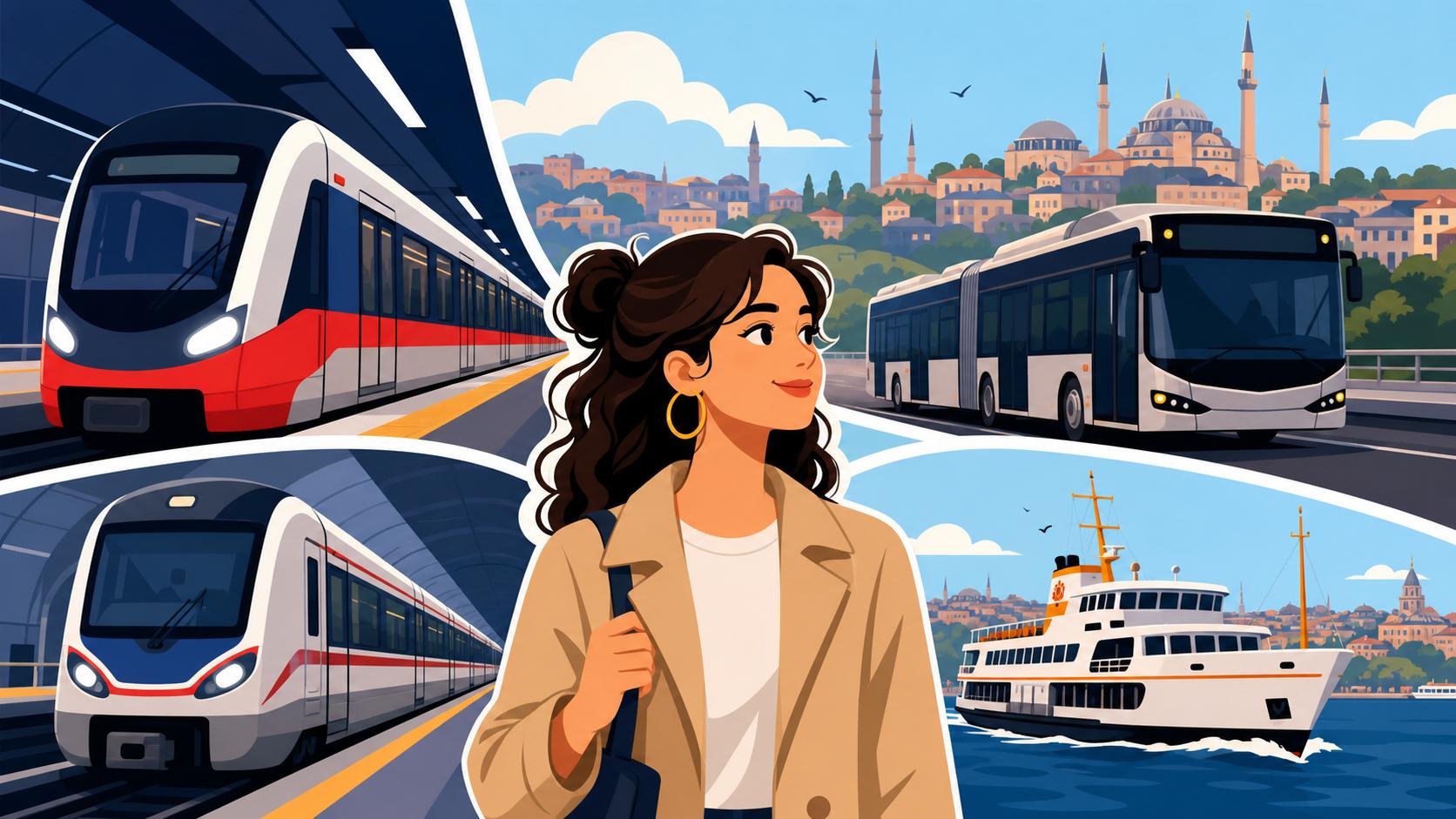
Commuting in Istanbul: Mastering the Metro, Metrobus, Marmaray, and Ferries
Trying to navigate Istanbul’s transit map for the first time feels like staring at a bowl of technicolor spaghetti, and I remember vividly the day I burst into tears at the Zincirlikuyu station because I couldn't find the right Metrobus platform. It is a chaotic, sprawling, and beautiful system, but it demands respect and local knowledge. This guide deconstructs every layer of the city's transport network to turn you from a bewildered newcomer into a confident urban navigator.
The Backbone of the City: The Istanbul Metro System
The Istanbul Metro is arguably the most reliable way to avoid the legendary "Istanbul traffic," which can turn a twenty-minute drive into a two-hour ordeal. When I first moved here, I made the mistake of relying on taxis, only to realize that the underground network is often cleaner, faster, and far more predictable. The system is divided into several lines, but as an expat, you will likely find yourself frequenting the M2 and M4 lines most often.
Navigating the M2 Hacıosman to Yenikapı Line
The M2 line is the golden child of the European side. It connects the high-end business districts of Maslak and Levent to the shopping hubs of Şişli and the historic districts near Taksim. If you have secured a flexible, high-quality rental through a service like Blueground, there is a very high chance your apartment is located near one of these major M2 stops. The trains are frequent, usually arriving every 3 to 5 minutes during peak hours.
One thing the maps don't tell you is the sheer depth of some of these stations. Stations like Gayrettepe or Taksim require several long escalator rides. Always stay to the right on escalators unless you want to face the silent (or not-so-silent) wrath of a rushing Istanbullu. During the humid summer months, the air-conditioned Metro cars are a sanctuary. I often suggest new arrivals use a travel eSIM from a provider like Airalo to ensure they have a stable data connection even in the deeper station mezzanine levels where public Wi-Fi can be spotty.
The M4 Kadıköy to Sabiha Gökçen Airport Line
If you have chosen the more "bohemian" lifestyle on the Asian side, the M4 line will be your best friend. This line starts in the heart of Kadıköy and stretches all the way to Sabiha Gökçen Airport. It is a lifesaver for those living in the Istanbul Neighborhood Guide: European vs Asian Side Lifestyles for Expats who need to commute between the two sides. The transfer at Ayrılık Çeşmesi to the Marmaray is one of the most important junctions in the city.
The M4 is fully automated and incredibly efficient, but it can get claustrophobically crowded around 6:00 PM. A pro tip I learned the hard way: if you are heading to the airport with luggage, try to board at the very first or last car. These usually have slightly more standing room for suitcases. If you find the noise of the crowded stations overwhelming, I highly recommend ordering a pair of noise-canceling headphones from Amazon Turkey to make the 50-minute trek to the airport more bearable.
Crossing Continents: The Marmaray and Bosphorus Ferries
Istanbul is the only city in the world where your daily commute can involve crossing from Europe to Asia. While there are bridges and tunnels for cars, the most efficient and scenic ways for residents to cross are the Marmaray rail and the iconic city ferries. Each offers a completely different experience of the city’s geography.
The Marmaray: The Deepest Undersea Rail
The Marmaray is a marvel of engineering, running through a tube tunnel submerged on the floor of the Bosphorus. It is the fastest way to get from the European side (Yenikapı or Sirkeci) to the Asian side (Üsküdar or Kadıköy/Ayrılık Çeşmesi). Because it links the far outskirts of the city on both sides, it is often very crowded with commuters coming from the deep suburbs.
When using the Marmaray, be aware that the pricing is different from the standard Metro. You pay a "maximum" fare when you tap in, and you must "tap out" at a refund machine (iade makinesi) after you exit to get the difference back based on how many stops you actually traveled. Forgetting to tap out is a common expat mistake that can drain your Istanbulkart balance quickly. For more details on managing your balance, see our guide on How to Buy, Register, and Reload an Istanbulkart for Public Transport.
Iconic Ferries and the Soul of the City
There is no better way to start your day than on a "Şehir Hatları" ferry with a glass of tea (çay) and a piece of simit. The ferries connect major points like Eminönü, Karaköy, and Beşiktaş on the European side to Kadıköy and Üsküdar on the Asian side. Unlike the Metro, the ferry is a moment of zen. You can sit on the deck, watch the seagulls, and take in the silhouette of the Hagia Sophia.
However, ferries are subject to weather conditions. During heavy fog or "Lodos" (southwest winds), the Bosphorus can be closed to maritime traffic. Always check the Şehir Hatları app or website on stormy mornings. If you are Living in Turkey as a Foreigner: The Ultimate Starter Guide (2027), you will soon learn that a canceled ferry is the only universally accepted excuse for being late to a meeting in Istanbul.
The High-Speed Arteries: Mastering the Metrobus and Tramways
While the Metro is the most comfortable, the Metrobus is the most "Istanbul" experience you can have. It is a system of articulated buses running in a dedicated lane down the middle of the E-5 highway. It is fast because it never gets stuck in traffic, but it is also intensely crowded.
Surviving the Metrobus During Rush Hour
The Metrobus operates 24 hours a day and is the lifeline for millions. It is the only way to quickly cross the July 15th Martyrs Bridge without a car. However, the experience can be brutal. You will need to master The Metrobus Etiquette: Surviving Istanbul's Intense Rush Hour Crowds if you plan on using this during peak times. The key is "active waiting"—positioning yourself exactly where the doors will open and being prepared to move with the crowd.
If you are staying in a neighborhood like Beylikdüzü or Avcılar and working in Mecidiyeköy, the Metrobus is your only realistic option. It is loud and can be bumpy, so many expats prefer to live in centrally located apartments provided by Blueground to minimize their time on this specific mode of transport. If you do use it, keep your backpack on your front for safety and to save space.
Historic Trams and the Modern T1 Line
The T1 Tramway is the pulse of the Old City. It runs from Kabataş (near Galatapuport) through Karaköy, over the Galata Bridge, and past the Blue Mosque and Grand Bazaar. It is incredibly useful for tourists, but for expats, it can be a bit slow because it moves at street level and has to wait for pedestrians and occasional traffic.
There is also the historic "Nostalgic Tram" (T2) that runs down Istiklal Avenue. It isn’t really for commuting—it’s more of a moving landmark. If you are Setting Up Your Turkish Home: Utilities, Internet Providers, and Aidat in a neighborhood like Galata, you might find the T1 tram useful for quick hops down to the ferry piers, but for longer distances, always opt for the Metro.
Comparison of Istanbul Transport Modes
| Mode | Coverage | Speed | Peak Hour Comfort | Best For |
|---|---|---|---|---|
| Metro | Major business & residential hubs | High | Medium | Avoiding all traffic; reliability |
| Marmaray | Long-distance East-West link | High | Low | Crossing the Bosphorus quickly |
| Ferry | Coastal neighborhoods | Medium | High | Comfort, views, and fresh air |
| Metrobus | E-5 Highway corridor | Very High | Very Low | Fast transit when the Metro isn't available |
| Tram | Historic and coastal areas | Low | Medium | Short distances in Sultanahmet/Eminönü |
| Taxi/Uber | Everywhere | Variable | High | Door-to-door (but expensive and slow) |
Practical Essentials: Istanbulkart, Apps, and Connectivity
You cannot function in Istanbul without an Istanbulkart. Gone are the days of buying single-use tokens; everything now runs on this contactless card. You can buy them at major transit hubs or small kiosks (büfe) near stations. Make sure you register your card online to enable "aktarma" (transfer) discounts, which significantly lower the cost of your second and third rides within a two-hour window.
Essential Apps for Real-Time Navigation
Navigation apps are your secret weapon. Google Maps is decent, but for Istanbul, "Moovit" or "Citymapper" are much more accurate regarding bus schedules and ferry cancellations. For those times when the transit system just won't cut it, you will need to know about Taking Taxis in Istanbul: How to Use BiTaksi and Uber to Avoid Scams. BiTaksi is the local favorite and tends to be more reliable for summoning a yellow or turquoise cab.
To keep these apps running, don't rely on finding open Wi-Fi. Istanbul's hills and concrete buildings are notorious for blocking signals. I always keep a backup Airalo data plan active so I can check my route while standing on a moving ferry or inside a deep Metro station. If you lose your way, don't be afraid to ask a local; even with a language barrier, most people will go out of their way to point you toward the right "İskele" (pier) or "Durak" (stop).
Choosing Housing Near Transit Hubs
When looking for a place to live, the proximity to a "hub" is more important than the neighborhood's name. A "hub" is where multiple lines meet, such as Yenikapı, Beşiktaş, or Kadıköy. Living in a neighborhood that is only served by buses can be frustrating, as buses are the first to get stuck in rain-induced gridlock.
If you are moving with children, you'll want to prioritize accessibility. Check our guide on Best Areas in Istanbul for Families with Young Children and Strollers to see which neighborhoods offer the flattest terrain and best elevator-equipped stations. For professionals, being near the M2 or the Zincirlikuyu Metrobus station is usually the top priority. If you're overwhelmed by the options, starting with a serviced apartment from a company like Blueground allows you to test out a neighborhood's commute before committing to a long-term lease.
Cultural Nuances of the Istanbul Commute
There is a rhythm to commuting here that takes time to learn. For example, giving up your seat for the elderly, pregnant women, or people with children is not just a suggestion; it is a strictly followed social rule. If you are sitting and an older person stands near you, you are expected to offer your seat immediately.
Another uniquely Turkish aspect is the "Akbil" culture. If someone’s card runs out of balance at a bus turnstile, they might hand you some cash and ask you to tap your card for them. This is a common and helpful practice. However, ensure you have your own card topped up. You can find "Hızlı Yükleme" (Fast Load) machines at almost every corner. If you ever find yourself in a medical emergency while commuting, knowing the locations of Finding English-Speaking Doctors in Istanbul: Top International Clinics can be a literal lifesaver, as many of the best clinics are located right along the M2 Metro line.
Finally, keep an eye on your surroundings. Istanbul is generally very safe, but crowded places like the Metrobus are hotspots for pickpockets. If you have ordered electronics or valuables from Amazon Turkey, keep them well-hidden in your bag. Commuting in Istanbul is an endurance sport, but once you master the transfers and the "vapur" schedules, the city opens up in a way that makes the chaos feel like home.
Disclaimer
The information provided in this guide is based on current transit regulations and city infrastructure as of 2026. Routes, pricing, and app availability are subject to change by the Istanbul Metropolitan Municipality (İBB). This content is for informational purposes and does not constitute legal or professional relocation advice. Always check official İBB or Şehir Hatları announcements for real-time service updates.