What to Do in a Minor Car Accident in Turkey: Filing a Kaza Tutanağı
Getting into a fender bender in Turkey’s high-energy traffic is a rite of passage that most expats would prefer to skip. I remember my first minor scrape in the narrow streets of Kadikoy; I was paralyzed by the language barrier and the honking horns, completely unsure how to document the damage legally. This guide provides the exact steps to navigate a minor accident and file the Kaza Tutanagi correctly.
Immediate Steps to Take After a Collision
The moments following a car accident are usually a blur of adrenaline and confusion, but in Turkey, the first sixty seconds are the most critical for your insurance claim. Before you even roll down your window to speak with the other driver, you must ensure the safety of everyone involved and secure the scene. If you are living in a managed residence provided by services like Blueground, you might have access to dedicated parking or support staff, but on the public roads of Istanbul or Antalya, you are your own first responder.
The first thing you must do is turn on your hazard lights and, if it is safe to do so, place your reflective warning triangles behind and in front of your vehicle. Turkish law requires these to be visible from a distance to prevent secondary collisions, especially on high-speed roads. If your car didn’t come with a comprehensive safety kit, I highly recommend ordering a European-standard roadside emergency pack from Amazon Turkey to keep in your trunk. Once the scene is marked, check yourself and your passengers for injuries. Even if you feel fine, remember that shock can mask pain, and if there is even a hint of a medical issue, you must transition from a minor accident protocol to an emergency protocol.
The most important "expats-only" tip I can give you is this: Do not move your vehicle until you have documented everything. In many Western countries, the norm is to pull over to the side of the road to avoid blocking traffic. In Turkey, if you move the car before taking photos of the final resting positions, the insurance companies may reject your claim or find you 100% at fault because the evidence was "disturbed." This often leads to angry honking from other drivers, but stay firm. Your financial protection depends on those initial, unedited photos of the cars exactly where they collided.
When to Call the Police vs. Handling it Privately
In Turkey, the traffic police (Trafik Polisi) or Gendarmerie (Jandarma) generally do not attend to minor accidents where only material damage has occurred. If there are no injuries, both parties are expected to fill out the Kaza Tutanagi (Accident Report) themselves. However, there are five specific scenarios where you must call 112 and wait for an officer to arrive, regardless of how minor the damage seems.
First, if one of the drivers does not have a valid driver’s license or is driving a vehicle unsuitable for their license class, you cannot file a private report. Second, if you suspect the other driver is under the influence of alcohol or drugs, a police report is mandatory for insurance purposes. Third, if one of the vehicles involved belongs to a government entity (like a municipality bus or a police car), the authorities must be called. Fourth, if there is damage to public property, such as a street lamp, a barrier, or a median, the police must document it. Finally, if one of the parties cannot provide proof of mandatory traffic insurance, do not attempt to settle it privately.
If you find yourself needing to call the authorities, you should be prepared for a bit of a wait, especially in major cities. While you wait, you can use a travel eSIM from Airalo to ensure you have a stable data connection to use translation apps or to look up the nearest police station. Having a working phone is also essential for Calling 112 for an Ambulance: Dispatch Workflows and Language Support if the situation escalates or if you realize someone is injured after the initial shock wears off.
Capturing the Necessary Evidence
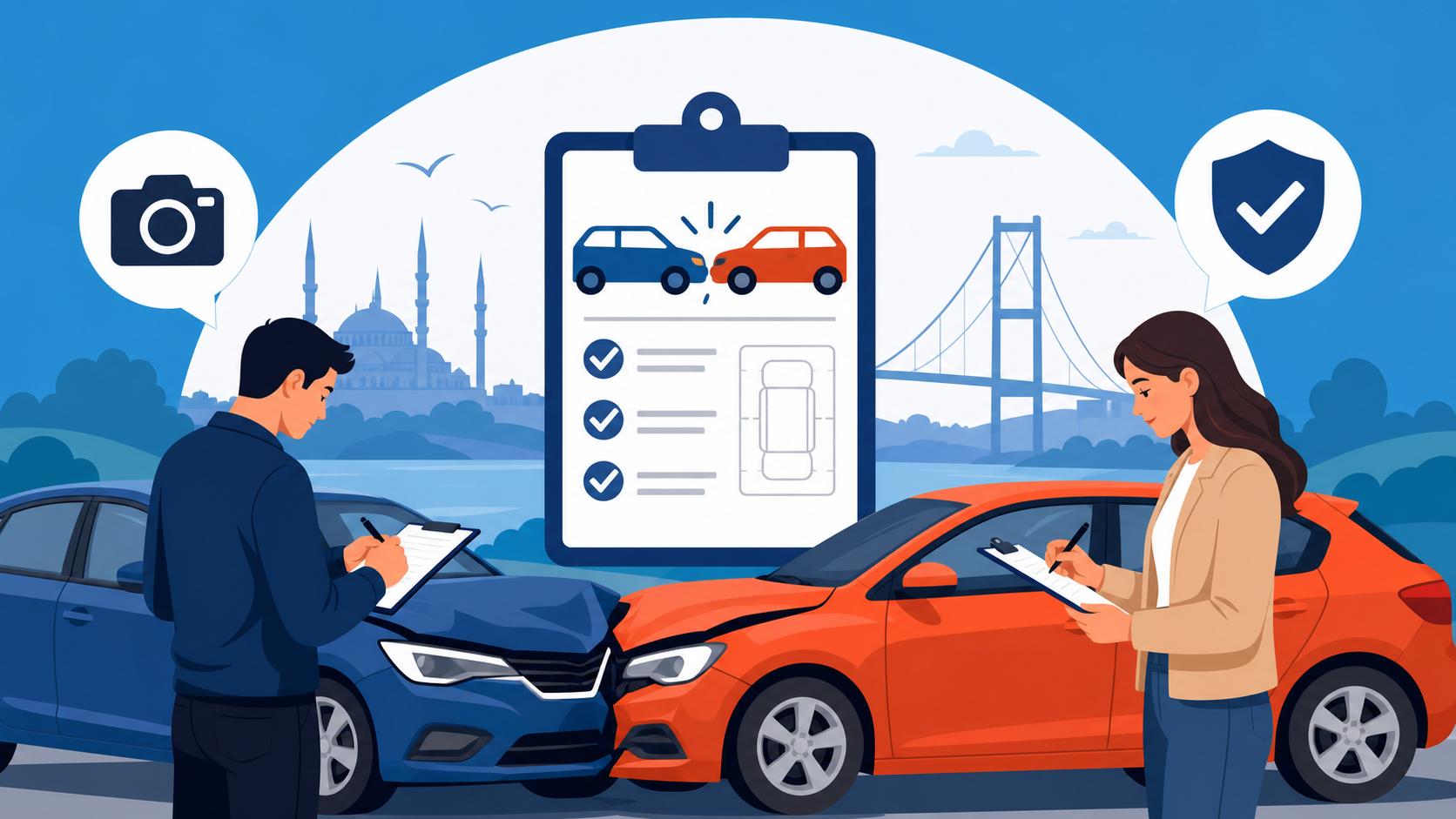
Before the other driver starts trying to negotiate a "cash under the table" settlement—a common occurrence in Turkey—start taking your photos. You need wide-angle shots that show the entire scene, including street signs, lane markings, and the relative positions of both cars. Then, take close-up shots of the damage on both vehicles, ensuring the license plates are clearly visible in the frame. If there are skid marks on the road or broken glass, photograph those as well.
It is also wise to take a quick video of the scene while narrating what happened. This can be helpful later if the other driver changes their story during the insurance evaluation. While you are doing this, ensure you have your data roaming or local SIM active; Airalo is particularly helpful here if you haven't yet secured a permanent local line. These photos will be the primary evidence used by the Tramer (the central insurance information center) to determine the fault percentages (0%, 50%, or 100%).
Mastering the Kaza Tutanagi Form
The Kaza Tutanagi is a standardized, carbon-copy form that every driver in Turkey is required to carry. If you are Buying a Used Car in Turkey: Notaries, Expertise Reports, and High Taxes, the first thing you should do after taking delivery is check the glovebox for this form. If it isn't there, you can buy them at stationery stores or download the "Mobil Kaza Tutanagi" app, which is the official digital version of the report.
The form is entirely in Turkish, which can be daunting for a new expat. It is divided into several sections: information about the drivers, vehicle details, insurance policy numbers, and a narrative section where you describe the accident. You will also find a small grid where you are expected to draw a basic diagram of the collision. Use simple arrows to indicate the direction of travel and an "X" to mark the point of impact. Do not worry about being an artist; the goal is clarity, not aesthetics.
The narrative section is where most foreigners struggle. You don't need to write a novel. Simple sentences like "Aracimla duruyorken arkadan çarpti" (He hit me from behind while I was stopped) or "Kirmizi isikta geçti" (He went through a red light) are sufficient. If you are unsure of the phrasing, use a translation app to draft your statement. Both drivers must write their own version of events in the designated boxes. If the other driver refuses to sign or disagrees with your version, that is an immediate signal to stop the private process and call the traffic police.
Essential Documentation Exchange
Once the form is filled out, you must exchange copies of several key documents. This is a non-negotiable part of the process. Even if you fill out the Kaza Tutanagi perfectly, your insurance provider will reject the file if it is missing the other party’s documents. You should take clear photos of the following items from the other driver:
| Document Needed | Why It Matters |
|---|---|
| Driver's License (Ehliyet) | To prove they are legally allowed to drive. |
| Vehicle Registration (Ruhsat) | To confirm ownership and vehicle specifications. |
| Traffic Insurance (Trafik Sigortasi) | To ensure there is a policy to claim against. |
| Kimlik or Ikamet Card | To verify the identity of the driver. |
As an expat, you must provide your own documents as well. This includes your Converting Your Foreign Driver's License to a Turkish License if you have been in the country for more than six months, or your original foreign license alongside a notarized translation. You will also need to provide The 99-Number: What Your T.C. Kimlik Number Gives You Access To in Daily Life so the insurance system can track your residency and policy.
Using the Mobil Kaza Tutanagi App
The digital shift in Turkey has made the paper form almost secondary. The "Mobil Kaza Tutanagi" app allows you to file the report entirely on your smartphone. The app guides you through taking the photos, scans the QR codes on the insurance policies, and uses GPS to pin the exact location of the accident. This is often much faster and reduces the chance of manual entry errors that could lead to a claim rejection.
The app requires a Turkish phone number and an active data connection. If you are still using a foreign device, make sure you are aware of The Turkey IMEI Rule: How to Register Foreign Phones in 2026 to avoid your phone being blocked at a critical moment. If your local line isn't set up yet, having an Airalo data package can be a lifesaver, allowing you to use the app and upload photos to the cloud immediately. Once submitted via the app, the report is instantly sent to the insurance companies of both parties.
Filing the Insurance Claim and Repairs
Once the Kaza Tutanagi is complete and the scene is cleared, you have two business days to notify your insurance company. In Turkey, there are two types of insurance: the mandatory "Trafik Sigortasi" (which covers damage to the other party) and the optional "Kasko" (which covers your own vehicle). For a deeper dive into these, check out my guide on Auto Insurance (Kasko) vs Compulsory Traffic Insurance (Trafik Sigortasi).
If you are not at fault, the other driver's Trafik Sigortasi will cover your repairs. However, many expats prefer to use their own Kasko policy to expedite the process and let their insurer subrogate the claim against the other party. This is usually the smoother route, especially if you have a policy with a "mini-repair" clause for small scratches or dents. When you call your insurance agent, they will ask for the Kaza Tutanagi, the photos of the accident, and the document copies you collected at the scene.
Choosing the Right Repair Shop
Your insurance company will likely give you two choices for repairs: an "Anlasmali Servis" (Contracted Service) or an "Ozel Servis" (Private Mechanic). The contracted services are usually authorized brand dealerships (like Renault, Fiat, or Volkswagen) and are the safest bet for maintaining the resale value of your car. They handle the paperwork directly with the insurance company, meaning you don't have to pay out of pocket and wait for a refund.
If you choose a local "Usta" or a private shop that isn't contracted with your insurer, you might have to pay for the repairs yourself and then submit the invoices for reimbursement. For minor bodywork, this can sometimes be faster, but it requires much more administrative legwork. If you need any tools or car care products to tide you over while your car is in the shop, Amazon Turkey often has faster delivery than many local parts shops.
Understanding the Tramer Result
About 3 to 10 days after the report is filed, the Tramer system will issue a verdict on fault. You can check this result on the E-Devlet Financial Services: Tracking Taxes, SGK Debts, and Bank Accounts portal or via SMS by texting your license plate to 5664 (though this service carries a small fee). The result will be 0% (no fault), 50% (equal fault), or 100% (full fault).
If you disagree with the Tramer result, you have a five-day window to object. This requires providing additional evidence, such as dashcam footage or witness statements. This is why those initial photos and videos are so vital. If the 50% or 100% fault stands, your insurance premiums will likely increase upon renewal. You can also How to Check Your Traffic Fines (Trafik Cezası) and Pay Safely on e-Devlet to see if the accident resulted in any automated camera-based fines, which sometimes happen if the collision occurred in an intersection monitored by the TEDES system.
Communication and Cultural Nuances
Driving in Turkey requires a thick skin and a calm demeanor. When an accident happens, it is common for bystanders to gather and offer unsolicited advice. While the Turkish people are incredibly helpful, this can sometimes add to the chaos. Politely thank them but stay focused on the other driver and the documentation. If the other driver becomes aggressive, do not engage. Simply get back into your car, lock the doors, and call 112.
If you are renting a vehicle through a service like Blueground or a traditional agency, their protocol might be slightly different. Most rental contracts in Turkey require a police report for any damage, even if it’s a minor scratch where a private Kaza Tutanagi would normally suffice. Always check your rental agreement or call the agency's emergency line before you start the paperwork. Failing to follow their specific rules could void your "Full Insurance" (CDW) coverage.
Finally, keep your language skills in mind. Knowing basic phrases like "Lutfen ehliyetinizi gorebilir miyim?" (Can I see your license, please?) can go a long way in de-escalating a tense situation. If the stress of the accident causes physical symptoms like headaches or nausea later in the day, don't hesitate to visit a local clinic. You can find useful vocabulary in my article on Essential Turkish Phrases for the Doctor: Communicating Symptoms Effectively to help you explain the situation to medical staff. Also, be aware of Toll Roads and Bridges: Navigating Turkish Highways with HGS Stickers, as you’ll want to ensure your HGS balance is sufficient if you need to take a different route or use a tow truck that crosses tolled infrastructure.
Disclaimer
This guide is intended for informational purposes only and does not constitute legal or professional insurance advice. Traffic laws and insurance regulations in Turkey are subject to frequent change. Always consult with your insurance provider or a qualified legal professional regarding your specific situation.