Converting Your Foreign Driver’s License to a Turkish License
Navigating the chaotic traffic of Istanbul or the winding coastal roads of Antalya is stressful enough without worrying about the legality of your paperwork. I remember the heart-sinking feeling of being pulled over at a routine Gendarmerie checkpoint near Fethiye, clutching my tattered home-country license and hoping the officer wouldn't notice I had exceeded my six-month grace period. This guide solves the confusion around legal driving limits and provides a foolproof roadmap for converting your foreign license into a Turkish one.
Understanding the Six-Month Rule for Foreign Licenses
The first thing every expat learns—usually the hard way—is that Turkey is incredibly generous with foreign licenses for a short window. If you are entering as a tourist, you can legally drive using your valid national driving license for up to six months from the date of your last entry into the country. This is a lifesaver for those who just arrived and are still finding their feet. However, the clock is ticking, and the rules shift the moment you become a long-term resident.
The "six-month rule" is often misinterpreted. Many think it applies to the duration of their residence permit, but it is actually tied to your entry stamp. If you leave Turkey and re-enter, that six-month window technically resets for driving purposes. However, once you have stayed for more than six months and hold an Ikamet, the authorities expect you to have a notarized translation of your license at the very least. Relying on this "reset" strategy is risky and can lead to complications with insurance providers if you are involved in an accident.
For those staying in flexible housing options like Blueground, having a permanent or semi-permanent base makes it easier to track these administrative deadlines. If you’ve settled into a neighborhood and plan to stay beyond a single summer, starting the conversion process early is the only way to ensure you aren't left stranded. If you are caught driving on an expired foreign license after your six-month limit, you face significant fines and, more importantly, your insurance policy will likely be voided on the spot.
How the Law Actually Works for Tourists vs Residents
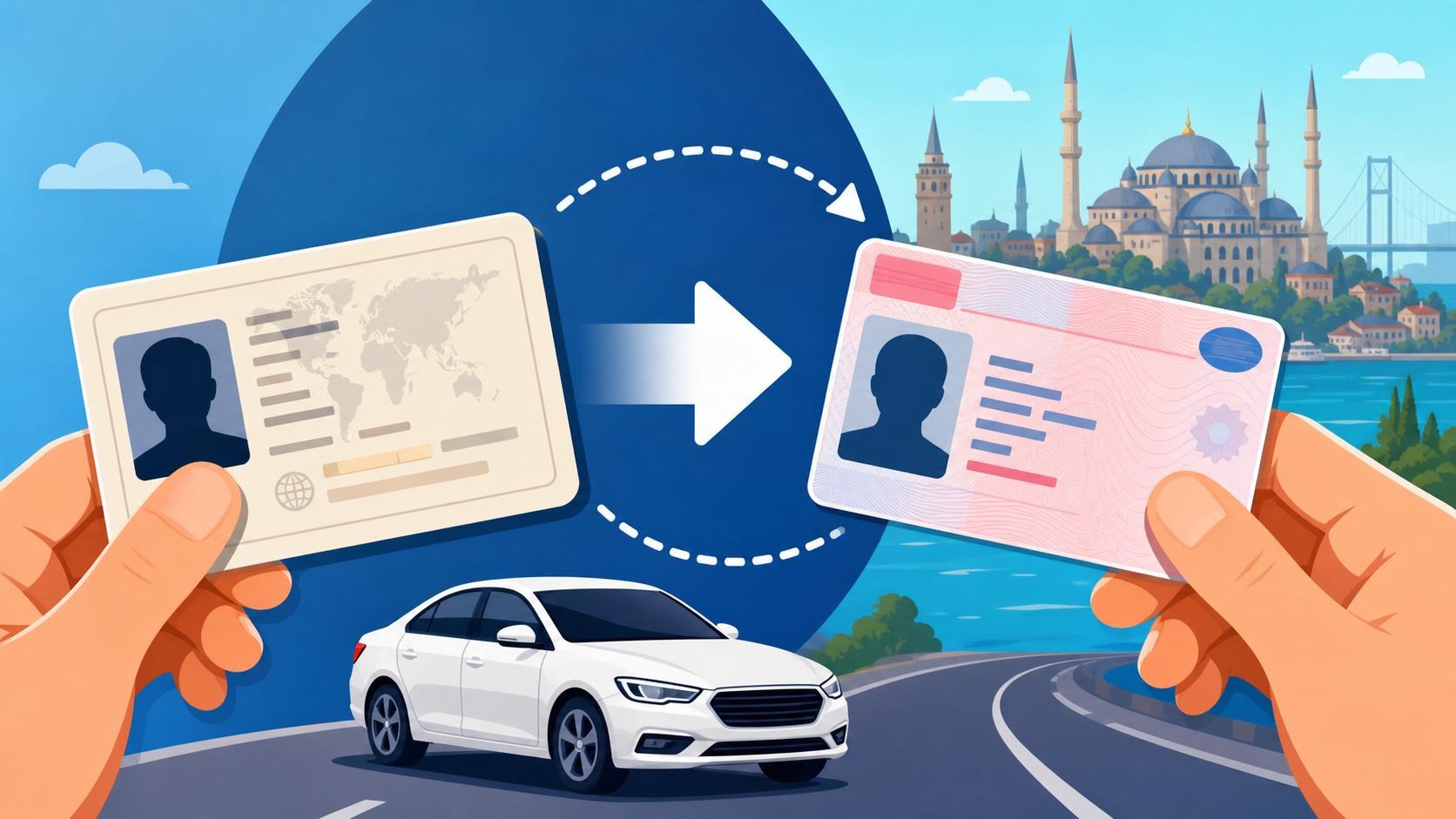
For tourists, the process is simple: keep your passport and original license on you. If your license doesn't have a photo or isn't in a Roman script, you should carry an International Driving Permit (IDP). But for us expats, the transition to a Turkish license is a mandatory rite of passage. Once you have surpassed the six-month mark of residency, the law requires you to swap your foreign license for a Turkish Sürücü Belgesi.
It’s important to note that Turkey is a signatory to the 1968 Vienna Convention on Road Traffic. If your home country is also a signatory, the conversion is a "swap" rather than a "re-test." This means you don't have to go back to driving school or take a grueling practical exam with a Turkish instructor. You simply provide the right paperwork, pay the fees, and they issue you a local card. If your country isn't on that list, you might be looking at a much longer road involving a full Turkish driving course.
The Risks of Overstaying Your License Validity
Many expats try to "wait it out," thinking they can just show their foreign license forever. This is a dangerous game. In Turkey, traffic police are increasingly tech-savvy. During a stop, they will often check your 99-number or passport entry dates against the date on your license. If they see you’ve been in the country for a year and are still handing over a British or German license without a conversion receipt, you’re in for a very expensive afternoon.
The biggest risk isn't just the fine; it's the liability. If you are in a collision, even if it’s not your fault, the first thing the insurance company checks is the legality of your license. If you are past the six-month limit without a Turkish license, they can legally refuse to pay out for damages to your car or others. When you are Living in Turkey as a Foreigner: The Ultimate Starter Guide (2027), protecting your financial assets is just as important as finding a good apartment.
Notarized Translations: A Temporary Fix
Between the six-month and one-year mark, some people opt for a notarized Turkish translation of their license. While this helps during a police stop—as it shows the officer exactly what your categories are in Turkish—it is not a permanent solution for residents. It’s a "band-aid" fix that might satisfy a sympathetic officer in a rural area, but it won’t hold up in a court of law or a serious insurance claim in a city like Ankara.
To get this translation, you’ll need to find a sworn translator (Yeminli Tercüman) and then take that document to a Notary (Noter) for an official stamp. This process is a small preview of the bureaucracy to come. I always recommend getting a few copies made while you’re there, as you’ll need them for various stages of the actual conversion process later.
The Step-by-Step Conversion Process at the Nüfus Directorate
In the old days, you had to go to the police station for license issues. Thankfully, that has changed. All driver's license services are now handled by the General Directorate of Population and Citizenship Affairs, known locally as Nüfus Müdürlüğü. This transition has made things slightly more streamlined, but the "Nüfus" is a busy place, so you need to be prepared.
Before you even think about showing up at the office, you need to ensure you have a stable internet connection—I personally used an Airalo e-SIM to manage my appointments while moving between apartments. You cannot simply walk into a Nüfus office and demand a license; you must have a pre-booked Randevu (appointment).
Securing an Appointment via NVI or e-Devlet
The appointment system is managed through the e-Ikamet portal or the NVI website. You can also call "199" from a Turkish phone line, but if your Turkish isn't quite there yet, the website is much easier to navigate with a browser translator.
When booking, you must select the specific office in the district where you are registered. If you live in Kadıköy, you go to the Kadıköy Nüfus office. Be warned: appointments in popular expat hubs fill up weeks in advance. If you find your local office is booked out, check daily at 8:00 AM or midnight when the system refreshes. Once you have your appointment, you’ll receive a confirmation SMS. Keep this—you’ll need to show it to the security guard at the door.
Preparing Your Dossier: The Essential Paperwork
This is the stage where most expats falter. You need a very specific set of documents, and if even one is missing or incorrectly formatted, the officer will send you home. It’s an "I've-been-there" frustration that you want to avoid. Your dossier must include:
- Your original foreign driver's license and a color photocopy of both sides.
- The notarized Turkish translation of your license.
- Your original Residence Permit (Ikamet) and a photocopy.
- A "Driver's Health Report" (Sürücü Olur Sağlık Raporu) from a doctor.
- A document showing your blood type (if not on your health report).
- One biometric photo (standard 5x6cm with a white background).
- Your education certificate or diploma (with a notarized translation).
- Receipts for the paid "License Fees."
Collecting these feels like a scavenger hunt. For the biometric photos, any local photography shop will know the "Ikamet" or "Ehliyet" (license) standard. For the diploma, if you don't have your original university degree with you, you might need someone back home to mail it to you. I’ve found that Amazon Turkey is a great place to buy organizers and folders to keep these precious documents safe during the process.
The Importance of Your Original Physical License
Here is the "catch" that surprises many: to get a Turkish license via conversion, the Turkish government usually keeps your original foreign license. They then send it back to the issuing authority in your home country. This is because, under international law, you aren't supposed to hold two full national licenses simultaneously for the same categories.
However, some countries have bilateral agreements that allow you to keep both, or you may be able to "lose" your license back home later and request a replacement. But strictly speaking, at the window in the Nüfus office, they will ask for your physical foreign card. If you are not prepared to part with it, you cannot complete the conversion. This is why some expats choose to go through the full Turkish driving school process from scratch, just so they can hold two separate licenses legally.
| Document Type | Source | Requirement |
|---|---|---|
| Foreign License | Home Country | Must be valid; color copy required |
| Notarized Translation | Turkish Sworn Translator | Must be stamped by a Turkish Notary |
| Health Report | Family Doctor or Private Clinic | Must state "Eligible to be a driver" |
| Education Certificate | University/School | Must be translated and notarized |
| Biometric Photo | Local Photo Shop | White background, 5x6cm |
| Payment Receipts | Bank or e-Devlet | All taxes and card fees must be paid |
Medical Reports and Education Requirements
One aspect that often baffles foreigners is why the Turkish government cares about your high school diploma or your blood type just to let you drive a car. But these are mandatory hurdles. The medical report, in particular, is where many get stuck because it involves navigating the local health system.
To get your health report, you have two options: the public route or the private route. The public route involves finding your assigned Choosing a Primary Care Physician (Aile Hekimi) at a Local Health Center. This is free but requires your address to be properly registered in the Nüfus system. The doctor will perform a basic eye test, check your coordination, and ask about any chronic illnesses.
Navigating the Aile Hekimi System
The Aile Hekimi is your gateway to many administrative tasks in Turkey. To find yours, you can check the e-Nabız app or ask your neighbors where the nearest Sağlık Ocağı (Health Clinic) is. When you go, bring your Ikamet and tell them you need a "Sürücü Sağlık Raporu."
The doctor will likely ask for your blood type. If you don't know it, they can do a quick finger-prick test right there, or they might send you to a local lab. If you have a serious vision impairment or a history of heart issues, the family doctor might refer you to a specialist at a state hospital. If you’re in a hurry, private clinics also offer these reports for a fee (usually between 500 and 1,500 TL), and they are often much faster.
Proving Your Education Level: The Diploma Dilemma
This is perhaps the most annoying part of the process. Turkey requires all drivers to have at least a primary school education. As a foreigner, you must prove this by showing your diploma. A photocopy isn't enough; it must be the original or a notarized copy.
Furthermore, the diploma must be translated into Turkish by a sworn translator and then notarized. In some cases, the Nüfus officer might ask for a "Denklik" (Equivalency) certificate from the Ministry of Education, but this is increasingly rare for simple license conversions. Usually, a notarized translation of a university degree is sufficient. If you’ve lost your diploma, you are in for a long wait while you request a new one from your home country.
Blood Type Certificates and Eye Exams
If your blood type is not listed on your foreign license or your medical report, you will need a separate blood type card (Kan Grubu Kartı). You can get this at any private laboratory or during your medical exam. It’s a small, credit-card-sized piece of paper that you’ll need to hand over at the Nüfus office.
The eye exam is standard—reading letters off a chart. If you wear glasses or contacts, your license will be marked with a specific code (usually "01.06"), meaning you are legally required to wear them while driving. If you’re caught driving without them, it’s a fine. It is sensible to suggest keeping a spare pair of glasses in the glove box, which you can easily order from Amazon Turkey to ensure you're never caught off guard.
Costs, Taxes, and Final Fees in 2026
Driving in Turkey isn't cheap, and neither is the paperwork. By the time you reach the final step, you’ll have spent a fair amount on translations and notaries. The government fees themselves are split into three categories: the license fee (Harç), the valuable paper fee (Değerli Kağıt Bedeli), and the police foundation fee (Vakıf Payı).
In 2026, these fees have seen adjustments due to inflation. It is essential to check the latest rates on the Money in Turkey for Expats: Banking, Payments, and Finance Guide (2027) before you pay. You cannot pay these fees in cash at the Nüfus office. They must be paid in advance.
Breaking Down the Değerli Kağıt and Foundation Fees
The "Valuable Paper Fee" is essentially the cost of the physical plastic card. The "Foundation Fee" goes to the Turkish Police Foundation. These are relatively small compared to the main license tax. The main tax depends on the category of vehicle you are licensed for (e.g., Class B for cars, Class A for motorcycles).
Make sure you pay for every category you want to keep. If your foreign license has both car and motorcycle categories, you need to pay the combined tax if you want both to appear on your Turkish license. If you only pay the "B" fee, they will "drop" your motorcycle privileges, and you’ll have to go through the whole process again later to add them back.
Paying Your Taxes via Ziraat Bank or e-Devlet
The easiest way to pay is through the How to Pay Your Annual Property Tax (Emlak Vergisi) via Municipality Websites portals or via the mobile apps of state banks like Ziraat Bankası, VakıfBank, or Halkbank. Look for the "GİB" (Revenue Administration) payment section and select "Driver's License Payments."
You will need your 99-number to complete the transaction. Once paid, the system updates almost instantly. You don't necessarily need to print the receipt as the officer can see it on their screen, but I highly recommend bringing a digital copy on your phone just in case of a system glitch. Having a reliable data plan from Airalo is vital here so you can pull up your banking app at the window if the officer asks for proof.
Why Some Nationalities Pay More Than Others
While the standard fees are the same for everyone, the hidden costs vary. Some countries’ documents are harder to translate, or the notary might charge more for multi-page diplomas. Furthermore, if your country does not have a reciprocity agreement with Turkey, you might not be able to "convert" at all, meaning you'd have to pay for a full driving school course, which costs significantly more (often upwards of 15,000–20,000 TL in 2026).
Always check if your country is part of the convention. Most European, North American, and Commonwealth countries are fine. If you are from a country that isn't, you might find that Real Estate Residence Permits: Understanding the Strict USD 200,000 Tapu Rule holders or investors have different paths, but for most of us, it’s the standard conversion or the driving school route.
Post-Conversion: Driving and Car Ownership in Turkey
Once the officer accepts your folder, they will give you a temporary paper license (Geçici Sürücü Belgesi). This paper allows you to drive legally in Turkey for 15 to 30 days while your actual card is printed and mailed. Your new Turkish license will be delivered to your registered address via PTT (the national postal service).
This is a proud moment! You are now legally integrated into the Turkish road system. But with a local license comes local responsibilities. You'll need to understand the HGS (High-Speed Toll) system and how to handle accidents without a police presence.
Do You Get to Keep Your Original Foreign License?
As mentioned earlier, in 90% of cases, the answer is no. The Nüfus officer will take your foreign license. Some expats report that they were able to keep theirs by claiming they needed it for an upcoming trip, but this is entirely at the discretion of the individual officer and is not the official policy.
If you absolutely must have your home license, you may need to apply for a "lost" replacement when you return to your home country. Just be aware that if you are caught with two licenses in a country that forbids it, you could face administrative issues. For most, the Turkish license is a badge of honor that simplifies Intercity Travel in Turkey: High-Speed Trains (YHT) and Luxury Long-Distance Buses and car rentals.
Registering a Vehicle and Navigating the HGS System
Once you have your license, you might be tempted to buy a car. Be prepared for the sticker shock. Turkey has some of the highest vehicle taxes in the world. When you do buy, the car must be registered in your name at a Notary. You will also need an HGS sticker for your windshield to pay for tolls on highways and bridges.
You can get an HGS account at any PTT office or through your Turkish bank app. It works like a pre-paid "EZ-Pass." You load money onto the plate number, and it’s deducted automatically as you drive under the sensors. If you forget to top it up, you’ll get a fine, which you can check on the E-Devlet Financial Services: Tracking Taxes, SGK Debts, and Bank Accounts portal.
Insurance and the Kaza Tutanağı Protocol
In Turkey, for minor accidents where no one is injured, you don't call the police. Instead, you use a "Kaza Tespit Tutanağı" (Accident Report Form). Every car should have one in the glove box. You and the other driver fill it out together, take photos of the cars' positions and IDs, and then submit it to your insurance companies.
If you don't speak Turkish, this can be terrifying. This is where having local friends or a good translation app is essential. If the other driver is aggressive or refuses to sign, then you call the police (112). Always ensure your Auto Insurance (Kasko) vs Compulsory Traffic Insurance (Trafik Sigortası) is up to date, as the "Traffic" insurance is mandatory, but "Kasko" is what actually protects your car's value.
Common Pitfalls and Troubleshooting
Even with the best preparation, things can go wrong. The Turkish administrative system is famous for "the person at the window" having a lot of power. If they are having a bad day, your apostille might suddenly look "suspicious," or your photo might be "too old."
The key is patience. Never argue with the officer. If they say a document is missing, politely ask for a list of exactly what is needed, go get it, and come back. This is part of the Daily Life & Culture: Religion, Social Etiquette, and Making Friends experience in Turkey—persistence and a smile go a long way.
Dealing with Denklik Equivalency Delays
If the Nüfus office insists on an education equivalency (Denklik), you’ll need to visit the local Ministry of Education (Milli Eğitim Müdürlüğü). This can add weeks to your timeline. They will look at your translated diploma and issue a document stating that your degree is equivalent to a Turkish one. To avoid this, try to bring the most "official-looking" university degree you have, as they are less likely to question a degree than a high school certificate.
Language Barriers at the Nüfus Office
Most Nüfus officers do not speak English. If your Turkish is basic, I highly recommend bringing a Turkish-speaking friend or hiring a translator for the morning. It makes the process 100% smoother. If you’re living in a managed apartment from Blueground, their local support might be able to recommend a reliable translator or fixer to help you navigate the appointment.
What to Do If Your Country Isn't Part of the Road Traffic Convention
If your home country isn't a signatory (like parts of the US that don't follow the convention strictly, though most states are fine), you cannot convert. You will have to enroll in a Turkish driving school (Sürücü Kursu).
You’ll attend classes (often available in English in big cities), take a written exam (available in several languages on a computer), and finally, a practical driving test. While it's more expensive and time-consuming, it does mean you get to keep your original license from home without any issues. Plus, you’ll learn the "unspoken rules" of Turkish driving, which is a survival skill in itself!
Disclaimer
This guide is for informational purposes only and reflects the administrative procedures in Turkey as of 2026. Laws, fees, and required documents can change without notice. Always verify the latest requirements with the General Directorate of Population and Citizenship Affairs (NVI) or a qualified legal professional before beginning your application.