Turkish Tea Culture: How to Accept and Refuse Hospitality Politely at Shops
Walking into a small hardware store in Istanbul to buy a single lightbulb and being told to sit down for a glass of tea can feel like a social trap for the uninitiated. I remember my first week in Kadıköy, when I drank three glasses of tea I didn't even want because I was too polite to say no and ended up shaking from a caffeine overdose by noon. This guide solves the mystery of Turkish tea etiquette, helping you navigate these frequent offers of hospitality with the grace of a local veteran.
The Social Architecture of Çay in the Turkish Marketplace
To understand why a shopkeeper is offering you tea, you must first understand that in Turkey, commerce is secondary to connection. Unlike the transactional nature of retail in Western Europe or North America, Turkish business culture is built on the foundation of "Tanışalım" (Let’s get to know each other). Tea is the medium through which this happens. It is the literal lubricant of every negotiation, every repair job, and every casual browse through a neighborhood shop.
If you are living in one of the beautifully curated apartments provided by Blueground, you might notice that your local "Mahalle" (neighborhood) operates like a small village. The tailor, the butcher, and the upholstery guy all know each other, and they spend a significant portion of their day drinking tea together. When you are invited into this circle, it isn't just about selling you a product; it’s an invitation to be part of the community. In Daily Life & Culture: Religion, Social Etiquette, and Making Friends, you begin to see that these small interactions are the building blocks of a successful expat life.
More Than Just a Beverage: The Philosophy of Hoşgeldiniz
When a shopkeeper says "Hoşgeldiniz" (Welcome) and immediately follows it with "Çay içer misiniz?" (Will you drink tea?), they are offering you their time. In the Turkish mindset, a guest is a "Tanrı misafiri" (a guest from God), even if that guest is just someone looking for a specific type of vacuum cleaner bag. Accepting the tea signals that you are not in a rush, that you value the person across from you, and that you are open to a conversation that might have nothing to do with what you’re buying.
I have sat in upholstery shops in Beşiktaş for forty-five minutes, discussing the price of lemons and the weather in Rize, only to realize I forgot to ask about the fabric I actually went there for. This is part of the charm. If you are still finding your feet, reading the Living in Turkey as a Foreigner: The Ultimate Starter Guide (2027) can help you manage these cultural shifts in pace.
Identifying the Çay Ocağı System
One of the most fascinating aspects of Turkish commercial life is the "Çay Ocağı" (Tea Hearth). Most small shops don't actually brew their own tea. Instead, there is a tiny, often hidden hub somewhere in the "pasaj" (arcade) or on the street corner that serves dozens of shops. When the shopkeeper offers you tea, they aren't going to the back to boil a kettle; they are pressing a buzzer or shouting to a "Çaycı" (tea waiter).
Seconds later, a man will appear carrying a swinging brass tray (askı) with small, tulip-shaped glasses (ince belli) rattling against each other. It’s a highly efficient system. If you’re curious about how this translates to professional environments, you might want to look into Office Tea Culture (Çay): Surviving and Enjoying Turkish Workplace Socializing to see how this tradition persists even in high-rise corporate towers.
The Etiquette of Acceptance: Navigating Your First Glass
If you have the time, you should almost always say "Evet" (Yes) to the first glass. It builds immediate rapport. However, there are a few physical and social "rules" that will make you look less like a tourist and more like a seasoned resident.
First, never look for a handle. The "ince belli" glass is designed to be held by the rim. Use your thumb and index finger to grasp the very top edge of the glass where the glass curves outward; this area stays cool while the tea below remains scorching. If you try to wrap your hand around the middle, you’ll learn a painful lesson very quickly.
The Visual Cues: Tulip Glasses and Beet Sugar
The tea served will be "tavşan kanı" (rabbit’s blood), which is the local term for the deep, clear red color that signifies a perfect brew. It is traditionally served with two cubes of beet sugar on the saucer. You are not required to use them, but the tea is quite strong (koyu). If you prefer it weaker, you can ask for it "açık" (light), which will result in a more amber-colored, less tannic tea.
While you’re sitting there, waiting for the tea to reach a drinkable temperature, it’s a great time to pull out your phone. If you are using a local data plan via Airalo, you can quickly look up a few phrases or check the price of what you’re about to buy. Just don't spend the whole time staring at your screen; the point of the tea is the person sitting across from you.
Knowing When to Pay (and When Not To)
This is the golden rule of Turkish hospitality: You never pay for the tea offered to you in a shop. The shopkeeper has a tab with the Çay Ocağı, and they will settle it at the end of the day or week. Attempting to pay the tea waiter or offer the shopkeeper money for the tea is actually quite insulting. It shifts the interaction from "hospitality" to "transaction."
The only exception is if you are at a "Çay Bahçesi" (Tea Garden) or a café, where you are there specifically to consume. But in a retail setting—whether it’s a carpet shop, a jewelry store, or a local "Eczane"—the tea is on the house. If you are browsing for items for your new home, perhaps searching for specific kitchenware on Amazon Turkey, remember that the local experience of buying a "çaydanlık" (double teapot) in person will always come with a free glass of the brew itself.
| Scenario | Should You Accept? | Who Pays? | Social Expectation |
|---|---|---|---|
| Small "Mahalle" Shop | Yes, if you have 10 mins | Shopkeeper | Casual chat, no pressure to buy |
| Grand Bazaar Carpet Shop | Exercise caution | Shopkeeper | High pressure to buy; stay alert |
| Notary or Government Office | Yes | The Official | Acknowledgment of a long wait |
| Bank (Private Banking) | Yes | The Bank | Professional courtesy |
| Visiting a Neighbor | Mandatory | The Host | Deep social bonding |
The Art of the Polite Refusal: How to Say No Without Offending
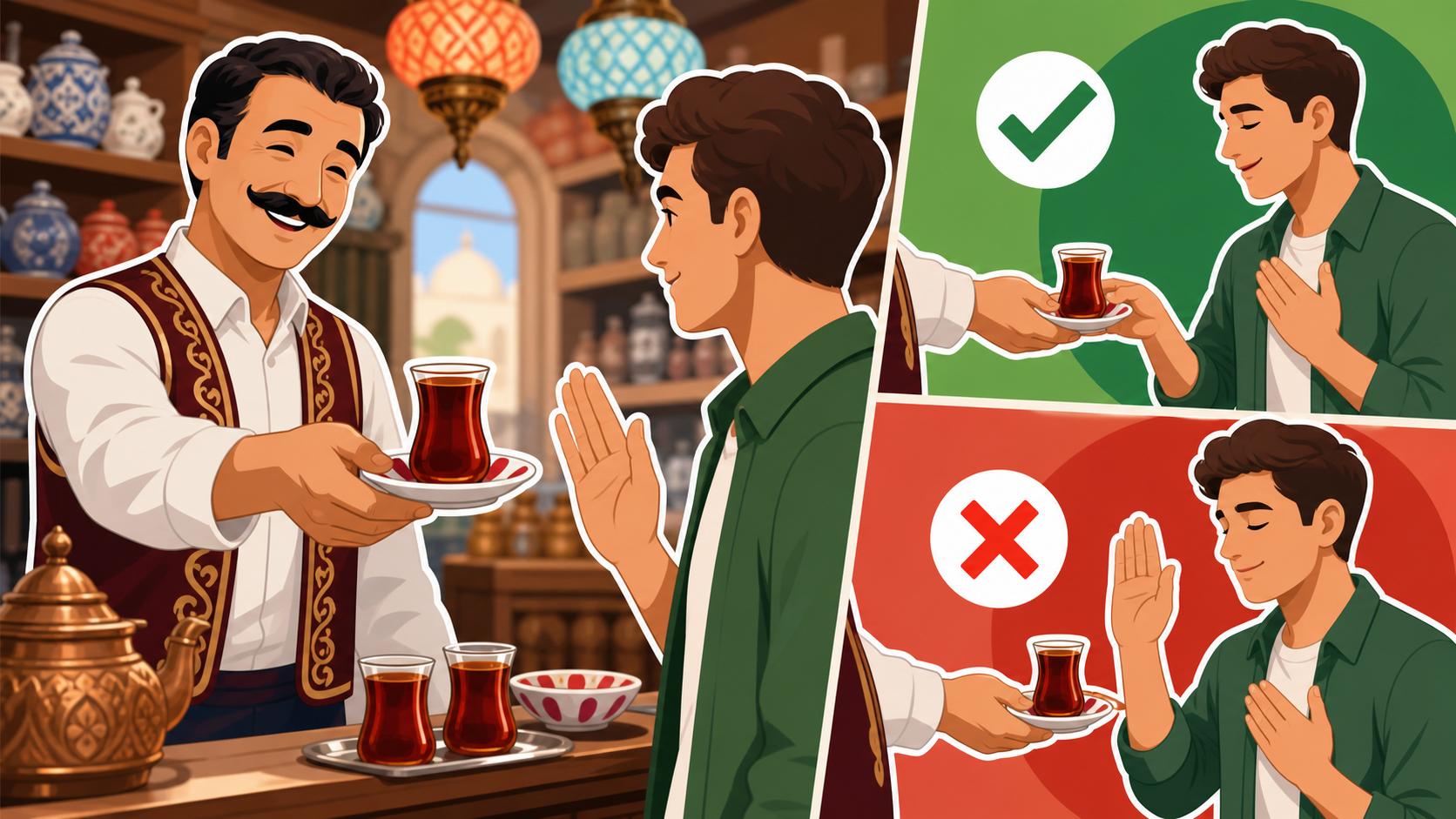
There will be days when you simply cannot drink another drop of tea. Maybe you’ve already had five glasses, or maybe you’re in a genuine rush to catch the ferry. You can refuse, but how you do it matters. A blunt "No" (Hayır) is considered quite cold.
The most common way to refuse is to place your right hand over your heart, smile, and say, "Teşekkür ederim, yeni içtim" (Thank you, I just drank some). This provides a face-saving "excuse"—you aren't refusing their tea; you are simply full. This gesture of hand-to-heart is a universal sign of sincerity in Turkey and goes a long way in softening the refusal.
The Teaspoon Trick: The Universal "I'm Done" Signal
What happens when you’ve accepted the first glass, finished it, and the shopkeeper immediately signals for a second? This is where many expats get stuck in an endless loop of caffeine. In Turkey, an empty glass is an invitation for a refill.
To signal that you have finished and do not want more, place your small teaspoon horizontally across the top of the tulip glass. This is the silent, universal code for "I am satisfied, thank you." If you leave the spoon in the saucer or in the glass, the host will assume you are ready for round two. Using this trick saves you from having to repeatedly say no verbally while you're trying to discuss things like Turkish Dining Culture: Lavish Breakfast Spreads (Kahvaltı) and Late Dinners.
Verbal Scripts for Declining Initial Offers
If you really are in a hurry, use "Başka zamana inşallah" (Another time, God willing). This is the perfect expat "get out of jail free" card. It acknowledges the offer, expresses a desire to participate in the future, and ends the interaction on a hopeful note.
Another useful phrase is "Acelem var" (I am in a hurry). When combined with the hand-on-heart gesture, it is perfectly acceptable. Shopkeepers understand that life in a city like Istanbul or Ankara is hectic. If you’re rushing to an appointment that you booked through A Step-by-Step Guide to Booking MHRS Appointments Without Perfect Turkish, they will understand your haste.
Practical Scenarios: Shops, Bazaars, and Service Centers
Hospitality varies depending on where you are. In the Grand Bazaar (Kapalıçarşı), tea is often used as a tactical tool. If you sit down for tea in a carpet or leather shop, you have entered the "negotiation phase." The shopkeepers there are masters of "The Long Sell." They know that the longer you sit, the more obligated you feel to buy.
In these high-tourist areas, it is perfectly fine to be more firm with your refusals. You can browse without sitting down. However, in a local neighborhood shop, the tea is much more likely to be genuine hospitality. If you’re out shopping for essentials and need to check a translation for a symptom, you might be looking at Essential Turkish Phrases for the Doctor: Communicating Symptoms Effectively while sipping your tea.
Tea at the Notary, Bank, or Real Estate Office
You might be surprised to find that even "stuffy" administrative locations offer tea. If you are at a private bank or a real estate office discussing your "Tapu" (title deed), tea is standard. In these cases, it’s best to accept. It signals that you are a serious client who is willing to take the time to get the details right.
If you are dealing with more stressful situations, like Getting Your Deposit Back: Navigating Move-Out Cleaning Disputes in Turkey, a glass of tea can actually help de-escalate the tension. It’s hard to stay angry at someone when you are both performing the ritual of blowing the steam off a hot glass of çay.
Administrative Hospitality: The Wait is Easier with Tea
In many government-adjacent offices or when Opening a Bank Account in Turkey: Rules for Expats, Tourists, and Investors, the wait times can be unpredictable. When the staff offers you tea, it’s often an unspoken apology for the delay. Accepting it makes the wait more bearable and humanizes the bureaucratic process.
By the end of it, I had consumed four glasses of tea, shared a plate of biscuits with the owner's nephew, and learned about the best place to buy local honey. If I had stayed on my phone the whole time, I would have been frustrated; instead, I felt like I’d had a productive social afternoon. This is the "hidden" benefit of Turkish tea culture—it turns "wasted" time into "social" time.
Final Thoughts on Mastering the Çay Ritual
The next time you’re offered a glass of tea while buying a kilo of oranges or looking at handmade lamps, don’t overthink it. If you have five minutes, sit. Accept the glass, hold it by the rim, and enjoy the rhythm of the street. If you’re done, put the spoon on top. It’s a simple, beautiful system that has survived the rise of Starbucks and the frenetic pace of modern life because it works. It turns strangers into acquaintances and acquaintances into "dostlar" (close friends).
Whether you’re just starting out or you’ve been here for years, embracing the çay ritual is the fastest way to feel like you truly belong in Turkey. It’s not just about the tea; it’s about the "hoş sohbet" (pleasant conversation) that comes with it.
Disclaimer
The information provided in this guide is for cultural educational purposes only. While tea culture is a staple of Turkish hospitality, individual experiences may vary. Always use your best judgment when entering shops or engaging in long negotiations, particularly in high-traffic tourist areas where hospitality can sometimes be used as a sales technique. This guide does not constitute legal or financial advice regarding business transactions in Turkey.