Natural Disasters in Turkey: Earthquake Preparedness and Safety for Expats
Moving to a seismic hotspot like Turkey often feels like a trade-off between breathtaking views and an underlying sense of anxiety. I still remember the first time my tea glass rattled on the table during a minor tremor in Istanbul; it was a sharp wake-up call that I was utterly unprepared for the geological reality of my new home. This guide provides a comprehensive roadmap for earthquake safety, helping you secure your home and protect your family from a veteran expat’s perspective.
Understanding the Seismic Landscape of Turkey
Turkey is geographically unique, sitting atop several major fault lines, most notably the North Anatolian Fault and the East Anatolian Fault. For those of us living here, this isn't just a fun fact from a geography textbook; it's a daily reality that influences where we choose to live and how we set up our apartments. The memory of the 2023 earthquakes is still very much alive in the local psyche, and it has fundamentally changed how the government and residents approach safety.
The Major Fault Lines and Regional Risks
The North Anatolian Fault is perhaps the most famous, running across the top of the country and passing dangerously close to Istanbul. If you are looking at Living in Turkey as a Foreigner: The Ultimate Starter Guide (2027), you must understand that different cities carry different risk profiles. While Istanbul gets the most headlines due to its density, cities like Izmir and those along the eastern border are equally vulnerable to significant tectonic shifts.
When I first arrived, I spent hours looking at seismic maps. It’s important to realize that "risk" doesn’t mean you shouldn't live there, but it should dictate your level of preparedness. For instance, living on the European side of Istanbul often involves different soil types—some more stable than others—compared to the Asian side. Always ask locals about the "zemin," or the ground quality, of a neighborhood before signing a lease.
The History of Turkish Building Codes
Turkey’s building regulations have undergone massive overhauls, specifically after the devastating 1999 Izmit earthquake. This was a turning point that led to the creation of the "Kentsel Dönüşüm" or Urban Transformation projects you see everywhere today. When you see old buildings being torn down to make way for new ones, it’s usually an attempt to bring the housing stock up to modern seismic standards.
The 2018 building code is currently the gold standard. As an expat, you should always inquire about the year a building was constructed. A building finished in 2020 is theoretically much safer than one from 1990 because it was built under stricter supervision and with better materials. It is wise to advise newcomers: do not let a "classic" facade blind you to the structural risks of an unreinforced masonry building.
Dealing with Seismic Anxiety as an Expat
It’s perfectly normal to feel a bit of "quake-brain" when you first move here. Every passing heavy truck that makes the floor vibrate might make your heart skip a beat. I’ve found that the best way to combat this anxiety is through action. Once you have your emergency kit ready and your furniture bolted down, the fear loses its edge because you know you’ve done what you can.
Community support is vital here. Talking to other foreigners who have lived through tremors can help normalize the experience. You might want to look into Expat Support Groups: Managing Isolation and Culture Shock in Turkey to find people who can offer both emotional support and practical local advice on which neighborhoods they feel safest in.
Choosing a Resilient Home and Neighborhood
One of the biggest mistakes I see expats make is prioritizing a sea view over structural safety. I get it—the Bosphorus is beautiful. But in a seismic event, the geological stability of the ground beneath you is far more important than the sunset. You need to be meticulous when selecting your residence, whether you are renting or buying.
Identifying Earthquake-Resistant Structures
When viewing apartments, look for signs of structural health. Are there large, diagonal cracks in the basement columns? Is the building leaning? More importantly, ask for the "Yapı Kayıt Belgesi" or the building's earthquake report. If a landlord or agent gets defensive when you ask about seismic reinforcement, that is your cue to walk away.
For many professionals moving to Istanbul, using a service like Blueground can be a lifesaver. Blueground specializes in high-quality, modern apartments that are often located in newer buildings or those that have undergone rigorous vetting. This takes a lot of the guesswork out of the process, as they tend to manage properties in developments that meet modern safety expectations. Since they cater to an international clientele, they understand the safety standards we expect.
Neighborhood Safety and Soil Composition
The "ground" (zemin) is everything. In Istanbul, for example, neighborhoods like Beşiktaş and Kadıköy have areas with very different soil qualities. Some parts are built on solid rock, while others are on softer, alluvial soil that can amplify shaking. This is why you see some buildings stand perfectly still while others nearby suffer.
Before committing to a long-term stay, check the official AFAD (Disaster and Emergency Management Authority) maps. If you are Renting in Turkey: Lease Contracts, Deposits, and Tenant Rights Explained, try to include a clause or at least have a verbal agreement about the building’s seismic status. I personally prefer the hills of the Asian side, which are known for having more stable rock foundations than some of the reclaimed land areas.
Avoiding "Closed" and High-Risk Zones
The government has recently implemented "closed neighborhoods" for residency, but there are also zones that are informally considered "high risk" due to their proximity to the shoreline or old infrastructure. While these areas might be cheaper, the trade-off in safety isn't worth it. I’ve lived in both old and new buildings, and the peace of mind that comes with a "Deprem Yönetmeliğine Uygun" (Compliant with Earthquake Regulations) certificate is priceless.
If you are Buying Property in Turkey: Understanding Title Deeds (Tapu) and Valuation, your lawyer should verify the seismic reports as part of the due diligence. Never take the seller’s word for it. In my experience, a third-party inspection is the only way to be 100% sure of what you are putting your money—and your life—into.
Mandatory Earthquake Insurance DASK
If you live in Turkey, you will become very familiar with the acronym DASK (Doğal Afet Sigortaları Kurumu). This is the compulsory earthquake insurance that every building must have. You cannot get a water or electricity connection in your name without a valid DASK policy. It’s the law, and honestly, it’s one of the more efficient systems in the Turkish bureaucracy.
What DASK Covers and What It Doesn't
It is a common misconception among expats that DASK will cover everything. It won't. DASK is designed to cover the structural damage to the building itself—the walls, the floors, the stairs. It is meant to ensure that the building can be rebuilt. It does not cover your furniture, your high-end electronics, or your personal belongings. For that, you need "Konut Sigortası" (Private Home Insurance).
I learned this the hard way when a friend’s apartment suffered minor cracks; DASK helped the building management, but his broken TV was his own responsibility. For a deep dive into the costs and specifics, check out Mandatory Earthquake Insurance (DASK): Premium Costs and Coverage Limits. Usually, the premium is quite low, calculated based on the square footage and the age of the building.
How to Renew and Pay Your Policy
Paying for DASK is straightforward. Most people do it through their bank’s mobile app or at the local PTT office. If you are Navigating the PTT Postal System and Private Courier Deliveries (Kargo), you can often handle your insurance renewals at the same time you’re picking up a package. Your landlord is technically responsible for the cost, but in many rental agreements, the tenant pays it and deducts it from the rent, or pays it as a matter of convenience to ensure the utilities stay on.
Always keep a digital copy of your DASK policy on your phone. If there is a major event, the system might be slow, and having your policy number handy will speed up any claims. I keep mine in a dedicated "Turkey Admin" folder in my cloud storage, along with my residence permit and lease.
Private Insurance Upgrades for Expats
Because DASK has a ceiling on its payout, many expats choose to supplement it with private insurance. This is especially true if you have expensive equipment or have invested heavily in furnishing your home. When you look for private policies, make sure they specifically include "earthquake" as a covered peril for contents, as some basic plans might exclude it.
I recommend looking at international providers or major local banks like Is Bankasi or Garanti. They often have English-speaking staff who can explain the "fine print" of the coverage. Having that extra layer of protection means that even if the worst happens, you aren't starting from zero financially.
Preparing Your Earthquake Go-Bag
In Turkey, we call it a "Deprem Çantası." This is not an optional accessory; it is a vital survival tool. In the minutes following a major quake, you may need to evacuate your building quickly, and you won't have time to pack. I keep mine right by the front door, and I’ve taught my kids exactly where it is and how to carry it.
Essential Items for Your Kit
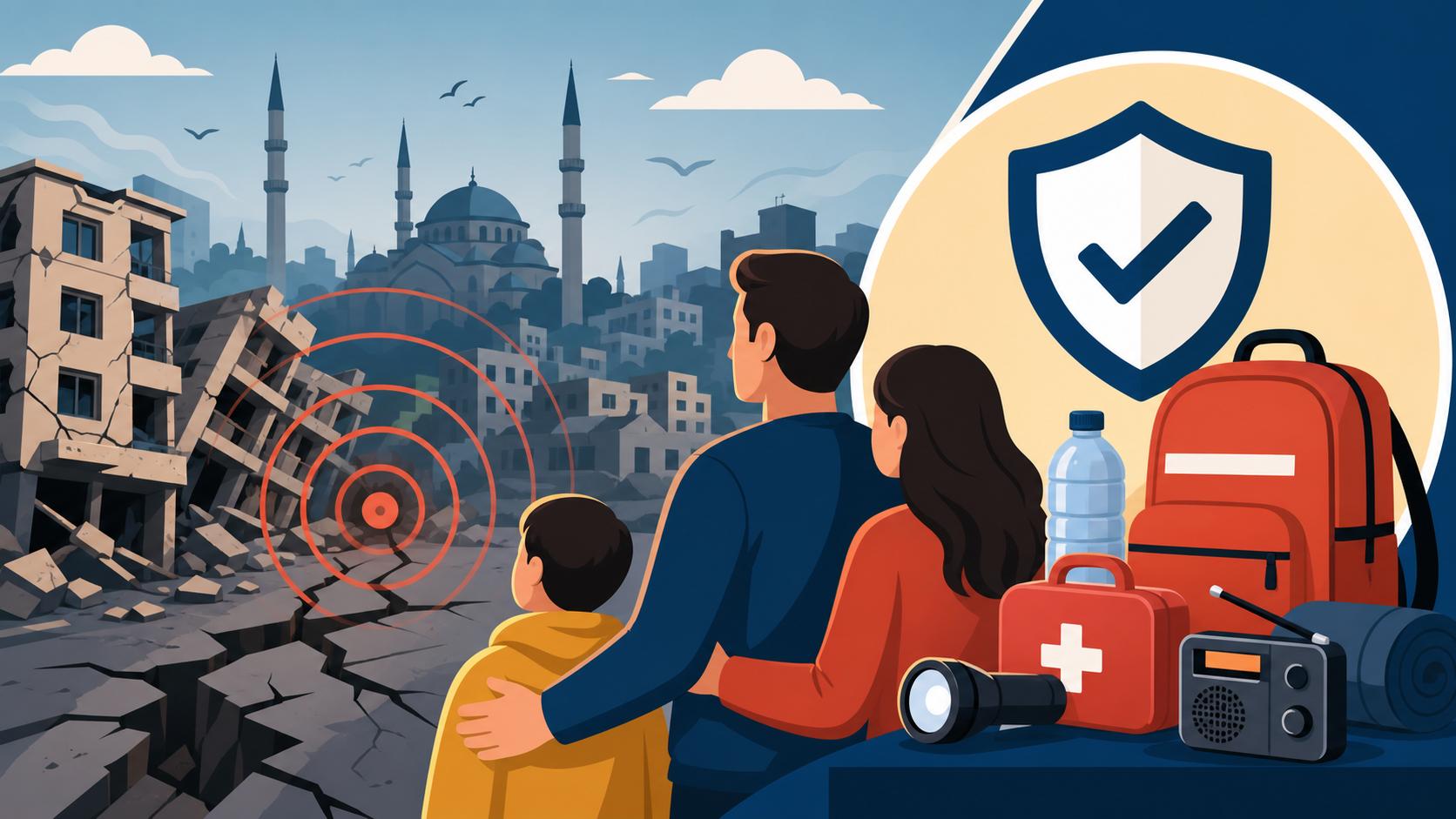
Your bag needs to sustain you for at least 72 hours. This includes water, non-perishable food (think high-calorie protein bars and canned goods with pop-tops), a first aid kit, and a whistle. The whistle is crucial—if you are trapped, shouting will exhaust you, but a whistle can be heard by rescue teams for a long distance.
I highly recommend sourcing your gear from Amazon Turkey. You can find specialized, heavy-duty backpacks and high-quality solar power banks there that might be hard to track down in local shops. I bought my emergency radio and foldable water containers on Amazon Turkey and they’ve held up well during my annual "kit refresh" checks.
| Item Category | Must-Have Items | Replacement Cycle |
|---|---|---|
| Hydration | 3 Liters of water per person, purification tablets | Every 6 months |
| Documents | Passport copies, Ikamet, DASK policy, cash (small bills) | Every year |
| Tools | Whistle, multi-tool, flashlight, heavy-duty gloves | Check batteries monthly |
| Health | Prescription meds, first aid kit, wet wipes, masks | Check expiry dates |
| Tech | Solar power bank, spare charging cables, battery radio | Monthly charge |
Customizing for Your Family and Pets
If you have children or pets, your kit will look different. For my dog, I have a spare leash and a small bag of dry food inside the go-bag. For kids, a small toy or a deck of cards can be a massive help in keeping them calm in a high-stress evacuation center. Don't forget any specific medications you or your family members take daily.
If you have a medical condition, ensure you have a "Sağlık Raporu" or a summary of your health needs translated into Turkish. If you’re unsure how to get one, see Getting a Health Report (Sağlık Raporu) for Work or Driving License Conversions. Having this information ready can be life-saving if you need to access Emergency Medical Care in Turkey: Dialing 112, Ambulances, and Triage during the chaos of a disaster.
Seasonal Adjustments and Maintenance
Turkey has extreme seasons. A go-bag packed for a July heatwave won’t help much if a quake hits in the middle of a snowy January in Ankara. I keep a "winter pouch" near my bag with thermal blankets and extra wool socks that I add to the kit when the temperature drops.
Every six months—I usually do it when the clocks change—I go through the bag. I swap out the water, check the expiration dates on the protein bars, and test the batteries in the flashlights. It’s a 20-minute chore that provides six months of peace of mind.
Digital Safety and Communication Tools
In the immediate aftermath of a disaster, the cellular networks in Turkey often become heavily congested. Everyone tries to call their loved ones at the same time, leading to a "system busy" message that can cause panic. Knowing how to communicate digitally is just as important as having a physical kit.
Using the AFAD Emergency App
The Turkish government has developed a very effective app called "AFAD Acil." Every expat should have this on their phone. It allows you to make emergency calls over the internet if the cellular lines are down, and it has a "one-button" feature to report your location to rescue teams if you are unable to speak.
Make sure you set up the app while you have a stable connection. It requires your Turkish phone number and some basic identification details. For more on how this works, check out Understanding the AFAD Emergency Alert System on Your Mobile Phone. It’s also worth following AFAD on social media, as they provide real-time updates and instructions in multiple languages during emergencies.
Connectivity and Backup Internet
When local networks fail, having a backup can be a game-changer. I always keep an e-sim from Airalo active on my phone with a small data roaming package as a secondary option. Airalo uses different network roaming protocols that can sometimes bypass the local congestion that affects standard Turkish SIM cards. It’s a cheap "insurance policy" for your connectivity.
Additionally, you should know how to use "Güvende Miyim?" (Am I Safe?) features on apps like Facebook or specialized local apps. These send a simple "I am okay" message to your designated contacts without requiring a voice call, which uses significantly less bandwidth. For your home setup, consider Choosing an Internet Provider in Turkey: Fiber vs VDSL (Turk Telekom, Superonline) that offers the most reliable infrastructure in your specific neighborhood.
Pre-Arranging a "Meeting Point"
Don’t rely entirely on technology. My family has a designated meeting point—a large, open park about ten minutes from our apartment. If the phones don't work, we know to head there. Make sure your meeting point is in an "Open Area" (Toplanma Alanı). You can find these marked with green signs throughout Turkish cities, or you can look them up on e-Devlet by searching for "Acil Toplanma Alanı."
Knowing where your local assembly point is located is a core part of being a prepared resident. I suggest walking the route with your family or roommates once so everyone knows exactly where to go, even in the dark or during a power outage.
What to Do During and Immediately After a Quake
The "Drop, Cover, and Hold On" method is the global standard, and it applies here too. However, Turkish homes have specific quirks—like heavy chandeliers and unanchored wardrobes—that you need to be aware of.
Survival Tactics Inside the Home
When the shaking starts, do not run for the stairs or the elevator. This is how many injuries occur in Turkey. Most modern Turkish buildings are designed to stay standing, even if they suffer damage. Your goal is to protect your head and neck. Move away from windows and glass-fronted cabinets.
I’ve spent a weekend bolting my bookshelves and wardrobes to the walls using "L-brackets" I found at the local hardware store. In a country where many apartments have high ceilings and tall furniture, this is a non-negotiable step. If you aren't handy, hire an "Usta" (handyman) to do it for you. It’s a small investment that prevents your furniture from becoming a lethal projectile.
Evacuation Protocols and Gas Safety
Once the shaking stops, your first priority is to turn off the gas. Most Turkish apartments use natural gas for heating and cooking. Locate your gas valve (usually near the entrance or in the kitchen) and make sure you know how to shut it off. Fire is often a greater secondary risk than the quake itself.
Grab your Deprem Çantası and head for the stairs. Never use the elevator, as power cuts are almost guaranteed and you could be trapped. As you exit, check on your neighbors—especially the "Teyzes" and "Amcas" (elderly residents) who might need help navigating the stairs. The sense of community in Turkey is incredible during crises; lean into it.
Navigating the Triage and Rescue Phase
If there is significant damage in your area, you will see AFAD and the "Kızılay" (Red Crescent) setting up tents and aid stations. This can be overwhelming. Knowing where to go for help is vital. If you are injured, remember that Emergency Medical Care in Turkey: Dialing 112, Ambulances, and Triage will be under extreme pressure.
Stay in the designated open areas and wait for official instructions. Avoid spreading rumors or "fake news" from WhatsApp groups—only trust updates from official government channels or reputable news outlets. If you are a foreigner, have your passport or Ikamet ready, as authorities will need to log who has been accounted for.
Long-Term Resilience and Community Support
Recovery from a major natural disaster isn't just about rebuilding walls; it's about the long-term psychological and social well-being of the community. Turkey has a "togetherness" culture (toplumsal dayanışma) that is truly heartening, but as an expat, you may need extra steps to integrate into these support networks.
Engaging with Local Volunteer Groups
After the immediate danger has passed, many people want to help. There are numerous volunteer organizations like AKUT (a search and rescue NGO) that offer training and opportunities to assist. Joining such a group is a fantastic way to give back to your host country and learn valuable skills.
Even if you don't speak perfect Turkish, there are roles for everyone. Engaging in this way helps combat the feeling of helplessness that often follows a disaster. It also ensures you are part of the information loop. You'll find that the "I've-been-there" bond between survivors and volunteers is a powerful way to integrate into the local culture.
Financial Recovery and Resources
If your home is damaged, the process of claiming DASK and private insurance begins. This can be a bureaucratic marathon. You will likely need to deal with adjusters and provide documentation of the damage. This is where having those digital copies of your policies and photos of your apartment "before" the event becomes essential.
For those who have lost their homes or need to move quickly, services like Blueground can again be useful for finding immediate, safe, and fully equipped housing while you wait for your permanent situation to be resolved. They offer the flexibility that standard 12-month leases often lack, which is a godsend during a transition period.
Maintaining Preparedness as a Way of Life
Earthquake preparedness in Turkey isn't a "one and done" task. It’s a lifestyle. Every time you buy a new piece of furniture, you should think about where it goes and how it's anchored. Every time you move apartments, you should check the seismic maps and the building's age.
By making these habits part of your routine, you can enjoy everything Turkey has to offer—the history, the hospitality, and the incredible landscapes—without the constant shadow of "what if." Stay informed, stay prepared, and remember that you are part of a resilient, vibrant community that has faced these challenges for millennia.
Disclaimer
This guide is intended for informational purposes only and does not constitute professional engineering, legal, or medical advice. Earthquake risks and building safety standards can vary significantly by region and specific property. Always consult with certified structural engineers, local authorities (AFAD), and your insurance provider to ensure your specific situation is addressed according to the latest Turkish laws and safety regulations. The author and publisher are not responsible for any loss or injury resulting from the use of this information.