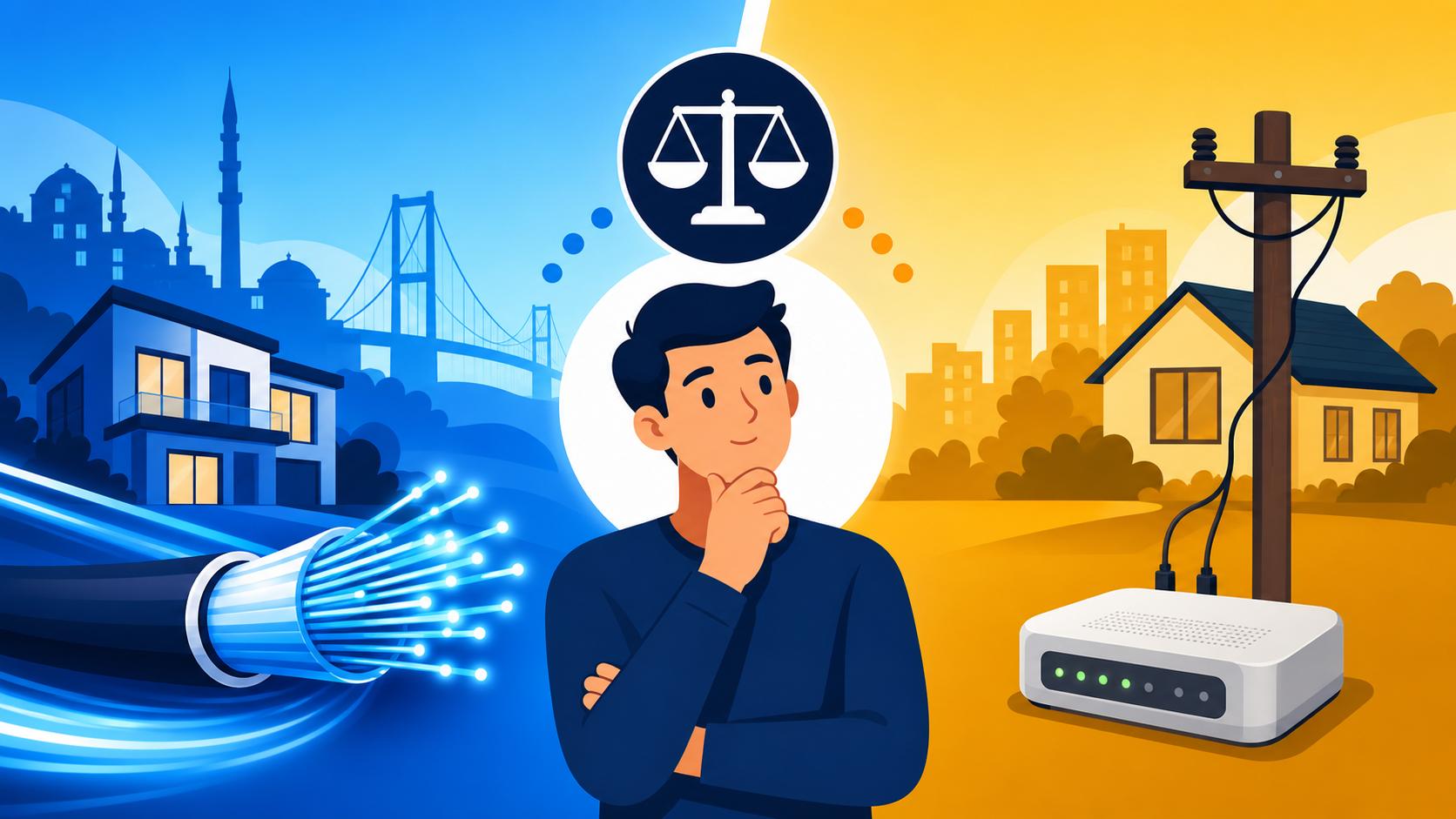
Choosing an Internet Provider in Turkey: Fiber vs VDSL (Turk Telekom, Superonline)
Moving into a new apartment in Istanbul or Antalya only to find out your "high-speed" connection is actually a relic from the early 2000s is a rite of passage for many expats. I've spent more hours than I care to admit sitting on a floor in an empty flat, staring at a blinking red LOS light on a router while a call center agent tells me my infrastructure is "perfectly fine." This guide will save you that headache and help you navigate the confusing world of Turkish ISPs.
Understanding the Turkish Broadband Landscape
When you first start looking for an internet connection, you will realize that the market is dominated by a few massive players, but the underlying wires are almost always owned by one of two entities. Turk Telekom owns the vast majority of the copper and fiber lines across the country. If you are moving into an older building, you are likely relying on their legacy infrastructure. On the other hand, Turkcell Superonline has spent the last decade laying its own independent fiber-optic cables, creating a secondary network that often outperforms the state-owned lines.
The distinction between who owns the wire and who sells you the service is vital. You can buy a plan from a boutique provider like TurkNet or Millenicom, but they are often "reselling" Turk Telekom's lines. If the physical wire in the street breaks, these smaller companies have to wait for Turk Telekom technicians to fix it, which can lead to frustrating delays. This is one of the many reasons why Living in Turkey as a Foreigner: The Ultimate Starter Guide (2027) emphasizes the importance of checking your specific building's infrastructure before you even sign a rental contract.
Fiber vs VDSL: Why Distance to the Cabinet Matters
If you have the choice, you always want Fiber (Fiber Optik). In Turkey, Fiber comes in two main flavors: FTTH (Fiber to the Home) and FTTB (Fiber to the Building). FTTH is the gold standard; a thin glass cable comes directly into your living room and plugs into a small box called a GPON. This gives you symmetrical or near-symmetrical speeds and incredible stability. FTTB usually means the fiber ends in the basement, and the rest of the journey to your apartment is over older copper wires, which can slightly degrade the speed.
VDSL (Very-high-bit-rate Digital Subscriber Line) is what most people in older central neighborhoods like Cihangir or Kadıköy end up with. It uses the old telephone lines. The speed you get with VDSL is entirely dependent on how close your building is to the "cabinet"—those grey boxes you see on street corners. If you are 50 meters away, you might get a crisp 100 Mbps. If you are 400 meters away, you’ll be lucky to see 24 Mbps. When looking at apartments on Navigating Sahibinden.com Safely for Apartment Rentals and Second-Hand Goods, always ask the agent to do an "altyapı sorgulama" (infrastructure check) for that specific door number.
Infrastructure Checks: How to See What is Available
Before you commit to a provider, you must perform your own independent check. Both Turk Telekom and Superonline have portals on their websites where you enter your province, district, neighborhood, and specific building number. It will tell you the maximum speed supported. Do not take a salesperson’s word for it over the phone; they are notorious for promising "Fiber" when they actually mean "High-speed VDSL."
If you find yourself in a situation where the infrastructure is poor or the wait time for installation is weeks away, you need a backup plan. We recommend using Airalo to get a local data eSIM immediately upon arrival. It allows you to stay connected for work and navigation while you battle the local ISP's schedule. It’s also worth considering premium managed housing like Blueground if you are a digital nomad, as they typically have high-speed business-grade fiber pre-installed, saving you the administrative nightmare of setting it up yourself.
Deep Dive into Top Providers
Choosing between the big two—Turk Telekom and Superonline—is often less about brand loyalty and more about who has the better box in your basement. However, each has a distinct corporate culture and service level that will affect your daily life. It is also important to consider the Cost of Living in Turkey 2026: Detailed Budgets for Singles and Families when choosing a plan, as prices have shifted significantly with inflation, and lock-in contracts (taahhüt) are now more critical than ever.
Turk Telekom: The Ubiquitous Giant
Turk Telekom is the "default" choice. Because they own the legacy copper network, they are available in virtually every corner of Turkey, from the peaks of the Black Sea mountains to the smallest village in Central Anatolia. Their service is generally reliable, and their fiber network (branded as "TT FIBER") is expanding rapidly. The main advantage of Turk Telekom is that if something goes wrong with the physical line, their technicians are the ones with the tools to fix it.
The downside is the bureaucracy. Dealing with Turk Telekom customer service can be a test of patience if you don't speak Turkish. While they have English-speaking lines, they aren't always available. Furthermore, their hardware (the routers they provide) is often subpar. I usually head straight to Amazon Turkey to buy a high-quality Wi-Fi 6 router or a mesh system to bypass the weak signal of the free ISP modem. This ensures my connection actually reaches every room in my Turkish stone-walled apartment.
Turkcell Superonline: The King of Independent Fiber
If your building has a Superonline fiber box, you should almost certainly choose them. Their network is independent of the old phone lines and is built for modern internet usage. They offer some of the highest residential speeds in the country, with 1 Gbps plans becoming increasingly common in major cities. Their customer service is generally considered slightly more "modern" and responsive than Turk Telekom's, and their mobile app is quite intuitive for paying bills and tracking usage.
However, Superonline is famous for its "walled garden" approach. They make it very difficult to use your own router because they use specific authentication protocols that are locked to their hardware. If you are a power user who needs complex port forwarding or custom DNS settings, you might find their provided Huawei or ZTE modems frustratingly limited. Still, for the average expat who just wants to stream 4K video without buffering, Superonline is usually the superior choice.
Alternative ISPs: TurkNet and Millenicom
For those who hate the idea of a 24-month contract, TurkNet is the darling of the expat and tech community. They were one of the first to offer a "no contract" (taahhütsüz) model. You pay month-to-month, and if you aren't happy, you leave. They also offer a "single price" model where they give you the maximum speed your line can handle for one flat fee. Their "GigaFiber" project is also laying independent fiber in select neighborhoods, offering symmetrical 1,000 Mbps speeds at incredibly low prices.
Millenicom is another strong contender, often acting as a bridge for those who want to use the Turk Telekom or Superonline infrastructure but want better digital-first customer service. These "alternative" providers are great, but a word of warning: they rarely have physical storefronts. Everything is handled via an app or phone. If you are the type of person who prefers walking into a shop to complain when the internet goes out, stick with the big two.
Navigating the Setup Process
The administrative hurdle of getting internet in Turkey is where most expats lose their cool. Unlike many Western countries where you can simply order a "self-install" kit, Turkish ISPs almost always require a technician visit. This process is deeply tied to your legal status in the country, which is why Turkish Residence Permits (Ikamet): The Complete Application Guide (2027) is the most important document you will need to get through this.
Required Documents and the Resident Permit Hurdle
To sign a contract with a major ISP, you typically need a Foreigner ID Number (starting with 99). If you are a brand new arrival and haven't received your card yet, you might find it impossible to sign a long-term contract. Some providers will allow you to sign up with just a passport, but they will often charge a much higher "non-resident" deposit or require you to pay for several months in advance.
Once you have your ID, you will also need to provide a copy of your rental agreement or a utility bill in your name. This is part of the government's effort to ensure every internet line is tied to a verified address. If you are still in the process of Using e-Devlet to Register Your Address at the Local Nüfus Directorate, you should prioritize this, as the ISP's system often cross-references the national address database. If your address isn't "active" in the system, the ISP order might get stuck in a digital limbo.
Understanding the Contract Trap
In Turkey, the "Taahhüt" (commitment) is king. Most ISPs will offer you a "discounted" rate if you sign a 12 or 24-month contract. With the current economic climate and inflation, these contracts are actually a massive advantage for the consumer. By locking in a price today, you are shielded from the price hikes that usually happen every 6 months.
However, the penalty for breaking these contracts can be steep. If you have to leave Turkey unexpectedly, you will be asked to pay back all the "discounts" you received since the start of the contract. This is why many nomads prefer staying in a Blueground apartment where the utilities are included in the rent, or they rely on Airalo data packages if they only plan to stay for a few months. Always read the fine print about "iptal bedeli" (cancellation fee) before you sign.
The Installation Visit: Expectation vs. Reality
Once you sign the paperwork, you will get a text message with an installation date. In my experience, these dates are "suggestions." The technician might show up three hours early or two days late. It is highly recommended to have a Turkish-speaking friend with you on installation day. The technician needs to find the "ankastre" (the distribution box) in your building, and if it’s not labeled properly, they might just leave and report "infrastructure not found."
When the technician arrives, make sure they actually test the speed in your presence. Don't let them leave until you see the "Connected" status on your own device. Also, be aware that the "free" modem they give you is often refurbished. If it looks beaten up, politely ask for a newer model. If the Wi-Fi signal is weak, don't waste time complaining to them; just go on Amazon Turkey and order a decent set of powerline adapters or a mesh Wi-Fi system to fix the problem yourself.
Costs, Equipment, and Hidden Fees
Budgeting for internet in Turkey requires looking beyond the monthly subscription fee. There are several one-time costs and recurring hidden fees that can catch a newcomer off guard. This is especially true when you are trying to manage your Healthcare Budgeting: Understanding Copays, Tariffs, and Billing in Turkey alongside your general household expenses.
Fiber Modem Fees and Activation Costs
Most Fiber plans include a "modem usage fee" (modem kullanım ücreti). You don't actually own the modem; you are essentially renting it from the ISP. This fee is usually baked into the monthly price, but if you look at your itemized bill on e-Devlet, you will see it listed separately. When you cancel your service, you must return this modem to a designated service center, or you will be hit with a massive "unreturned equipment" fine.
Activation and installation fees are also common. Sometimes these are waived as part of a promotion, but more often, they are spread out over the first 6 months of your bill. Expect to pay anywhere from 300 to 800 TL for the initial setup. If you are moving into a building that has never had an internet connection before, there might also be a "connection fee" for pulling the wire from the street to your apartment.
Aidat and Building Wiring Issues
A common frustration for expats is finding out that while the ISP has "Fiber" in the street, the wiring inside the building is old and broken. In Turkey, the ISP is only responsible for the wire up to the building's entrance. The wiring from the basement to your apartment is technically the responsibility of the building management (Yönetim).
If your internal wiring is faulty, you may have to hire a private electrician to pull a new Cat6 or Fiber cable through the building’s conduits. This can be a sensitive issue with neighbors, so it's best to check the rules regarding Understanding 'Aidat': Apartment Complex Maintenance and Pool Fees to see if the building has a preferred technician or if such repairs are covered by the communal fund.
Managing Your Connection and Troubleshooting
Once your internet is up and running, you need to know how to manage it. Turkey's internet is subject to certain regional filters and occasional "throttling" during major national events or emergencies. To maintain a truly open connection, many expats use a high-quality VPN. This is also helpful for accessing streaming services from back home that might be geo-blocked in Turkey.
| Provider | Best For | Typical Speeds | Contract Type |
|---|---|---|---|
| Turk Telekom | National coverage, reliability | 24 – 1000 Mbps | 12/24 Months |
| Superonline | High-speed Fiber, modern app | 100 – 1000 Mbps | 12/24 Months |
| TurkNet | No contracts, power users | Up to 1000 Mbps | Month-to-Month |
| Millenicom | Budget-friendly, easy setup | 35 – 100 Mbps | Flexible |
| Airalo (eSIM) | Emergency backup, new arrivals | 4G/5G Speeds | Prepaid / Data-only |
Moving House: The Nakil Process
If you decide to move to a different neighborhood, you don't necessarily have to cancel your contract. You can request a "Nakil" (transfer). You tell the ISP your new address, and they send a technician to set up the connection there. However, be warned: if your new building doesn't support the same speed as your old one (e.g., moving from a Fiber building to a VDSL building), you might be forced to downgrade your speed while keeping the same monthly payment.
Always check the infrastructure of your new home before you sign a lease. If you are moving to a neighborhood that has "closed" status for foreigners, you may also face challenges with address registration, which can interfere with your utility accounts. Refer to the Navigating Closed Neighborhoods: A Guide to Areas Where Foreigners Cannot Register list to ensure your move won't trigger an administrative nightmare that ends with your internet being cut off because your residency address doesn't match your service address.
Final Recommendations for Expats
If you are just arriving, don't rush into a 24-month contract on your first day. Use an Airalo eSIM to get through the first week. If you have the budget, staying in a Blueground unit for your first month gives you the "soft landing" of having pro-grade internet already working while you scout neighborhoods. Once you find your permanent home, do a physical infrastructure check on the Turk Telekom and Superonline websites using the exact door number.
For those who value speed above all else, Superonline Fiber is the gold standard. For those who want flexibility and no "hidden" contract terms, TurkNet is the way to go. Regardless of who you choose, remember that the hardware provided by Turkish ISPs is often the weakest link. Investing in a high-quality router from Amazon Turkey will solve 90% of the "slow internet" complaints you see in expat Facebook groups. Stay patient, keep your The Turkey IMEI Rule: How to Register Foreign Phones in 2026 in mind if you're using mobile hotspots, and you'll be connected in no time.
Disclaimer
This guide is intended for informational purposes only. Internet infrastructure, ISP pricing, and government regulations in Turkey are subject to frequent changes due to economic conditions and legislative updates. Always verify current terms and conditions directly with the service providers or a qualified legal professional before signing binding contracts.