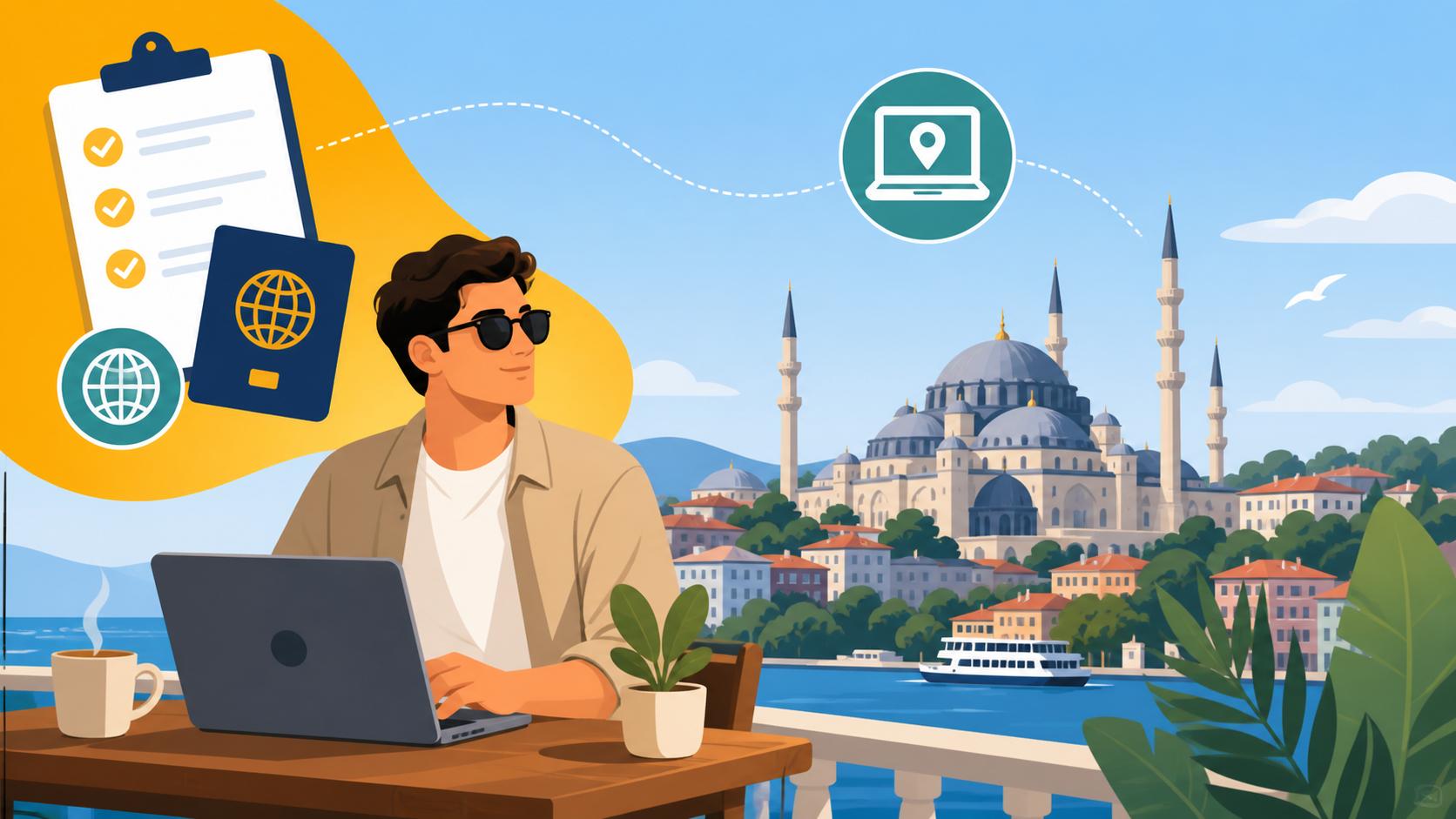
Digital Nomad Visa Turkey (2027): Full Requirements and Application Guide
For years, the "digital nomad" life in Turkey was a gray area of visa runs and prayer that your touristic permit wouldn't be rejected. I’ve spent countless hours sitting in crowded immigration offices, clutching a folder of documents and wondering if my remote job would be enough to let me stay in the country I’d fallen in love with. This guide finally provides the clarity we’ve all been waiting for regarding the official Digital Nomad Visa Turkey (2027): Full Requirements and Application Guide.
Understanding the Turkish Digital Nomad Visa
The landscape for remote workers in Turkey has shifted dramatically over the last few years. Historically, many of us relied on the "Short-Term Touristic Residence Permit," which was essentially a catch-all for anyone who didn't fit into a specific category like student or worker. However, as the government tightened regulations, those touristic permits became increasingly difficult to obtain or renew, especially in popular hubs like Istanbul or Antalya. The introduction of a dedicated visa for remote workers was a direct response to the global nomad trend, recognizing that people who earn their income from abroad contribute significantly to the local economy without taking jobs from Turkish citizens.
If you are a remote employee, a freelancer with a stable client base, or a business owner who can operate entirely online, this visa is designed specifically for you. It bridges the gap between being a temporary visitor and a fully-fledged resident with a work permit. Unlike a traditional work permit, which requires a Turkish employer to sponsor you and navigate the complex 5-to-1 hiring ratio, the nomad visa focuses entirely on your ability to support yourself through foreign-earned income. It is a liberating path, but one that comes with its own set of bureaucratic hurdles that I have learned to navigate through trial and error.
In 2026, the Turkish government has streamlined this process through a two-stage system: an initial digital certificate followed by a formal residency application. This structure is intended to filter out those who don’t truly meet the income or professional criteria before they ever set foot in a Migration Office (Göç İdaresi). While it might seem like more paperwork, it actually saves you the heartache of moving your entire life only to have your residence permit denied a month later. Understanding this evolution is the first step in planning your long-term stay in Turkey.
The Evolution from Tourist Permits to Specific Nomad Visas
I remember the "wild west" days of the early 2020s when you could simply show a bank statement with a few thousand dollars and get a two-year residency card. Those days are long gone. The Ministry of Interior began to realize that the "touristic" category was being overused, leading to the "closed neighborhoods" policy and a wave of rejections that left many expats stranded. The nomad visa was born out of a need for a more structured, legal pathway for high-value residents who bring foreign currency into the country.
The 2026 version of this visa is much more robust than the pilot programs of previous years. It now integrates directly with the Turkish Residence Permits (Ikamet): The Complete Application Guide (2027) framework, ensuring that once you are approved as a nomad, your rights and responsibilities are clearly defined. You aren't just a "tourist who works"; you are a recognized legal resident with a specific status. This shift has also improved how landlords and banks view us, as a dedicated visa provides a level of legitimacy that a simple tourist permit never could.
Furthermore, the government has integrated the application with the GoTürkiye portal, making the initial "Digital Nomad Identification Certificate" a mandatory prerequisite. This certificate acts as your golden ticket. Without it, the immigration officers at the Göç İdaresi won't even look at your remote work contract. It’s a way of pre-vetting applicants, and while it adds a step, it significantly increases the approval rate for the final residence permit stage.
Who is it For? Eligibility Basics
Eligibility for the Turkish Digital Nomad Visa is strictly defined in 2026. You must be between the ages of 21 and 55. This age bracket was chosen to target the most active demographic of the global remote workforce. If you fall outside this range, you may still be able to stay in Turkey through other means, such as the Real Estate Residence Permits: Understanding the Strict USD 200,000 Tapu Rule, but for the nomad-specific route, these age limits are firm.
Beyond age, the most critical factor is your professional status. You must be able to prove that you are either an employee of a company located outside of Turkey or a self-employed individual with contracts from foreign clients. The key is that your income must not originate from within Turkey. If you start taking on Turkish clients and getting paid in Lira to a local account without a traditional work permit, you are technically violating the terms of your residency. This visa is for those of us who are "exporting" our services while living in the country.
Finally, you must hold a university degree or an equivalent professional certificate. Turkey is looking to attract "knowledge workers"—IT specialists, writers, graphic designers, consultants, and tech entrepreneurs. During the application process, you will need to provide proof of your educational background. Applicants can get stuck if their diplomas are not apostilled or translated, so keep in mind that "basic" isn't enough; you need to prove your professional standing.
Why the $36k Income Rule is a Game-Changer
In the past, the "sufficient funds" requirement was a moving target. Some officers wanted to see $500 a month, others wanted $2,000. For 2026, the government has set a clear, non-negotiable threshold: $3,000 USD per month, or an annual income of $36,000 USD. This might seem high compared to the local minimum wage, but it is a strategic move to ensure that nomads can easily afford the rising Cost of Living in Turkey 2026: Detailed Budgets for Singles and Families without putting a strain on local social services.
This rule is a game-changer because it provides a clear benchmark. If you earn $2,900, you will likely be rejected. If you earn $3,100, you are in the clear. This transparency is something I wish we had years ago. It allows you to plan your finances with precision. However, proving this income is where many expats stumble. You cannot just show a screenshot of your bank balance; you need signed, stamped, and often apostilled proof of your monthly earnings from your employer or clients.
The $36,000 annual requirement also reflects the reality of Turkey’s inflation and the fluctuating value of the Lira. By requiring a relatively high USD income, the government ensures that nomads remain "recession-proof" in the eyes of the local economy. This income level also makes it much easier when you go to Opening a Bank Account in Turkey: Rules for Expats, Tourists, and Investors, as banks are much more willing to work with foreigners who can prove a steady, high-volume inflow of foreign currency.
The Core Requirements: Do You Qualify?
Before you start packing your bags for a seaside villa in Kaş, we need to dive into the technicalities of the requirements. The Turkish government doesn't just want to know that you have a job; they want to see a specific paper trail. Many applicants go through this, and the most common reason for a "red paper" (rejection notice) is a lack of proper documentation. You need to treat this application with the same seriousness as a mortgage application in your home country.
The first thing to understand is that the requirements are split into three buckets: professional, financial, and national. Turkey has limited this visa to specific nationalities for now. This isn't a "global" visa in the sense that anyone can apply; it’s a strategic partnership with 36 specific countries. If your passport isn't on the list, you’ll need to look at other residency options. It’s frustrating. Many remote workers from countries not on the list have to leave—but for now, these are the rules.
Additionally, the documentation must be "official." In Turkey, a simple signature often isn't enough. Many documents need to be notarized and apostilled in the country where they were issued. If you are already in Turkey, this can be a nightmare to handle via mail or through your embassy. My advice? Get everything ready before you leave your home country. It will save you weeks of stress and expensive courier fees later on.
The GoTürkiye Identification Certificate: The First Hurdle
The GoTürkiye Identification Certificate is a relatively new requirement for 2026. Think of it as a pre-screening. You apply for this certificate through the official GoTürkiye web portal before you even touch the immigration system. You’ll need to upload your passport, a biometric photo, your university degree, and your employment contract. The portal is designed to be user-friendly, but it can be finicky. I recommend using a desktop browser and ensuring all your files are in the exact PDF or JPEG format requested.
The most important part of this stage is your employment contract or "Service Agreement." This document must clearly state your role, the fact that you work remotely, and your monthly salary. If you are a freelancer, you may need to provide a collection of contracts or a formal letter from a long-term client. The reviewers are looking for stability. They want to see that your income isn't going to vanish the moment you arrive in Istanbul.
Once submitted, the processing time for the certificate is usually between 1 to 4 weeks. If approved, you receive a digital certificate with a QR code. This certificate is what allows you to proceed to the next stage of the visa application. I’ve found that using tools like TurkishPod101 to learn basic administrative vocabulary can really help if you ever need to follow up with a government office regarding your status, as English support can sometimes be hit-or-miss during the peak application seasons.
Eligible Nationalities: The 36 Countries List
Not everyone can apply for this specific visa. As of 2026, the program is open to citizens of 36 countries, primarily including most of the EU, the USA, Canada, the UK, and several other strategic partners. You should verify the exact updated list on the official portal, but a good rule of thumb is that if your country has a strong diplomatic and trade relationship with Turkey, you are likely eligible. For more details, see the specific guide on Digital Nomad Visa: Exactly Which 36 National Passports are Eligible?.
If you hold dual citizenship, use the passport that is on the list. I had a friend who tried to apply with his secondary passport that wasn't eligible, even though his primary one was, simply because he had entered Turkey on the "wrong" one. Don't make that mistake. Your entry stamp, your e-visa (if applicable), and your nomad application must all be tied to the same eligible passport.
If your country is not on the list, don't lose hope. Turkey is constantly expanding these programs. In the meantime, you might explore other residency routes or look into the Digital Nomad Visa Turkey (2027): Full Requirements and Application Guide updates that happen quarterly. The 36-country limit is partially about managing the volume of applicants and ensuring that the reciprocal tax and legal agreements are in place between Turkey and the respective nations.
Income Verification and the $3,000 Monthly Threshold
Let's talk about the money. The $3,000 monthly requirement is the part that catches most people off guard. It is not enough to have $36,000 in a savings account. The authorities want to see that you are earning at least $3,000 every single month. They will ask for bank statements showing the incoming transfers from your employer or clients for the last 3 to 6 months. They are looking for a consistent pattern of income.
If your income fluctuates—say you earn $2,500 one month and $4,000 the next—it is best to provide a year's worth of statements to show that your average meets the requirement. You should also be prepared to explain any large gaps. One trick I’ve learned is to have your bank or your company's HR department write a formal letter on letterhead, stating your monthly salary in USD or EUR. In the eyes of a Turkish official, a stamped letter often carries more weight than a raw bank statement printout.
Remember that this income must be "clean." By that, I mean it should clearly come from a business or employment source. If you’re living off of stock dividends or rental income from back home, the nomad visa might not be the right fit; you might be better off applying for a standard residency based on "financial independence." The nomad visa is specifically for those who are actively working. If you're looking for help with the financial jargon, TurkishPod101 has some great lessons on business and banking terms that can help you understand your bank's local requirements.
Step-by-Step Application Process via the Digital Portal
Once you have your GoTürkiye Identification Certificate in hand, the real work begins. You are now moving from the "tourism" side of things into the "immigration" side. This is the stage where you actually apply for your residence permit (Ikamet). The process is primarily digital, but it always ends with an in-person appointment. This is the part that stresses people out the most, but if you have your documents in order, it’s mostly just a waiting game.
The digital portal for the residence permit is called the e-Ikamet system. It’s a separate website from the GoTürkiye portal. You’ll need to create a new application, select "Short-Term Residence Permit," and then choose the specific sub-category for Digital Nomads. The system will ask for a lot of the same information you already provided for your certificate, but you’ll also need to add local details like your Turkish address and your local health insurance policy.
One thing I cannot stress enough: do not wait until the last minute. If your tourist visa or e-visa is about to expire, get your application submitted online immediately. Once you have a "reservation" or appointment date from the e-Ikamet system, your stay in Turkey becomes legal until the date of your appointment, even if your initial 90 days run out. This is a life-saver for those of us who arrived and fell in love with a city and decided to stay at the 11th hour.
Navigating the GoTürkiye Portal for the Certificate
The GoTürkiye portal is your first stop. You’ll need to upload a scan of your passport's information page and your university diploma. If your diploma isn't in English or Turkish, you will need a sworn translation. I highly recommend getting a digital version of your diploma apostilled if possible, as this is becoming a standard requirement for all "professional" visas in Turkey.
The portal also requires a "Service Agreement" or "Employment Contract." If you are a freelancer, this can be tricky. You may need to provide a formal "Statement of Work" or a long-term contract that proves your engagement for the duration of the visa (usually one year). Make sure the document includes your name, the company name, your monthly pay, and the fact that the work is performed remotely.
After you click submit, you’ll get a tracking number. Check it daily. Sometimes they will ask for additional documents via email, and they usually give you a very short window to respond. Once the certificate is issued, download and print several copies. You’ll need one for your physical file and one to keep with your passport as you travel.
Transitioning to the e-Ikamet System
With your certificate QR code ready, head over to the e-Ikamet website. This is where the process gets "official." You will fill out a long form that asks for your parents' names, your local address, and your insurance details. For the address, you must have a valid rental contract. Be very careful here—some neighborhoods are "closed" to foreigners. If you try to register in one of these areas, your application will be rejected instantly. Check the guide on Navigating Closed Neighborhoods: A Guide to Areas Where Foreigners Cannot Register before you sign any lease.
You will also need to pay two fees: the "card fee" and the "residence fee." In 2026, you can usually pay these online using a Turkish credit card or at a local Ziraat Bank or tax office (Vergi Dairesi) using your tax ID. Always keep the original "paid" receipts with the red stamp. These are mandatory for your appointment.
While filling out the e-Ikamet form, you will be asked to choose an appointment date. In big cities like Istanbul, these dates can be weeks or even months away. Don't worry—as long as you have that appointment paper, you are legally allowed to stay in the country. Just make sure you don't leave Turkey for more than 15 days while your application is pending, or you might void the whole process.
The Biometric Appointment at Göç İdaresi
The final step is the "Randevu" (appointment). This is where you take your thick folder of documents to the Migration Office. You’ll need your GoTürkiye certificate, the e-Ikamet application form, your passport and copies, four biometric photos (exactly 5x6cm with a white background), your insurance policy, and your notarized rental contract. If you’ve been studying with TurkishPod101, now is the time to use those polite greetings. A "Kolay Gelsin" (may it be easy for you) goes a long way with the officers.
At the appointment, the officer will review your documents, take your fingerprints, and likely ask a few basic questions about your work. They aren't looking to catch you out; they just want to make sure everything matches. If everything is in order, they will give you a "proof of application" document (Müracaat Belgesi). This paper acts as your temporary ID until your physical card arrives in the mail.
Your card will be sent via PTT (the Turkish postal service) to your registered address within 2 to 4 weeks. Make sure your name is clearly written on your doorbell or mailbox, or the postman might return it to the office, causing another month of delays. Once you have that card, you are officially a digital nomad resident of Turkey!
Financial and Legal Logistics
Living in Turkey as a nomad is more than just getting the visa; it’s about managing your life in a way that keeps you on the right side of the law. One of the biggest mistakes I see nomads make is ignoring the financial and legal "fine print." Turkey has very specific rules about how long you can stay before you become a tax resident, and how you manage your money can affect your future visa renewals.
You also need to think about your local footprint. Getting a local phone number, a bank account, and a tax ID are all essential steps that happen after you apply for the visa but before you are fully settled. It can feel like a lot of "admin days," but once it's done, you can enjoy the 1,000 Mbps fiber internet and the incredible food without a care in the world.
Let's break down the three most critical logistics: taxes, banking, and health care. These are the pillars of a sustainable nomad life. If you ignore them, you might find yourself with a blocked bank account or a surprise tax bill that ruins your budget.
Tax Residency and the 183-Day Rule
The "183-day rule" is the international standard, and Turkey follows it strictly. If you spend more than 183 days in Turkey during a single calendar year, you are technically considered a tax resident. This means Turkey may have the right to tax your worldwide income. However, Turkey has double-taxation treaties with many of the countries on the eligible 36-country list. This means you generally won't pay tax on the same income twice.
For most nomads, the goal is to remain a tax resident of their home country while living in Turkey. You’ll need to keep careful track of your entry and exit dates. If you do cross the 183-day threshold, I highly recommend consulting with a local accountant (Mali Müşavir). They can help you navigate the "Stopaj" (withholding tax) system and ensure you are compliant. For more on the local financial landscape, check out Money in Turkey for Expats: Banking, Payments, and Finance Guide (2027).
The 2026 nomad visa is designed to be "tax-friendly," but it is not a tax-free haven. You are still responsible for your social security contributions in your home country or through a private scheme. I always tell people to keep at least 20% of their income in a separate "tax and emergency" fund just in case the rules shift or you decide to stay long-term and transition to a different permit.
Banking for Nomads: Wise, Local Accounts, and Currency
While you can survive on international cards like Revolut or Wise for a while, you will eventually need a local bank account to pay for things like your utilities, your Health Insurance in Turkey: SGK Public System vs Private Coverage Explained, or your rent. Most Turkish landlords will only accept rent via bank transfer (it's the law), and many utility companies require a local account for automatic payments.
Opening a bank account as a foreigner can be a bit of a "quest." Some branches will tell you it's impossible without a work permit, while the branch across the street will do it in ten minutes. Bringing a friend who speaks Turkish or using phrases from TurkishPod101 to explain that you have a residence permit can make a huge difference. I recommend banks like Ziraat (state-owned and everywhere), İş Bank, or Garanti BBVA (very expat-friendly apps).
One pro-tip: always keep your money in a USD or EUR sub-account within your Turkish bank. The Lira is volatile, and you don’t want your $3,000 monthly income to lose value while sitting in your checking account. You can exchange small amounts of Lira as you need them through the bank's mobile app. It’s the safest way to manage your finances while living on the Mediterranean coast.
Health Insurance Needs for the Application
You cannot get a residence permit in Turkey without valid health insurance. For the nomad visa application, you have two main choices: a local Turkish private policy or a recognized international policy that has a local branch or partnership. The local policies are often cheaper—sometimes as low as $100 for a year—but they have limited coverage and are mostly designed just to satisfy the visa requirement.
If you actually want good medical care, you should look into a more comprehensive plan. Turkey has world-class private hospitals, but they aren't cheap if you pay out of pocket. For many nomads, the best balance is getting the cheapest local policy for the visa and then keeping a high-quality international policy for actual medical needs. You can find out more about the different options in Finding English-Speaking Doctors in Istanbul: Top International Clinics.
In 2026, the migration office has become stricter about checking the "coverage clauses" in your insurance. It must explicitly state that it covers both inpatient and outpatient care and that it meets the minimum requirements of the "Circular on Health Insurance for Residence Permit Applications." Most local insurance agents know exactly what you need, so just ask for "Ikamet Sigortası."
Life as a Nomad in Turkey: Practical Considerations
Once the visa is in your passport and your bank account is set up, it's time to actually live. Turkey is a massive country, and the lifestyle in Istanbul is worlds away from the lifestyle in a town like Fethiye. As a nomad, your priorities are likely different from a typical tourist. You need stable electricity, fast internet, and a community of like-minded people.
The infrastructure in Turkey has improved immensely. Fiber-optic internet is now standard in most major cities, with speeds reaching up to 1,000 Mbps. However, there are still "dead zones," especially in older buildings or remote villages. I’ve spent more than one afternoon frantically tethering to my phone because the "fiber" in my Airbnb turned out to be a flaky ADSL connection from 2005.
Another thing to consider is the social aspect. Turkey is a very social culture. If you stay in your apartment all day working, you’re missing out on 90% of the experience. Learning even a little bit of the language via TurkishPod101 will open doors you didn't even know existed. A simple "Merhaba" to the man at the corner shop can turn into a 30-minute tea session and a lifelong friendship.
Best Cities: Istanbul vs. Antalya vs. Izmir
Istanbul is the obvious choice for most nomads. It’s a 24-hour city with endless co-working spaces, cafes, and history. Neighborhoods like Kadıköy on the Asian side or Cihangir on the European side are nomad magnets. However, Istanbul is also expensive and crowded. If you’re earning $3,000 a month, you’ll live very well, but you might find the pace of life exhausting after a few months.
Antalya and its neighbor Alanya are great if you want the beach lifestyle. The "Turkish Riviera" has a huge expat community and is generally cheaper than Istanbul. The downside is that it gets incredibly hot in the summer—we’re talking 40°C (104°F) with high humidity. Many nomads head north to the mountains or back to Europe during July and August to escape the heat.
Izmir is the "middle ground." It’s a liberal, laid-back city on the Aegean coast. It has the infrastructure of a major city but with a much slower pace. The nearby town of Urla is becoming a boutique hub for tech nomads and wine lovers. If I were starting my nomad journey today, I’d probably pick Izmir for its balance of cost, culture, and climate. For a deeper look at your options, check Best Cities in Turkey for Expats: Comparing Istanbul, Izmir, Ankara, and Antalya.
Internet Speeds and the IMEI Phone Rule
Internet in Turkey is generally excellent, but you have to be specific about what you want. When looking for an apartment, always ask for "Fiber" (pronounced fee-ber). Providers like Turkcell Superonline and Türk Telekom are the market leaders. If you’re a heavy user, avoid "VDSL" if possible. Most co-working spaces in Istanbul, like Kolektif House or Impact Hub, have rock-solid connections if your home internet ever fails.
Then there’s the infamous IMEI rule. This is the "final boss" of moving to Turkey. If you bring a foreign phone into Turkey and put a local SIM card in it, your phone will be blocked after 120 days unless you pay a massive registration tax. In 2026, this tax is over 30,000 TL—often more than the cost of a new phone. You can read the full, painful details in The Turkey IMEI Rule: How to Register Foreign Phones in 2026.
Most nomads handle this by either buying a cheap local phone to use as a hotspot or by only using their foreign phone on roaming/WiFi. If you're staying for a year, it might be worth buying a local Turkish phone. They are more expensive due to taxes, but you won't have to worry about your device becoming a paperweight in the middle of a Slack call.
Language Barriers and Social Integration
While you can get by with English in the tourist areas of Istanbul and Antalya, the "real" Turkey runs on Turkish. If you want to negotiate your rent, talk to a plumber, or understand why your electricity bill is so high, you’re going to need some basics. Turkish is a logical, phonetic language, but the grammar is totally different from English. It’s an "agglutinative" language, meaning you add suffixes to words to change their meaning.
This is where TurkishPod101 comes in handy. I spent my first six months using their audio lessons during my ferry rides across the Bosphorus. Being able to say more than just "Teşekkür ederim" (Thank you) changes the way locals treat you. It shows respect for the culture, and in Turkey, respect is the currency of social life.
Socially, the easiest way to integrate is through "hobbies." Join a local yoga studio, a running club, or a board game group. Turks are incredibly hospitable, and if they see you trying to participate in the community, they will welcome you with open arms. Don't be the nomad who only hangs out with other nomads at the "expat bar." You’re in one of the most culturally rich countries in the world—get out there and experience it!
Managing Your Stay and Potential Pitfalls
Getting the visa is just the beginning. Maintaining it and staying out of trouble is the real challenge. Some people lose their residency because they moved apartments and forgot to update their address, or because they spent too much time outside the country. The Turkish government is very strict about their rules, and "I didn't know" is rarely accepted as an excuse at the Göç İdaresi.
The most important thing you can do is stay organized. Keep a folder (both physical and digital) with every document you’ve ever used for your visa. Take photos of your residence card, your entry stamps, and your receipts. Set reminders for when your insurance and your visa are set to expire. In Turkey, you should start the renewal process 60 days before your current card ends.
Let’s look at the three most common "traps" that nomads fall into: the closed neighborhoods, the renewal process, and the risk of rejection. If you can navigate these three, you’re golden.
The "Closed Neighborhoods" Problem
Due to the high concentration of foreigners in certain areas, the Turkish government has "closed" over 1,000 neighborhoods to new foreign residents. This means that even if you have the world's best nomad visa application, if your rental contract is in a closed neighborhood like Fatih in Istanbul or certain parts of Konyaaltı in Antalya, your residency will be denied.
This is the number one reason for rejection in 2026. Before you even look at an apartment, check the list of closed neighborhoods. It changes frequently, so always look for the most recent updates. You can find a comprehensive breakdown in Navigating Closed Neighborhoods: A Guide to Areas Where Foreigners Cannot Register. If a landlord tells you "it's fine, don't worry," don't believe them. Verify it yourself on the official e-Devlet portal or with a local agent.
One workaround is to find an apartment in an "open" neighborhood that is just a short walk or metro ride from the popular areas. For example, instead of living in the closed parts of Kadıköy, look at the nearby areas of Üsküdar or Maltepe. You still get the vibe, but your residency application will be safe.
Renewals and Transitioning to Other Permits
The Digital Nomad Visa is usually issued for one year at a time. When it comes time to renew, you have to prove that you still meet all the requirements. This means showing another 6 to 12 months of income statements and a new GoTürkiye certificate. Don't assume the second time will be easier; they will look at your file with the same scrutiny as the first time.
If you fall in love with Turkey and decide you want to stay for 5 or 10 years, you might want to look into other permits. After 8 years of legal residency, you can apply for a Long-Term (Permanent) Residence Permit, which gives you almost all the same rights as a Turkish citizen. Alternatively, if you decide to buy property, you could transition to a real estate permit.
One thing to watch out for: if you lose your job or your income drops below the $3,000 threshold, you are technically required to notify the migration office. If they find out during your renewal that you haven't been earning the required amount, they will likely deny your extension. Always have a "Plan B" for your income.
Common Reasons for Rejection
Aside from the closed neighborhoods and income issues, rejections often happen due to "technicalities." This could be a blurry photo, a missing signature on a notarized document, or an insurance policy that doesn't meet the specific legal wording. Another common reason is being unreachable. Sometimes the police will do a "spot check" to your registered address to make sure you actually live there. If they visit three times and you’re never home, they might cancel your permit.
Another pitfall is the "90/180 rule." If you enter Turkey on a tourist visa and then apply for the nomad visa, make sure your application is submitted before your 90 days are up. If you are even one day over, you are considered "overstayed," and you will have to pay a fine and likely leave the country to re-apply from an embassy abroad.
Finally, keep your documents consistent. If your passport says one thing and your employment contract says another (like a slight name misspelling), it can cause major delays. Use tools like TurkishPod101 to help you double-check any local forms you are filling out. In the world of Turkish bureaucracy, consistency is key to a smooth experience.
Digital Nomad Visa vs. Tourist Ikamet: Key Differences
To help you decide which path is right for you, I’ve put together this comparison table. While the tourist permit was the "old way," the nomad visa is the clear future for remote workers.
| Feature | Digital Nomad Visa | Short-Term Touristic Ikamet |
|---|---|---|
| Primary Requirement | $3,000/mo income from abroad | Vague "sufficient funds" |
| Age Limit | 21 to 55 years old | None (but older is harder) |
| Professional Status | Must be remote worker/freelancer | No specific status |
| Nationalities | Limited to 36 specific countries | Most nationalities |
| Documentation | GoTürkiye Identification Certificate | Travel plan & bank statement |
| Success Rate | High (if requirements are met) | Very low (high rejection rate) |
| Work Rights | Legal remote work only | No work allowed in Turkey |
| Renewal | Possible with updated income proof | Extremely difficult to renew |
Useful Resources for Nomads
The best thing you can do for your nomad journey is to build a "toolkit" of resources. Don't try to figure everything out on your own. There is a huge community of people who have already made the mistakes so you don't have to.
For language, TurkishPod101 is my top recommendation. It’s practical and focuses on the things you actually need to say in daily life. For community, join the "Istanbul Digital Nomads" or "Expats in Turkey" groups on Facebook and Slack. They are great places to find apartment leads or co-working buddies.
Learning the Language with TurkishPod101
I cannot emphasize enough how much your quality of life will improve if you learn some Turkish. TurkishPod101 offers a range of levels, from absolute beginner to advanced. Their "Survival Phrases" series was exactly what I needed when I first moved. It covers everything from ordering a "Sade Türk Kahvesi" (plain Turkish coffee) to asking for directions to the nearest "Eczane" (pharmacy).
When you’re dealing with the Göç İdaresi, being able to understand the basic instructions the officer is giving you will lower your stress levels significantly. Even if you only learn 100 words, those words will be the most valuable 100 words in your vocabulary. Check out TurkishPod101 and start with their "10-day challenge" before you even arrive.
Networking and Community Groups
Turkey has a vibrant nomad scene. In Istanbul, you’ll find nomads from all over the world at places like Galata or Moda. There are weekly meetups, "Work from Cafe" days, and weekend trips to places like Cappadocia or Ephesus. These groups are also invaluable for getting recommendations for trustworthy lawyers, real estate agents, or accountants.
If you’re moving to the coast, the community is a bit smaller but very tight-knit. In places like Kas or Fethiye, you’ll quickly become a "regular" at the local spots. Being part of a community makes the inevitable "bad days" (like when your water gets cut off for no reason) much easier to handle. You’ll find that people in Turkey are incredibly willing to help if you just ask.
Disclaimer
The information provided in this guide is for informational purposes only and is based on the rules and regulations for the year 2026. Immigration laws and visa requirements in Turkey are subject to change without notice. We are not a government agency or a law firm. You should always verify the latest requirements on the official GoTürkiye and Directorate General of Migration Management websites or consult with a qualified immigration attorney before making any travel or residency plans.