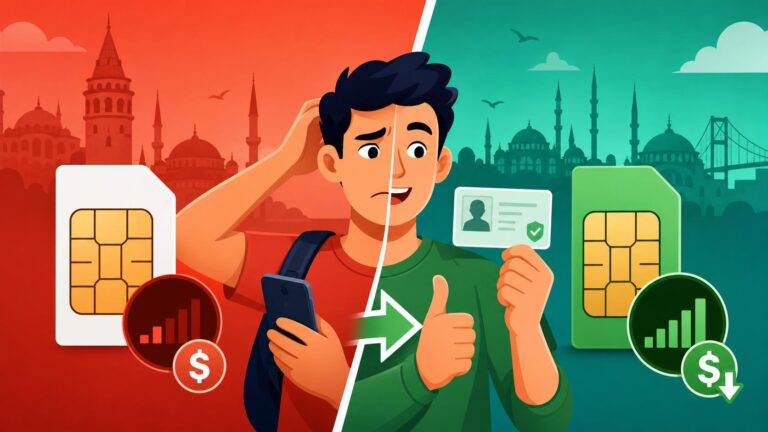
Buying a Phone in Turkey: Why Local iPhones are Among the Most Expensive Globally
You walk into a glitzy mall in Istanbul, eyes set on the latest iPhone, only to feel your stomach drop when you see a price tag that looks more like a car down payment. I remember my first month in Turkey, standing in an electronics store in Kadıköy, staring at a display and wondering if I had forgotten how to do basic math. This guide breaks down the brutal reality of Turkish tech taxes and why buying a local device might actually be your only sane option.
The Anatomy of a Turkish iPhone Price Tag
When you look at the price of an iPhone in Turkey, you aren't just paying for the glass, the silicon, and the Apple logo. You are essentially paying for two phones—one for yourself and one for the Turkish government. This isn't an exaggeration; Turkey consistently ranks as the most expensive place on earth to buy an iPhone. The reason lies in a layered cake of taxes that makes the Cost of Living in Turkey 2026: Detailed Budgets for Singles and Families feel particularly heavy when it comes to technology.
First, there is the Special Consumption Tax, known locally as ÖTV (Özel Tüketim Vergisi). This isn't a flat fee; it’s a percentage that scales with the price of the device, often reaching as high as 50%. Then, the government adds a 20% Value Added Tax (KDV). But wait, there’s more. Because your phone can receive radio and television signals, you must pay a TRT (Turkish Radio and Television Corporation) bandrol fee, which is around 12%. Finally, a 1% contribution is clipped for the Ministry of Culture and Tourism.
By the time these are all stacked on top of each other, the tax-on-tax effect takes hold. Many expats who are just starting out with their Living in Turkey as a Foreigner: The Ultimate Starter Guide (2027) find themselves browsing Amazon Turkey for any possible discount, only to realize that even the largest retailers are bound by these mandatory levies. When you shop on Amazon Turkey, you at least get the peace of mind of a local warranty, but the "sticker shock" remains a rite of passage for every newcomer.
The Great IMEI Dilemma: To Import or to Buy Local
If you’re moving here, your first instinct is likely to bring your existing phone from home. It makes sense—until you hit the 120-day wall. Turkey uses a central database called the MCKS to track Every International Mobile Equipment Identity (IMEI) number that connects to a Turkish SIM card. If your foreign phone stays on a Turkish network for more than 120 days without being registered, the government will remotely block your device’s communication module. Your expensive smartphone effectively becomes a very pretty iPod that only works on Wi-Fi.
This brings us to the infamous IMEI registration fee. In years past, this was a manageable expense. However, as of 2026, the cost has skyrocketed. You can find the full details in our guide on The Turkey IMEI Rule: How to Register Foreign Phones in 2026, but the current figure sits at a staggering 57,241 TL. For many, this fee is actually higher than the cost of a mid-range phone back in their home country.
I’ve sat with many friends who tried to "wait it out," hoping the system would glitch. It doesn't. Once that block hits, your only options are to pay the massive fee via the E-Devlet Guide: Checking Your Tax Debt (Vergi Borcu) and Traffic Fines Online system or buy a local device. If you choose to pay the fee, you must also ensure your phone was brought into the country within the last 365 days and that you have a valid residency permit. This is where The 99-Number: What Your T.C. Kimlik Number Gives You Access To in Daily Life becomes essential, as you cannot register a phone on the government portal without it.
Hardware Blocking and the Dual-SIM Strategy
The 120-day rule is technically applied "per IMEI slot." This has led to a common expat "hack" where people use the physical SIM slot for four months and then switch to an E-Sim for another four months. While this can buy you a total of 240 days, it is a temporary fix. If you are planning a long-term stay, perhaps in one of the managed apartments from Blueground, you’ll eventually need a permanent solution.
Living in a Blueground apartment gives you the comfort of a ready-to-go home, but your digital life still needs local stability. Many long-term residents eventually cave and buy a "cheap" local Android phone to use as a hotspot or for banking apps, while keeping their high-end foreign iPhone for photos and Wi-Fi use. However, carrying two phones is a hassle. If you are constantly on the move, services like Airalo can be a lifesaver during your first few months. By using an e-sim from Airalo, you can often delay the "local SIM countdown" if you rely on data roaming, but this gets expensive quickly.
When you finally decide to buy local, you’ll find that even the second-hand market is pricey. Because the IMEI registration is so expensive, a "clean" local phone holds its value incredibly well. If you are looking at used options, you must be extremely careful. It is wise Navigating Sahibinden.com Safely for Apartment Rentals and Second-Hand Goods to understand how to verify if a used phone is actually a "local" device (TR Registered) or a foreign one that will soon be blocked.
Comparing the Costs: Is It Ever Worth Importing
Is it ever actually cheaper to bring a phone from abroad and pay the tax? Let’s look at a hypothetical comparison for 2026. Note that these prices fluctuate wildly with the Lira’s volatility, but the ratio usually stays consistent.
| Expense Type | Buying Local (Turkey) | Importing from USA + Tax |
|---|---|---|
| Device Base Price (iPhone 16 Pro 256GB) | ~115,000 TL | ~36,000 TL ($1,100) |
| Turkish Taxes (ÖTV, KDV, TRT) | Included in Price | N/A |
| 2026 IMEI Registration Fee | 0 TL | 57,241 TL |
| Total Cost | 115,000 TL | 93,241 TL |
| Potential Savings | N/A | ~21,759 TL |
At first glance, importing looks like it saves you about 21,000 TL (roughly $650). However, there are significant catches. A phone registered this way is "locked" to your specific T.C. Kimlik number for three years. You cannot sell it to a Turk or even let a friend use their SIM card in it. If you decide to leave Turkey in a year, you’ve spent nearly $1,800 on a registration fee that adds zero resale value to your phone outside of Turkey.
Furthermore, Apple’s international warranty is often limited to one year, whereas local Turkish consumer law mandates two years for any device bought through Amazon Turkey or local vendors. For many, the headache of the Step-by-Step Guide to Registering Your Phone's IMEI on e-Devlet and the lack of resale flexibility makes buying local the "least-bad" option.
Practical Survival Tips for the Tech-Hungry Expat
If you are currently reeling from these numbers, take a deep breath. You aren't alone in your frustration. Every expat I know has a story about their phone suddenly "going dark" because they missed the 120-day window. To avoid the worst of the tech-tax sting, consider these strategies:
- Use Airalo Early On: Before you commit to a local SIM and start the 120-day timer, use an Airalo data-only e-sim. It allows you to navigate and use WhatsApp without immediately alerting the local towers to your IMEI if you keep your local SIM settings off.
- Shop Amazon Turkey for 'Old' Stock: When new models launch, Amazon Turkey often clears out the previous year's stock at a "slight" discount. It’s still expensive, but it’s the closest you’ll get to a bargain.
- The 'Backup' Phone Strategy: Buy a very cheap local Turkish brand phone (like Casper or Reeder) for about 5,000 TL. Use this for your Turkish SIM, banking apps, and Getting a Health Report (Sağlık Raporu) for Work or Driving License Conversions. Use your high-end foreign phone on the cheap phone's hotspot.
- Residency Matters: Remember that you cannot pay the IMEI tax until you have your residency permit. If you are struggling with the process, check out The e-Ikamet System: How to Apply, Renew, and Track Your Residence Permit.
- Address Registration: Once you have your phone and your residency, don't forget that Address Registration (Nüfus): The Most Critical Post-Arrival Step for Foreigners is required for almost all legal transactions in Turkey, including certain long-term mobile contracts.
Ultimately, the Turkish government views high-end electronics as a luxury, and they tax them accordingly to bolster the national budget and control foreign currency outflow. Whether you choose to pay the "registration ransom" or bite the bullet on a local purchase, understanding the rules beforehand will save you from being stranded without a working map in the middle of Istanbul. It’s an expensive hurdle, but once it’s cleared, you can go back to enjoying the things that make Turkey wonderful—like the fact that while the phones are pricey, the tea is almost always free.
Disclaimer
This guide is for informational purposes only. Tax rates, IMEI registration fees, and immigration laws in Turkey are subject to frequent and sudden changes by official decree. The figures mentioned, including the 57,241 TL fee, reflect the known costs as of early 2026. Always verify current fees on the official e-Devlet portal or the Information and Communication Technologies Authority (BTK) website before making a financial commitment.