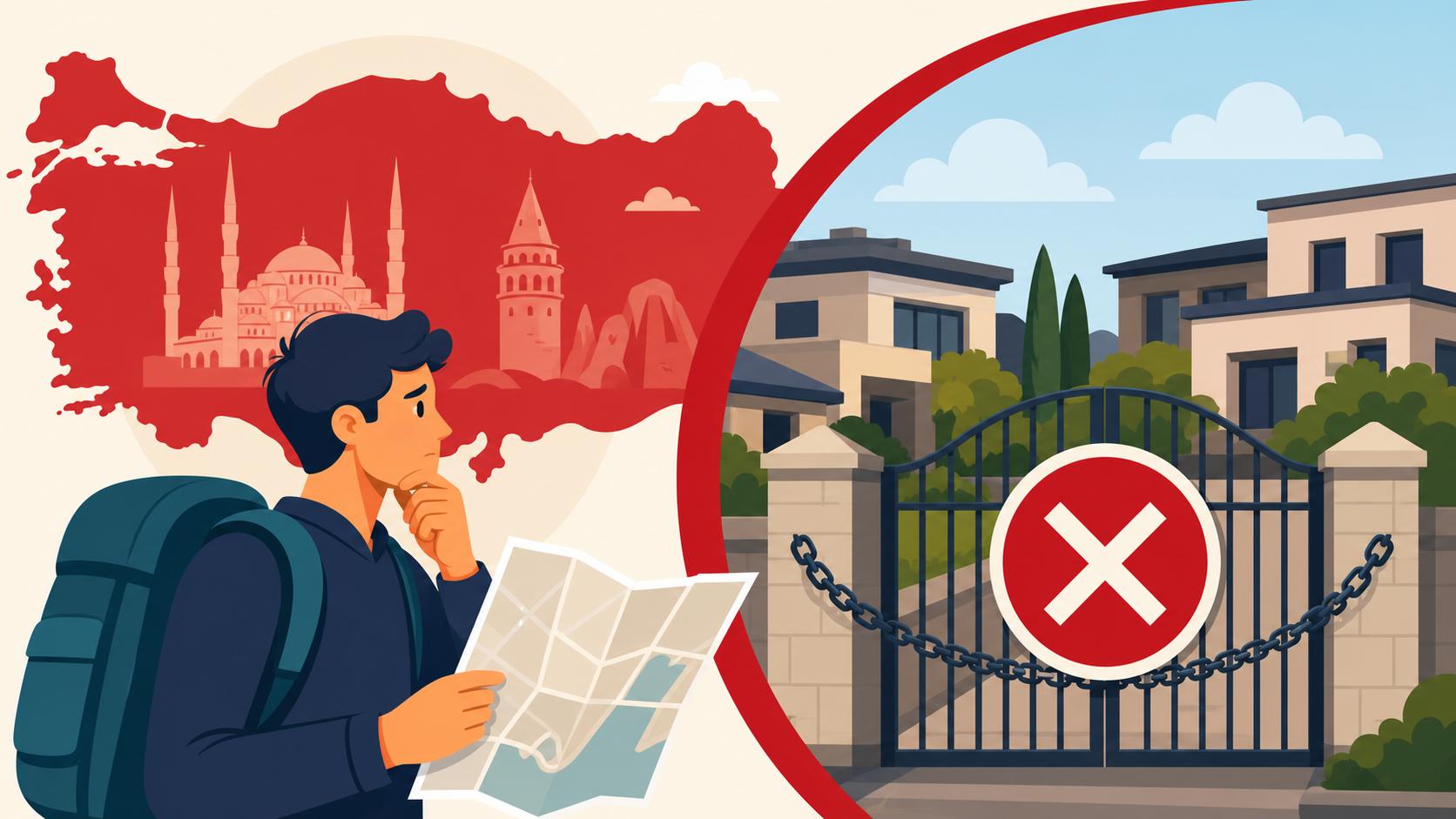
Navigating Closed Neighborhoods: A Guide to Areas Where Foreigners Cannot Register
Finding a perfect apartment in Istanbul or Antalya only to discover it sits in a "closed neighborhood" is a heartbreak I have witnessed far too many times among the expat community. I personally recall the confusion when these regulations first rolled out, turning what should have been a simple address registration into a bureaucratic nightmare. This guide provides the definitive clarity you need to navigate Turkey’s restricted zones and secure your residency without the sting of a sudden rejection.
Understanding the Legal Basis of Closed Neighborhoods
The concept of "closed neighborhoods," or kapalı mahalleler in Turkish, isn't just a random administrative hurdle; it is a calculated demographic policy. In mid-2022, the Turkish Ministry of Interior and the Presidency of Migration Management (Göç İdaresi) implemented a rule stating that in areas where the foreign population exceeds 20% of the total local population, no new residence permits would be issued. This was a significant jump from the previous 25% threshold, and it effectively locked out thousands of potential residents from their preferred districts overnight.
The Evolution of the 20% Rule
When I first moved to Turkey, you could live almost anywhere as long as you had a valid lease. However, as certain districts became global hubs, the government felt the need to preserve "social cohesion." By 2026, this policy has matured into a sophisticated monitoring system. The 20% rule is not static; it is updated based on the latest census data provided by the Nüfus (Civil Registry) offices. If a neighborhood's foreign population drops below the threshold, it could theoretically reopen, though in practice, once a neighborhood is closed, it tends to stay that way for a long time.
For those of us on the ground, this means your Required Documents Checklist for a Short-Term Turkish Residence Permit must be triple-checked against the current status of your chosen street. There are cases where expats sign year-long leases in Fatih or Esenyurt, pay thousands in deposits, and only then realize that they cannot legally register their address. This doesn't just mean you can't get a residence permit; it means you are technically living in the country illegally if you cannot register your place of residence with the authorities within the mandatory 20-day window.
Impact on the Expat Ecosystem
This policy has fundamentally shifted how expats choose their homes. It has created a two-tier rental market where "open" neighborhoods command a premium. Landlords in open areas know their property is more valuable to foreigners, while those in closed areas often lower prices to attract locals or students who may not need the same residency registration. When you are calculating your Cost of Living in Turkey 2026: Detailed Budgets for Singles and Families, you must account for this "residency premium" in districts like Kadıköy or Beşiktaş, which remain largely open but are increasingly expensive.
The frustration is palpable in the waiting rooms of the Göç İdaresi. You might have your Health Insurance Requirements: Securing a Policy for First-Time Ikamet Applications all sorted, but if the address on your notarized lease is in a restricted zone, the officer will hand your folder back within minutes. It feels unfair, especially when you’ve already moved your life across borders, but understanding the logic—preserving the cultural and demographic balance—helps in planning a more stable move.
The 2026 List of Restricted Districts and Neighborhoods
As of 2026, the list of closed neighborhoods has expanded to cover over 1,100 areas across Turkey. It is no longer just a few blocks in Istanbul; it spans across the Mediterranean and Aegean coasts, as well as the capital, Ankara. If you are moving, you must check The List of Closed Neighborhoods in Istanbul, Antalya, and Mersin (2026 Updates) before you even consider viewing a property. The list is extensive, but certain "hotspots" are almost entirely off-limits to new foreign residents.
Istanbul’s Extensive No-Go Zones
In Istanbul, the restrictions are most concentrated. Entire districts like Fatih and Esenyurt are almost completely closed to new registrations for short-term touristic permits. This is particularly difficult for those who love the historical charm of Fatih or the modern high-rises of Esenyurt. Other districts like Zeytinburnu, Avcılar, and parts of Bahçelievler have significant numbers of closed neighborhoods.
When navigating these areas, you should be aware that even if a district is mostly open, specific neighborhoods within it might be closed. For example, while much of Sarıyer is open, certain dense pockets are not. This is why you must use The e-Ikamet System: How to Apply, Renew, and Track Your Residence Permit to verify the specific neighborhood name (Mahalle) rather than just the general district (İlçe). If you are using a service like RushTranslate to prepare your home-country documents, ensure you don't finalize your paperwork until the address is verified as "open."
Coastal Hubs: Antalya, Alanya, and Mersin
The Mediterranean coast has seen some of the most aggressive "closing" of neighborhoods due to the massive influx of digital nomads and retirees. In Antalya, the popular Konyaaltı and Muratpaşa districts have several closed neighborhoods, particularly those closest to the beach. Alanya, a long-time favorite for Northern Europeans, has also seen many of its central areas close to new foreign residents. Mersin has followed suit, especially in areas like Mezitli, where the foreign population grew exponentially in recent years.
If you are planning to settle on the coast, you might find yourself pushed further into the suburbs. While this might seem like a disadvantage, it often leads to a more authentic Turkish experience. However, you must ensure your Health Insurance in Turkey: SGK Public System vs Private Coverage Explained is valid for use in the clinics available in these outlying areas. Companies like Cigna Global provide comprehensive coverage that is often preferred by expats living in these newly developing regions because their network of private hospitals remains accessible even if you are an hour away from the city center.
Restricted Areas in Ankara and Izmir
Ankara, being the political heart of the country, has a different set of restrictions, often centered around areas with high concentrations of refugees or international students. Districts like Altındağ and Çankaya have specific neighborhoods that are now closed. In Izmir, while generally more relaxed, the "liberal" jewel of the Aegean has started closing neighborhoods in Konak and Bornova to maintain its demographic balance.
If you are a student, you should check Student Visas and Permits: Immigration Requirements for University Enrollment to see if your university's dormitory or local housing falls within a closed zone. Usually, student dormitories have different rules, but if you are renting an apartment off-campus, the standard closed neighborhood rules apply. Students have been forced to commute two hours across Izmir because they unknowingly rented in a closed zone near their campus.
How to Verify an Address Before Signing a Lease
Never, under any circumstances, take a landlord’s or a real estate agent’s word that an address is "open for foreigners." In the rush to close a deal, some agents—intentionally or not—may provide outdated information. You must perform your own due diligence. The most reliable way to do this is through official government channels, even if the interfaces are predominantly in Turkish.
Using the E-Devlet Portal for Verification
The e-Devlet (Electronic Government) portal is your best friend in Turkey. Once you have your initial 99-number (Foreigner Identity Number), you can access a wealth of data. While there isn't a single "Search My Address" button for closed neighborhoods, you can cross-reference the official list published by the Presidency of Migration Management against the neighborhood name on your title deed or lease. For those who find the Turkish portal daunting, a Step-by-Step Guide to Registering Your Phone's IMEI on e-Devlet can help you get familiar with the basic navigation of the site.
If you are still abroad and don't have e-Devlet access yet, you should ask the landlord for the "UAVT" code of the property. This is a unique 10-digit address code used by the Turkish government. You can then try to verify this code through the Nüfus or Göç İdaresi websites. If the landlord hesitates to provide this, consider it a major red flag. For official document prep, using RushTranslate for your previous residency proofs or income statements ensures that the authorities have no reason to doubt your application other than the address itself.
Consulting the Local Nüfus and Göç İdaresi
Before you hand over a deposit, take a trip to the local Nüfus Müdürlüğü (Population Directorate) or the Göç İdaresi (Migration Office) in that district. Show them the address and ask, "Yabancı kayıtlarına açık mı?" (Is it open for foreign registration?). This direct approach saved me from a disastrous lease agreement in 2023. Even if there is a language barrier, the clerks understand this specific question very well.
| Method of Verification | Reliability | Difficulty for Expats |
|---|---|---|
| Real Estate Agent Word | Low | Easy |
| Official Göç İdaresi PDF List | High | Moderate (Turkish only) |
| E-Devlet Address Check | Very High | Moderate |
| Direct Inquiry at Nüfus Office | Absolute | Hard (Requires presence) |
If you are coming from abroad and need to prove your financial status, make sure your bank statements are ready. You might want to look into Proving Financial Sufficiency for a Turkish Ikamet Application in 2026 to see how much you need to show, as a rejection due to a closed neighborhood can sometimes lead to a deeper audit of your entire file.
Impact on Residence Permit Applications and Renewals
The "Closed Neighborhood" policy behaves differently depending on whether you are a new arrival or a long-term resident. This is where most of the confusion lies. The government has tried to be somewhat fair to those who were already settled before the rules changed, but the "grandfathering" clauses are very specific and easy to accidentally void.
New Applications (The Hard "No")
If you are applying for your first-ever Turkish Residence Permits (Ikamet): The Complete Application Guide (2027), and your address is in a closed neighborhood, your application will be rejected. There are almost no exceptions to this for touristic permits. The system will often allow you to book a randevu (appointment) and even pay the fees, but the officer at the interview will issue a "rejection notification."
Once rejected, you typically have 10 days to leave the country. This is a terrifying prospect if you have already moved your furniture in. To avoid this, many expats choose comprehensive health plans like Cigna Global, which can sometimes be transferred if you have to move to a different country or region suddenly, providing a safety net that local "Ikamet insurance" simply doesn't offer. If you find yourself in this situation, you must act fast to find a new address in an open area and see if the Göç İdaresi will allow you to update your file before the final decision is made.
The Renewal and "Grandfather" Clause
If you were already living in a neighborhood before it was closed, and you are renewing your permit at the same address, you are generally allowed to stay. This is the "Grandfather Clause." The key here is continuity. You must not have a gap in your residency, and you must not have changed your address to a different closed neighborhood.
However, if you move from one closed neighborhood to another closed neighborhood—even in the same building—it is treated as a new registration, and you will likely be denied. This is a trap people often fall into when they try to "upgrade" their apartment within the same district. If you are staying put, ensure your Health Insurance in Turkey: SGK Public System vs Private Coverage Explained is always active, as a lapse in insurance can lead to a lapse in residency, which might void your right to stay in that closed area.
Real Estate Residency and the USD 200,000 Rule
One of the biggest shifts in 2024 and 2025 was the introduction of the USD 200,000 minimum valuation for real estate-based residency. This rule and the closed neighborhood policy often collide in confusing ways for investors. Buying a property in Turkey is no longer a guaranteed ticket to residency if you don't choose the location and price point carefully.
Buying in a Closed Neighborhood
Can you buy a house in a closed neighborhood? Yes, the land registry (Tapu) office will still process the sale. However, buying the house does not grant you the right to live in it if the neighborhood is closed to new foreign residents. You could own a beautiful $500,000 villa in a restricted part of Konyaaltı but be unable to get a residence permit to actually occupy it.
Investors must distinguish between Turkish Citizenship by Investment 2026: The $400,000 Property Route Explained and a simple residence permit. If you are going for citizenship, the closed neighborhood rules generally do not prevent you from obtaining your passport. But if you are just looking for a residency permit (Ikamet), the neighborhood's status is paramount. Always ensure your Title Deed (Tapu) is correctly valued and that the neighborhood is "open" if your goal is immediate residency.
The Interaction of Price and Location
Even in an open neighborhood, the property must meet the $200,000 threshold based on the official valuation report (Ekspertiz). If you buy in an open neighborhood for $150,000, you will be treated as a "touristic" applicant rather than a "property" applicant, which carries a much higher risk of rejection. For those moving large sums of money, using a service like RushTranslate for your sales contracts or power of attorney documents is vital to ensure the Göç İdaresi accepts your valuation at face value.
I strongly recommend reading up on Real Estate Residence Permits: Understanding the Strict USD 200,000 Tapu Rule before signing any sales agreement. Many people have been misled by developers who claim that "the rules will change soon." In Turkey, once a rule is in place, it usually gets stricter before it gets easier.
Legal Exceptions and Legitimate "Workarounds"
While the rules are strict, there are a few legal scenarios where you can live in a closed neighborhood. These are not "loopholes" in the shady sense, but rather defined legal exceptions for specific life circumstances.
Family Reunification
If you are a foreign spouse of a Turkish citizen, or if you are the child of a person already holding a valid residence permit in a closed neighborhood, you may be eligible for a Family Residence Permits: How to Sponsor Your Foreign Spouse and Children. The government prioritizes keeping families together over demographic quotas. However, the burden of proof is high. You will need your marriage certificates and birth certificates apostilled and translated—tasks that RushTranslate handles with the precision required by Turkish officials.
Even with a family permit, you must still register your address at the Nüfus office. The clerks may initially tell you "no" because the neighborhood is closed, but you must insist on showing your family permit eligibility. It helps to have a professional by your side or to consult Hiring an Immigration Lawyer in Turkey: Spotting Red Flags and Standard Costs if the local office is being particularly difficult.
Moving Within the Same District
There is some anecdotal evidence that if you are already registered in a closed neighborhood and move to another apartment within that same closed neighborhood, the Nüfus office might allow the transfer. However, this is highly discretionary and varies from district to district. I would never recommend planning your life around this possibility. If you must move, it is always safer to move to an "open" area to ensure your Address Registration (Nüfus): The Most Critical Post-Arrival Step for Foreigners remains valid.
Practical Steps If Your Neighborhood Is Closed
If you discover that you are currently living in or have just rented in a closed neighborhood, you need to act methodically. Panic leads to mistakes, and mistakes in Turkish immigration can lead to entry bans.
The 20-Day Rule and Address Registration
Regardless of the neighborhood status, you are legally required to register your address within 20 days of moving or arriving. If you try to register in a closed neighborhood and are rejected, you have a paper trail of your attempt. This is better than doing nothing. However, a rejection at the Nüfus office will eventually trigger an inquiry from the Göç İdaresi.
Check Address Registration Penalties: The Strict 20-Day Rule for Moving House to see the current fines. If you are rejected, your next step should be to find a new lease in an open neighborhood as quickly as possible. Do not wait for your appointment date to find out you've been rejected; if you know the neighborhood is closed, start looking for a new home now.
Planning Your Next Move to an "Open" Area
When searching for a new home, use filters on sites like Sahibinden or Hepsiemlak to target districts known to be open. Areas like Kadıköy (Asian Side), Beşiktaş (certain parts), and the newer developments in Başakşehir often have more open neighborhoods than the historic center. While looking, ensure you maintain your Health Insurance in Turkey: SGK Public System vs Private Coverage Explained so there is no gap in your coverage during the transition.
| Recommended Open Districts (General) | Why They Are Good |
|---|---|
| Kadıköy | Cultural hub, very expat-friendly, many open mahalles. |
| Kağıthane | Modern, central, and still has many open areas. |
| Kartal | Great sea views, quieter, largely open for residency. |
| Üsküdar | Traditional but many neighborhoods remain open. |
While you are in transition, it’s worth checking Expat Support Groups: Managing Isolation and Culture Shock in Turkey. Many people in these groups have gone through exactly what you are facing and can recommend specific streets or apartment complexes that are currently "open" and welcoming to foreigners.
Dealing with the Administrative Fallout
A rejection due to a closed neighborhood can feel like the end of your Turkish journey, but it doesn't have to be. It is a hurdle, not a wall. You just need the right documentation and a bit of patience.
Ensuring Your Paperwork is Flawless
The Göç İdaresi is looking for any reason to say "no" when quotas are tight. This is why your translations must be perfect. If you are bringing documents from your home country, using RushTranslate ensures that the sworn translation meets the exact standards of the Turkish notary system. A small error in a translated birth certificate can be the excuse an officer needs to deny an application that is already on the edge because of a neighborhood quota.
Similarly, having a global insurance policy like Cigna Global shows a level of financial and personal stability that officers appreciate. It proves you won't be a burden on the local SGK system, which is a subtle but important factor in how some discretionary decisions are made at the provincial level.
Navigating the Appeals Process
If you believe your neighborhood was closed in error or if you fall under an exception that was ignored, you can file an appeal. This is a complex legal process that involves the Turkish Administrative Court. Before you go down this road, read Ikamet Rejections: Exact Steps on What to Do If Your Residence Permit is Denied. In most cases, it is faster and cheaper to simply move to an open neighborhood and reapply, but in certain property-ownership cases, an appeal might be necessary.
Always remember that the officers at the Göç İdaresi are following a script. They aren't personally trying to ruin your plans; they are managing a massive, nationwide demographic shift. Approaching them with kindness and a folder full of perfectly organized, RushTranslate-certified documents will always get you further than an angry confrontation.
Disclaimer
The information provided in this guide is for informational purposes only and does not constitute legal advice. Immigration laws, restricted neighborhood lists, and residency requirements in Turkey are subject to frequent and sudden changes by the Ministry of Interior and the Presidency of Migration Management. Always verify the status of a specific neighborhood through official government channels (e-Devlet, Nüfus, or Göç İdaresi) before entering into any financial or legal commitments. Individual circumstances vary, and you should consult with a qualified immigration professional for specific legal guidance.