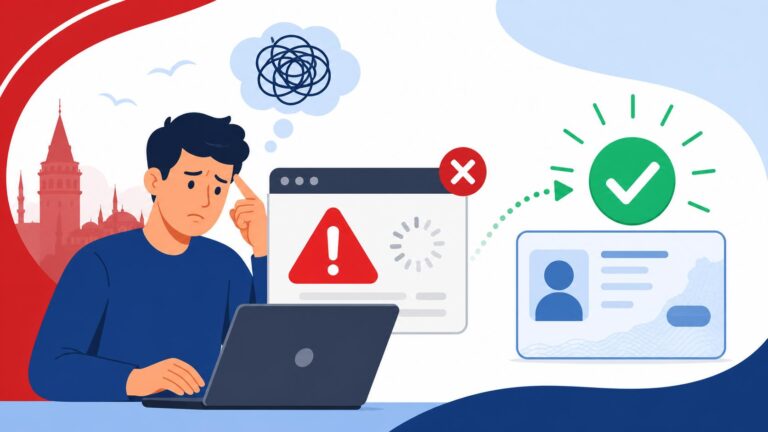
Address Registration (Nüfus): The Most Critical Post-Arrival Step for Foreigners
Most expats arrive in Turkey, secure their residence permit card, and breathe a sigh of relief, thinking the hard part is over. I made that same mistake during my first year in Istanbul, only to have my bank account frozen because I skipped the final administrative hurdle. This guide solves the mystery of address registration, ensuring you remain legally compliant and avoid heavy fines.
Understanding Why Address Registration is the Missing Piece of the Puzzle
When you receive your plastic residence permit card (the ikamet), you are officially a resident, but you are not yet "active" in the eyes of the many state institutions that govern your daily life. The address you provided during your initial visa or permit interview is often just a placeholder in the system. To truly "exist" in the Turkish administrative landscape, you must link your biometric ID number—the one starting with 99—to a specific physical residence in the Central Population Management System, known as MERNIS.
I remember sitting in a local bank branch in Kadıköy, trying to update my contact information, only for the teller to tell me I didn't "live" anywhere. It was a bizarre feeling, considering I had been paying rent for six months. Without this registration, you cannot easily enroll children in school, sign up for the SGK Monthly Premiums 2026: Payment Methods and Coverage for Expats, or even receive official mail from the government. It is the connective tissue between your identity and your right to access public services.
The Difference Between Ikamet and Nüfus
It is vital to distinguish between the Provincial Directorate of Migration Management (Göç İdaresi) and the Population and Citizenship Affairs Directorate (Nüfus Müdürlüğü). The former grants you the right to stay in the country, while the latter records where you are staying. Think of it like this: the Göç İdaresi gives you the "keys" to the country, but the Nüfus office registers the "deed" to your presence in a specific neighborhood.
For many years, these two systems didn't talk to each other very well. You could update your address at one and find the other still had your old hotel address from three years ago. Today, the systems are more integrated, but the responsibility still lies with you to ensure the Nüfus database is accurate. If you are following the Turkish Residence Permits (Ikamet): The Complete Application Guide (2027), remember that the card in your hand is only half the battle. The Nüfus registration is what validates that card for long-term use.
The Legal 20-Day Window and Penalties
Turkish law is quite strict regarding the timeline for address updates. You technically have 20 working days from the moment you move into a new property or receive your residence permit to register that address. If you miss this window, you aren't just looking at a stern look from an official; you are looking at an Address Registration Penalties: The 4,000+ TL Fine for Missing the 20-Day Window that can increase significantly depending on how long you've delayed.
In my second year, I moved from a cozy flat in Beşiktaş to a larger place in Şişli and completely forgot about the 20-day rule. When I finally went to the Nüfus office, the system flagged my delay immediately. The fine had to be paid at a tax office before they would even process my new address. It is a frustrating, time-consuming loop that can be easily avoided by making an appointment the same week you sign your lease.
How Unregistered Addresses Affect Your Daily Life
Beyond the threat of fines, an unregistered address creates a "ghost" status that haunts your logistics. For instance, if you need to see a doctor, the system for Choosing a Primary Care Physician (Aile Hekimi) at a Local Health Center relies entirely on your registered address. You are assigned a doctor based on your neighborhood; if the system doesn't know where you live, you cannot access these free or low-cost services.
Furthermore, many expats find that their mobile phone lines or home internet packages are suddenly suspended. Since the 2026 regulations, service providers are required to cross-reference customer IDs with the MERNIS system. If the data doesn't match, they assume the resident has left the country or moved, leading to a service cutoff. I’ve seen friends lose their fiber internet connection for weeks because they hadn't bothered to visit their local Nüfus directorate.
Preparing Your Documentation Like a Pro
The secret to a stress-free visit to any Turkish government office is the "folder of doom." You want to walk in with every possible document, organized and ready, so the official has no reason to send you away. Turkish bureaucracy often feels like a puzzle where the pieces change depending on who is behind the desk, but the core requirements for address registration remain relatively stable.
You will certainly need your original residence permit (ikamet) and your passport. However, the most critical piece of evidence is the proof of your residence. This is where things get tricky. If you are a renter, a notarized copy of your rental contract is the gold standard. If you are an owner, you must bring your Title Deed (Tapu). I always recommend bringing a few extra photocopies of everything; it saves you from having to find a "kırtasiye" (stationery shop) in a panic when they ask for a duplicate.
Essential Documents for Renters and Owners
For renters, the process has become more digital, but the paper trail still matters. You need a signed and notarized rental agreement. Make sure the address on the contract matches exactly what is in the national address database. Sometimes, a building is known by one name locally but is registered as a different number on the street; always verify this with your landlord. Owners, on the other hand, should ensure they have a recent "Tapu Kaydı" (Title Deed Record) which can be generated via e-Devlet to show the property is currently in their name.
If you are living with someone else—perhaps a partner or a friend—without your name on the lease, the process changes. The person whose name is on the lease (the "primary occupant") must accompany you to the office to sign a declaration (muvafakatname) stating that you are indeed living there. I had to do this for a cousin visiting on a long-term stay, and it required both of us to present our IDs and for the primary occupant to sign a digital tablet at the desk.
The Role of Sworn Translations and Notaries
If any of your supporting documents—such as marriage certificates for a family registration or power of attorney forms—are in a foreign language, they must be translated and notarized. I highly recommend using RushTranslate for these needs. They understand the specific formatting required for Turkish officialdom, which is notoriously picky about how names and dates are displayed.
For example, if you are registering a spouse under a Family Residence Permits: How to Sponsor Your Foreign Spouse and Children, the Nüfus office will demand a translated marriage certificate with an Apostille. Using a service like RushTranslate ensures that the terminology used matches what the Turkish system expects, reducing the risk of a rejection. Some applicants have used "standard" translations only to be told the "official" terminology was wrong, forcing them to start the whole process over. RushTranslate helps bridge that gap before you ever step foot in the Nüfus office.
Handling Utility Bills and Proof of Residence
One of the most common requests at the Nüfus office is a utility bill (electricity, water, or gas) in your name. This is often a "chicken and egg" problem: the utility company wants a registered address to give you a contract, and the Nüfus office wants a bill to register your address. The trick is to take your notarized rental contract to the water or electricity company first. They will usually let you open an account using your ikamet number.
Once you have that first bill—or even just the signed contract from the utility provider (the "abonelik sözleşmesi")—take it to your appointment. This is considered ironclad proof that you are the inhabitant of that property. If you are struggling with these steps, a Step-by-Step Guide to Registering Your Phone's IMEI on e-Devlet might also give you a glimpse into how these various registrations are interconnected in the Turkish digital ecosystem.
| Document Type | Requirement for Renters | Requirement for Owners |
|---|---|---|
| ID Document | Original Residence Permit (Ikamet) | Original Residence Permit (Ikamet) |
| Primary Proof | Notarized Rental Contract | Original Title Deed (Tapu) |
| Utility Proof | Electricity or Water Bill in your name | Electricity or Water Bill in your name |
| Digital Entry | Appointment via e-Devlet or 199 | Appointment via e-Devlet or 199 |
| Extra Items | Photocopy of Landlord's ID | N/A |
Step-by-Step Guide to the Appointment Process
Once your folder is ready, you cannot simply walk into the Nüfus office and expect service. In major cities like Istanbul, Ankara, or Izmir, you must have an appointment. The system is efficient, but it is also rigid. If you show up ten minutes late, your slot will likely be given to someone else, and you'll be back at square one.
I remember my first appointment in the Fatih district. I thought I could just "wing it" because I spoke a little Turkish. I was wrong. The sheer volume of people meant that without a confirmed "randevu" (appointment), I wasn't even allowed past the security desk. Learn from my frustration: book your slot as soon as you have your lease in hand.
Booking Your Appointment via the e-Devlet Portal
The easiest way to book is through the e-Devlet portal, but you can also call "Alo 199," the dedicated helpline for population and migration queries. If you are using the website, look for "Nüfus ve Vatandaşlık İşleri Genel Müdürlüğü" and then the "Randevu" section. You will select "Adres Kayıt" (Address Registration) as the service type.
If your Turkish isn't quite there yet, don't worry. The interface is somewhat intuitive, but you might want to use a browser with a translation feature. Keep in mind that you must book the appointment for the specific district (İlçe) where you live. If you live in Beşiktaş, you cannot register your address at the Kadıköy office. If you need more help with the digital side, check out How to Obtain an Official Address Certificate (Yerleşim Yeri Belgesi) on e-Devlet for a better understanding of how the portal works.
What Happens Inside the Nüfus Directorate
When you arrive at the İlçe Nüfus Müdürlüğü, you will usually find a kiosk where you enter your T.C. identity number (the 99 number) to get a queue ticket. Watch the screens carefully. When your number is called, you’ll head to a desk where an official will review your documents. They aren't looking for a chat; they are looking for specific data points: your name, your 99 number, the "UAVT" code (the unique national code for your address), and your signature.
The official will scan your fingerprints again—standard procedure in Turkey—and ask you to sign a digital pad. In most cases, the process takes less than ten minutes if your papers are in order. They will give you a stamped and signed printout. Keep this! This piece of paper is your temporary proof of registration until the digital systems sync up, which usually happens within 24 to 48 hours.
Common Pitfalls and Communication Strategies
One of the biggest hurdles is the language barrier. While some offices in tourist-heavy areas might have English speakers, it is not guaranteed. It is wise to have a few phrases ready, such as "Adresimi kaydetmek istiyorum" (I want to register my address). If things get complicated, you can always use a translation app, but having your documents neatly organized usually does the talking for you.
Another common pitfall is the "already registered" issue. If the previous tenant didn't move their address, the system might block you from registering. If this happens, don't panic. You will need to show your rental contract to prove you are the new legal resident. The official will then start a process to "drop" the old tenant's registration. It might require a follow-up visit, but it is a standard procedure that they handle daily.
Navigating the Complexities of Closed Neighborhoods
In recent years, the Turkish government has implemented a policy of "closed neighborhoods" (Kapalı Mahalleler) to manage the density of foreign residents in certain areas. This is perhaps the most stressful part of the modern expat experience in Turkey. If you move into one of these areas as a new resident, you may find it impossible to register your address, which effectively invalidates your residence permit.
Some families sign year-long leases in beautiful apartments in Esenyurt or Fatih, only to discover at the Nüfus office that they cannot legally live there. It’s a heartbreaking situation that can result in the loss of your security deposit and your legal status. You must check the list of Navigating Closed Neighborhoods: A Guide to Areas Where Foreigners Cannot Register before you even look at an apartment.
Understanding Why Certain Areas are Restricted
The policy is based on a 20% or 25% threshold. If the foreign population in a specific neighborhood exceeds this percentage of the total population, that neighborhood is "closed" to new foreign registrations. This is intended to encourage integration and prevent the formation of "ghettos." While the intention is demographic management, the reality for an expat is a minefield of potential rejections.
This rule applies to all types of short-term residence permits. However, there are exceptions for students and sometimes for those moving for work, but these are handled on a case-by-case basis. If you are moving to Istanbul, Ankara, or Mersin, this is a critical check. For a current list of affected areas, refer to The List of Closed Neighborhoods in Istanbul, Antalya, and Mersin (2026 Updates).
How to Verify Your Neighborhood Status on e-Devlet
While lists are published, they change frequently. The most reliable way to check is to look at the "Adres Kayıt" section of e-Devlet or ask the local "Muhtar" (neighborhood head). The Muhtar is a local elected official who keeps a pulse on the neighborhood. They are often incredibly helpful and can tell you immediately if your street is open for foreign registration.
When I was looking for a new place last year, I actually went to the Muhtar's office in the neighborhood I was eyeing. I showed him my ikamet and asked, "Yabancı kayıt açık mı?" (Is foreign registration open?). He checked his ledger and gave me a thumbs up. It took five minutes and saved me from a potentially disastrous lease.
What to Do If You Already Live in a Closed Zone
If you were registered in a neighborhood before it was closed, you are generally "grandfathered" in. You can continue to live there and renew your permit at that address. The trouble starts if you move house—even if it's just to the building next door. If you move within a closed neighborhood, the system may block the new registration.
If you find yourself in this bind, you generally have two options: appeal the decision if you have a compelling reason (like marriage to a local) or move to an "open" neighborhood. It is a harsh reality of the current Short-Term Touristic Ikamet: Why Renewals are Being Strictly Denied in 2026 climate. Always prioritize staying in an open zone to keep your residency path clear.
Post-Registration Mastery: Using e-Devlet for Address Certificates
Once you have successfully navigated the Nüfus office, you are officially in the system. Congratulations! But the work isn't quite done. You now need to know how to provide proof of this registration whenever a bank, a school, or a hospital asks for it. In the old days, you had to visit the Muhtar and pay a small fee for a stamped paper. Today, it’s all digital.
The "Yerleşim Yeri Belgesi" (Residence Certificate) is the most important document you will generate. It is a QR-coded PDF that proves your address and is accepted by every institution in Turkey. I keep a fresh copy of this saved on my phone at all times. It has saved me during random police checks and when I needed to quickly update my Health Insurance in Turkey: SGK Public System vs Private Coverage Explained records.
Generating Your Official Address Certificate (Yerleşim Yeri Belgesi)
To get your certificate, log into e-Devlet and search for "Yerleşim Yeri." Select the service provided by the Nüfus ve Vatandaşlık İşleri. You will be asked who the certificate is for (select "Kendisi" for yourself) and why you are generating it (you can select "Kuruma İbraz" – presentation to an institution).
The system will generate a PDF with a barcode. This barcode is valid for about a month, after which you should generate a new one if needed. It is a beautiful piece of technology that eliminates the need for physical office visits. For a deeper dive into the technical steps, see the How to Obtain an Official Address Certificate (Yerleşim Yeri Belgesi) on e-Devlet guide.
Updating Your Address for the Göç İdaresi
Now, here is a step many people miss: once the Nüfus office has your address, you should also ensure the Göç İdaresi knows about the change. While the databases are supposedly linked, it is safer to upload your new address certificate through the "Adres Güncelleme" (Address Update) section of the e-Ikamet portal.
This is especially important if you are planning to apply for Applying for Long-Term (Permanent) Residency After 8 Years of Legal Stay. Any "gaps" in your address history can be used as a reason to deny a long-term permit. You want a continuous, unbroken record of where you have lived for every single day you've been in Turkey.
Keeping Your Information Current During Future Moves
Every time you move, the clock resets. You have 20 days to start the process over again. I know it feels like a chore, but it is the price of a legal life here. I’ve found that the second and third times I did this, it was much faster because I already knew the layout of the local offices and had my "folder of doom" ready to go.
Also, keep an eye on your "UETS" (National Electronic Notification System). This is a digital mailbox where the government sends legal notices. Often, if there is an issue with your address, they will notify you there first. Staying on top of your UETS Setup: Getting Your PTT Electronic Mailbox as a Foreign Resident is a pro-level expat move that separates the veterans from the newcomers.
Troubleshooting Common Registration Nightmare Scenarios
Even with the best preparation, things can go wrong. Turkey is a land of exceptions and "system errors." I’ve spent more hours than I’d like to admit in waiting rooms, trying to figure out why my perfectly valid lease was being rejected. Most problems boil down to data discrepancies or the leftovers of previous tenants.
One of the most common issues is the "Occupied Address" problem. This happens when the person who lived in your apartment before you never updated their address when they moved out. In the eyes of the Nüfus computer, the apartment is "full." You cannot be registered there until the previous person is removed.
The "Occupied Address" Problem: Dealing with Previous Tenants
If you are told your address is occupied, you will need to provide your notarized rental contract and, ideally, a utility bill in your name. The official will use these to prove that you are the current inhabitant. They will then move the previous tenant to a "ghost" status (usually marked as "address unknown").
Sometimes, the office might ask for a "Tahkikat" (investigation). This means they will send a local police officer to your door to verify that you actually live there. It sounds scary, but it's very routine. They just want to see your ID and see that the apartment has furniture and clothes in it. Once the officer files their report, your registration will be cleared. For more on this, check Why the Police Do Random Address Checks (Tahkikat) for New Residence Permits.
Random Police Checks (Tahkikat) and Home Visits
Don't be alarmed if a "Polis" or "Bekçi" (neighborhood watch) knocks on your door a few weeks after you register. They are usually very polite. They might ask for your residence permit and ask how many people live in the house. This is part of the government's effort to ensure that people aren't using "fake" addresses to get permits for neighborhoods they don't actually live in.
I remember my first visit. I was in my pajamas, drinking tea, when the doorbell rang. Two officers were there with a clipboard. They checked my card, asked if I was the only one living there, and thanked me. That was it. If you aren't home, they will usually leave a note or ask your neighbors about you. If you miss them, it’s a good idea to visit your local police station (Karakol) to let them know you’re around.
Reclaiming Your Legal Status After a Missed Deadline
If you realize you’ve missed the 20-day deadline by months, don't ignore it. The longer you wait, the worse the consequences. Go to the Nüfus office, apologize for the delay, and be prepared to pay the fine. Usually, once the fine is paid, they will process the registration without further issue.
The real danger of a missed deadline is during your residency renewal. If the Göç İdaresi sees that you haven't been registered at a Nüfus office, they may reject your renewal outright, leading to Overstays, Fines, and Deportation: Navigating Harsh Immigration Rules in Turkey. It is always better to pay a small fine now than to face a deportation order later.
Mandatory Insurance and Financial Compliance
Address registration isn't just about immigration; it's about your financial and physical safety. In Turkey, your address is linked to your tax ID, your bank accounts, and your health insurance. If these aren't synced, you could find yourself unable to pay your bills or, worse, unable to get medical help when you need it.
For instance, when you apply for your ikamet, you need health insurance. If you are using a provider like Cigna Global, they offer the kind of comprehensive coverage that expats trust. However, for that insurance to be fully recognized by local hospitals under the private system, your address needs to be correctly registered. Cigna Global provides excellent international support, but local hospital administrative systems often pull your data directly from the MERNIS system to process claims.
Linking Your Address to Your Health Insurance
Whether you are using the public SGK system or a private plan from Cigna Global, your registered address is the key to your "Health File." In Turkey, this is managed through the "e-Nabız" system. Once your address is in the Nüfus database, your e-Nabız profile will update, allowing you to see which family doctor (Aile Hekimi) you've been assigned.
If you have a chronic condition and rely on Cigna Global for specialist care, having your address correctly registered ensures that your medical records are consistent across all platforms. I’ve seen cases where insurance claims were delayed because the patient's address on their ID didn't match the address on the hospital's intake form. Keeping these in sync is a vital part of Healthcare in Turkey for Foreigners: Complete Expat Guide (2027).
The Impact on Banking and Tax ID Records
Your Turkish bank is required by law to have your up-to-date registered address on file. If they see a mismatch, they are obligated to freeze the account under "Know Your Customer" (KYC) regulations. This happened to me right before a rent payment was due—not a fun experience. I had to take my "Yerleşim Yeri Belgesi" to the branch manager to get the hold lifted.
The same applies to your Tax ID (Vergi Numarası). If you are working or running a business, your tax obligations are tied to your residence. If you are interested in the financial side of things, our guide on Taxes in Turkey for Foreigners: Residency, Income, and Filing Basics covers how these registrations impact your fiscal life.
Final Checklist for a Compliant Life in Turkey
To wrap things up, living in Turkey is an incredible adventure, but it requires a bit of administrative discipline. Don't let the paperwork overwhelm you. If you take it step-by-step, the system actually works quite well.
- Secure a notarized rental contract or Title Deed.
- Get a utility bill in your name.
- Book a Nüfus appointment via e-Devlet or 199 within 20 days.
- Translate any foreign documents with RushTranslate.
- Attend the appointment and get your stamped confirmation.
- Download your "Yerleşim Yeri Belgesi" from e-Devlet 48 hours later.
- Ensure your Cigna Global policy is updated with your new address.
By following this roadmap, you ensure that your time in this beautiful country is spent enjoying the Bosphorus sunsets and the mountain air, rather than arguing with officials in a crowded waiting room.
Disclaimer
This guide is provided for informational purposes only and does not constitute legal advice. Immigration laws, neighborhood statuses, and administrative procedures in Turkey change frequently. Always consult with the official websites of the Ministry of Interior, the Directorate of Migration Management, and the General Directorate of Population and Citizenship Affairs, or seek professional legal counsel to ensure compliance with the most current regulations.