Mobile Networks in Turkey: Comparing Turkcell, Vodafone, and Türk Telekom
Landing at Istanbul Airport and realizing your foreign SIM card is racking up hundreds of dollars in roaming charges is the quintessential "Welcome to Turkey" moment. I’ll never forget standing in the arrivals hall, desperately trying to load a map of Kadıköy on a connection that felt like dial-up, only to have it cut out entirely. This guide settles the debate on which Turkish mobile provider actually delivers on its promises for long-term residents and travelers alike.
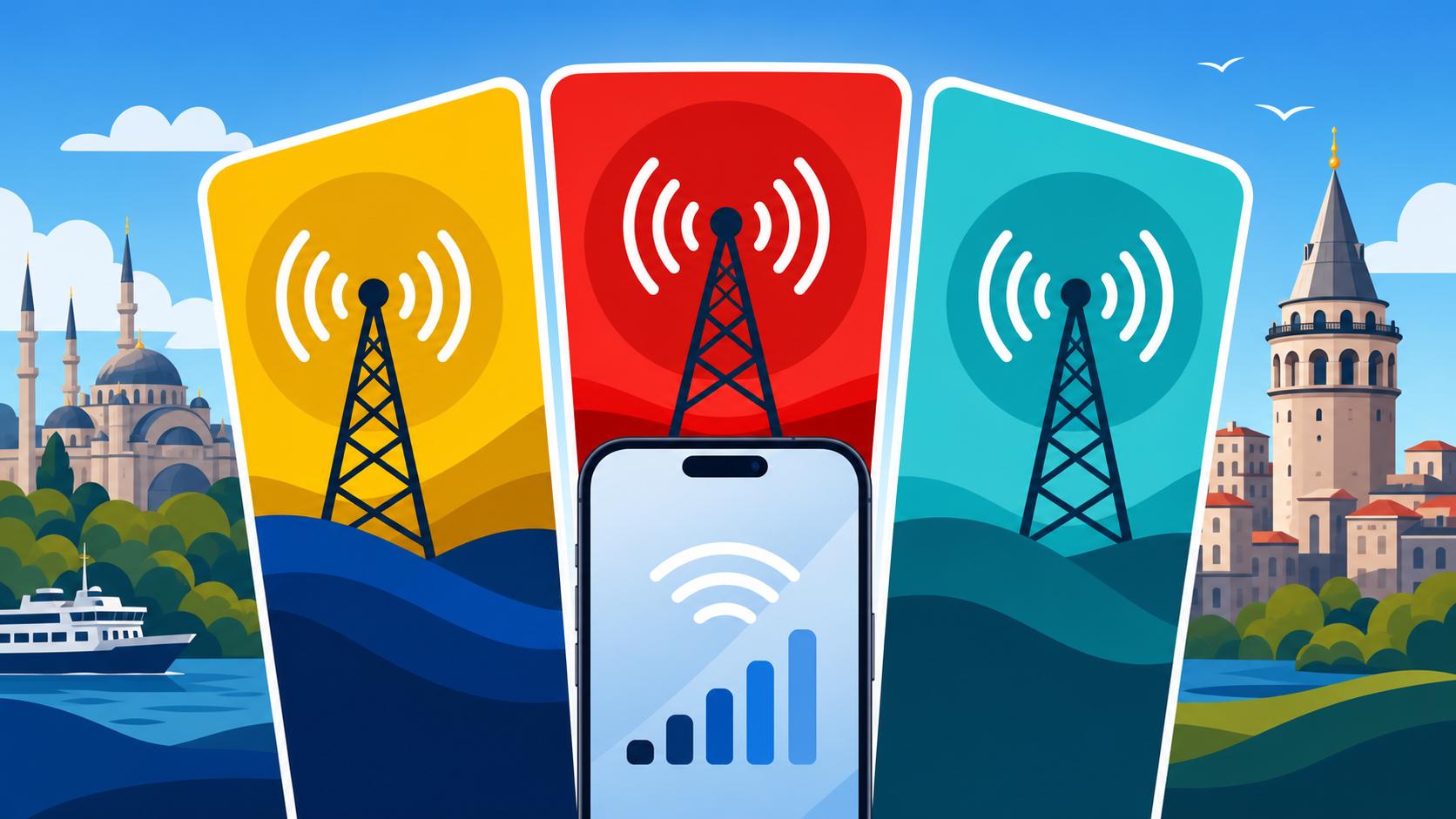
Navigating the Big Three: Turkcell vs. Vodafone vs. Türk Telekom
When you first start looking at your options, you’ll realize the market is dominated by three main players. While they all offer the same basic services, the experience of using them as a foreigner can vary wildly depending on where you live and how often you travel within the country. If you are moving into a pre-furnished apartment through a service like Blueground, you might already have home internet, but your mobile data will be your lifeline for everything from ordering a taxi to translating a menu at a local "lokanta."
Turkcell: The Gold Standard of Coverage
Turkcell is widely regarded as the "premium" choice in Turkey. In my years of traveling from the bustling streets of Nişantaşı to the remote mountains of Artvin, Turkcell is the only provider that consistently keeps me in 4G or 5G territory. They have the most extensive infrastructure, which is why their prices are slightly higher than the competition. For many expats, the extra few liras a month are a small price to pay for not losing signal in the middle of a vital banking transaction.
The customer service experience at Turkcell is also generally more "foreigner-friendly" in major hubs. If you visit a branch in a tourist-heavy area like Sultanahmet or near a Blueground property in Maslak, you are much more likely to find a staff member who speaks English. Their mobile app, "Turkcell Super App," is surprisingly robust, allowing you to buy extra data packages or pay your bills without needing to visit a physical shop.
Vodafone Turkey: The Global Alternative
Vodafone is a familiar name for many Europeans, and they leverage that brand recognition well. In Turkey, Vodafone often positions itself as the middle-ground option—better coverage than Türk Telekom but cheaper than Turkcell. I’ve found that Vodafone works exceptionally well in urban centers like Ankara and Izmir. However, if you plan on doing a "blue cruise" along the Mediterranean coast, you might find some dead zones where your Turkcell-using friends are still posting stories.
One of the perks of Vodafone is their "Red" packages, which often include international roaming benefits or discounts on popular apps. This can be a lifesaver if you are still Living in Turkey as a Foreigner: The Ultimate Starter Guide (2027) and haven't quite cut the cord with your home country's services. They also frequently partner with local brands for "buy one get one free" deals on coffee or cinema tickets, which helps offset the monthly cost.
Türk Telekom: The Budget-Friendly Veteran
Formerly the state-owned monopoly, Türk Telekom has rebranded itself as a modern, aggressive competitor. They are almost always the cheapest option. If you are a student on a tight budget or a digital nomad who spends 90% of their time in high-speed Wi-Fi cafes, Türk Telekom is perfectly adequate. Their fiber-optic infrastructure for home internet is world-class, but their mobile towers still lag slightly behind Turkcell in rural areas.
The main drawback I’ve experienced with Türk Telekom is the "indoor" signal strength. In some of the older, thick-walled stone buildings in neighborhoods like Galata, the signal can drop significantly. However, if you are looking to save money to spend on more important things—like upgrading your tech on Amazon Turkey—this is the provider that will give you the most gigabytes for your lira.
The Tourist SIM Trap and the Residency Transition
One of the biggest frustrations for newcomers is the "Tourist SIM." By law, if you do not have a Turkish Residency Permit (Ikamet), you are limited to special tourist packages. These are significantly more expensive than the plans locals use and, most annoyingly, they automatically expire after 60 to 90 days. Many expats lose their phone numbers because they didn't realize their tourist SIM had a "kill switch."
Why Tourist SIMs are a Financial Headache
When you walk into a shop at the airport, they will push a tourist package that costs three times what a resident pays. They usually come with a massive amount of data you probably won't use in a week. If you’re just here for a vacation, grabbing an e-sim from a provider like Airalo is often much more cost-effective and saves you the hassle of physical paperwork. With Airalo, you can have data the moment you touch down without the predatory "airport tax" added by local shops.
If you are planning to stay longer, you should avoid buying a physical SIM at the airport entirely. Wait until you get into the city. A shop in a local neighborhood will always give you a better deal than the kiosks at IST or SAW. Even without an Ikamet, a neighborhood shop might be more flexible with the packages they offer, though they are still legally bound to the "tourist" designation until you provide a residency number.
Switching to a Resident Plan with Your Ikamet
The moment you receive your residency card, your first stop should be your mobile provider. Transitioning from a tourist line to a resident line (known as a "faturalı" or "faturasız" line for locals) is a game-changer. Not only do the prices drop by about 60%, but you also gain access to long-term contracts. This is also a critical step for Navigating the Turkey Digital Nomad Visa: Full Requirements and Application Guide, as a stable, local phone number is required for almost every digital service in the country.
To make the switch, you’ll need your original passport and your Ikamet card. The staff will "update" your subscriber information in the system. Be aware that sometimes providers prefer to cancel the old tourist line and give you a brand-new SIM card to ensure the "99" ID number is correctly attached to the account. This is a great time to browse Amazon Turkey for a dual-SIM phone if you want to keep your home country's number active alongside your new Turkish one.
Prepaid vs. Postpaid: Which is Better for Expats?
For the first year, I highly recommend staying on a "faturasız" (prepaid) plan. Turkish "contracts" (faturalı) can be difficult to get out of if you decide to leave the country unexpectedly. Prepaid plans in Turkey are very sophisticated; you simply "top up" your balance (TL) and then use that balance to purchase a "paket" (package) of minutes, SMS, and data.
Once you are settled and have a local bank account, a postpaid plan becomes more convenient. You can set up an automatic payment through your bank, and you won't have to worry about your data cutting out in the middle of a Zoom call. Just keep in mind that many of the best "resident" deals require a 12-month commitment. If you break it, you’ll be charged a "cayma bedeli" (cancellation fee) which is usually the sum of the discounts you received during the months you were active.
Signal Quality and Real-World Coverage Realities
In Turkey, "full bars" on your phone doesn't always mean high-speed internet. Network congestion is a real thing, especially in crowded areas of Istanbul. During my time living in different parts of the country, I've noticed that the performance of Turkcell, Vodafone, and Türk Telekom can change block by block.
| Feature | Turkcell | Vodafone | Türk Telekom |
|---|---|---|---|
| Best For | Coverage & Speed | International Expats | Budget & Students |
| City Signal | Exceptional | Very Good | Good |
| Rural Signal | Best in Class | Average | Weak |
| English App | Yes (Partial) | Yes (Partial) | Limited |
| Price Point | High | Medium | Low |
| E-Sim Support | Yes | Yes | Yes |
Connectivity in Major Urban Hubs
In Istanbul, all three networks perform well, but Turkcell usually wins the speed tests. If you are staying in a high-rise in Levent or an apartment in a Blueground building in Ataşehir, you will likely have 5G access. However, in the narrow, winding streets of Beyoğlu, the tall buildings can create signal shadows. If you find your data is crawling, it might not be the provider—it might just be the sheer volume of people connected to that specific tower.
Ankara and Izmir are similar stories. Vodafone has a particularly strong presence in Izmir, perhaps due to the city's more "European" vibe and layout. Türk Telekom is quite popular in Ankara among government workers and students because they often offer special "corporate" or "student" bundles that are unbeatable in price. If you’re just Starting a Business in Turkey (Limited Şirket) as a Foreigner, having a reliable Türk Telekom or Turkcell line is essential for the e-government (e-Devlet) notifications you’ll be receiving.
Staying Online on the Turquoise Coast
This is where the divergence becomes obvious. If you are living in Fethiye, Kaş, or the outskirts of Bodrum, Turkcell is practically a requirement. I’ve spent summers in remote bays where Vodafone and Türk Telekom phones were nothing more than expensive paperweights, while the Turkcell users were still streaming Netflix.
The geography of the Turkish coast—mountains that drop straight into the sea—is a nightmare for cell towers. Turkcell has invested more in "micro-cells" and towers in these difficult terrains. If your lifestyle involves hiking the Lycian Way or taking boat trips, don't skimp on your provider. Even a service like Airalo, which often roams on multiple networks, will struggle if the local infrastructure isn't there, so always check which local partner the e-sim is using.
Understanding the "120-Day Rule" and IMEI Registration
This is the part where I see the most expat tears. Turkey has a very strict law regarding foreign mobile phones. If you bring a phone from abroad and put a Turkish SIM card in it, the network will detect your phone's unique ID (IMEI). You have exactly 120 days of usage before that phone is "blacklisted" from all Turkish networks.
The Infamous Phone Block
Many people think that if they leave the country and come back, the 120-day clock resets. It does not. The clock is tied to the IMEI of your device. Once those 120 days are up, your phone will simply stop connecting to any Turkish signal. You can still use it on Wi-Fi, but your SIM card won't work. This is one of the most frustrating parts of The Turkey IMEI Rule: How to Register Foreign Phones in 2026, and there is no way around it other than paying the registration tax.
The tax to register a foreign phone is currently astronomical—often exceeding the cost of a brand-new mid-range phone. This is why you’ll see many expats carrying a "cheap" Turkish phone for calls and hotspots, while keeping their "good" iPhone for photos and Wi-Fi. Alternatively, many residents choose to buy their devices locally from Amazon Turkey to avoid the registration headache entirely, as locally purchased phones are pre-registered.
Using E-Sims to Buy More Time
One "hack" that worked for a while was using the physical SIM slot for 120 days and then switching to the E-Sim slot for another 120 days (since they have different IMEIs). However, the government has been tightening these loopholes. If you are a short-term nomad, using an e-sim from Airalo is a great way to manage your data without immediately triggering the local "registry" clock, as long as you aren't using a local Turkish SIM card.
If you do decide to pay the tax, you must have a residency permit and the phone must be registered in your name via the e-Devlet system. It’s a bureaucratic marathon that involves paying at a tax office (Vergi Dairesi) and then entering the details online. Unless you have the latest flagship iPhone or a phone with deep sentimental value, it’s almost always smarter to just buy a local phone.
Costs, Hidden Taxes, and Bill Management
When you see a price advertised in a Turkcell window—say, 300 TL for a package—that isn't the final price you will pay. Turkey has a specific tax for "Wireless Communication" that is added to every mobile line.
The "Wireless Use Fee" (Telsiz Kullanım Ücreti)
Every month, the government charges a small fee for the "right" to use the airwaves. If you are on a prepaid plan, this fee is deducted from your TL balance every month.
When you are Healthcare Budgeting: Understanding Copays, Tariffs, and Billing in Turkey, you learn that small, recurring costs are a staple of Turkish life, and mobile phones are no different. Always keep an extra 50-100 TL in your balance to cover these small monthly deductions so your service isn't interrupted.
Managing Your Account via Apps
The mobile apps for Turkcell (Hesabım), Vodafone (Yanımda), and Türk Telekom (Online İşlemler) are actually quite good. You can see exactly how many gigabytes you have left, pay your bills, and even participate in weekly "shake and win" games. Turkcell’s "Salla Kazan" and Vodafone’s "Hediye Çarkı" give you free data or minutes just for shaking your phone once a week. It sounds silly, but I’ve won 10GB of data more than a few times when I was running low.
The apps are also the best place to buy "International Roaming" packages if you are traveling to Greece or Georgia for a weekend. Buying these in the app is significantly cheaper than just letting your phone roam automatically. If you're struggling to navigate the Turkish menus, remember that many of these apps now have an English toggle hidden in the settings, or you can use a screen translator to get through the initial setup.
Digital Solutions for the Modern Expat
If the thought of walking into a noisy Turkcell shop in the Grand Bazaar gives you anxiety, there are modern ways to handle your connectivity. Digital-first solutions have made the first 30 days in Turkey much easier than they used to be.
The Role of E-Sims for New Arrivals
For the first few weeks, newcomers are often advised to use an e-sim. It allows you to have data the moment the plane wheels touch the tarmac. Providers like Airalo offer Turkey-specific packages that are very reliable. It gives you the breathing room to find your permanent apartment, perhaps a Blueground unit where the Wi-Fi is already screaming fast, before you have to deal with the paperwork of a local SIM.
The beauty of an e-sim is that it’s all handled through an app. No need to show your passport to a stranger, no need to wait for a physical card to activate. It’s the perfect bridge while you are waiting for your Ikamet or just getting your bearings. Once you are settled, you can keep the e-sim as a backup for when your local provider inevitably has a "maintenance" day.
Buying Hardware and Accessories
If you decide to take the "buy local" route to avoid the IMEI tax, don't just walk into the first shop you see. Prices can vary significantly. Large electronics retailers like Teknosa or MediaMarkt are reliable, but I’ve often found the best deals on Amazon Turkey. They have a wide selection of "official" Turkish distribution phones which come with a two-year local warranty.
Buying on Amazon Turkey also ensures you aren't getting a "gray market" phone. Some smaller shops sell phones that were imported illegally, which means they will eventually get blocked by the IMEI rule just like your foreign phone. Always look for the "Vatan" or "Official Distributor" stickers on the box. And while you're at it, grab a high-quality power bank—between the hills of Istanbul and the constant use of Google Translate, your battery will drain faster than you expect.
Summary Checklist for Your Turkish Mobile Journey
- Before You Land: Download the Airalo app and buy a small data pack to get from the airport to your accommodation.
- First Week: Visit a local Turkcell or Vodafone shop (not at the airport) to get a "Tourist SIM." Be prepared to show your passport.
- Hardware Strategy: Decide if you will pay the IMEI tax (expensive) or buy a local phone from Amazon Turkey (recommended).
- Residency Milestone: As soon as your Ikamet arrives, go back to the shop and convert your line to a "Resident" account to save money.
- Daily Management: Download your provider's app and use the "shake to win" features for free data.
- Moving House: If you move to a new area, check the signal strength before committing to a long-term home internet contract with the same provider.
Mandatory Disclaimer
The information provided in this guide is based on current Turkish telecommunications regulations and market conditions. Laws regarding IMEI registration, tax rates, and residency requirements are subject to frequent change by the Information and Communication Technologies Authority (BTK). Always verify the latest fees and procedures with your service provider or an official government representative before making significant financial commitments.