E-Invoicing (e-Fatura) Requirements for Registered Businesses in Turkey
The moment you transition from a casual freelancer to a registered business owner in Turkey, the paper trail you once found manageable suddenly morphs into a digital labyrinth. I remember the cold sweat I broke into when my accountant first told me my hand-written invoices were no longer legally valid for my biggest client. This guide demystifies the Turkish e-invoicing system so you can stay compliant without the administrative headache.
Decoding the Turkish E-Transformation Environment
The Turkish Revenue Administration, known locally as GİB (Gelir İdaresi Başkanlığı), has been on a decade-long crusade to digitize every single financial transaction in the country. For us expats, this is both a blessing and a curse. It’s a blessing because it reduces the physical clutter of paper folders stashed in your Istanbul apartment, but it’s a curse because the technical requirements can be incredibly rigid. This "e-Transformation" (e-Dönüşüm) isn't just a suggestion; it is a mandatory framework for almost anyone serious about Starting a Business in Turkey (Limited Şirket) as a Foreigner.
When you hear people talk about e-invoicing, they are usually referring to a broad umbrella of services. However, in the eyes of the law, there are two distinct paths: e-Fatura and e-Arşiv. Understanding the difference is the first step to ensuring you don't get slapped with a penalty during your first tax audit.
E-Fatura vs. E-Arşiv: What is the Difference?
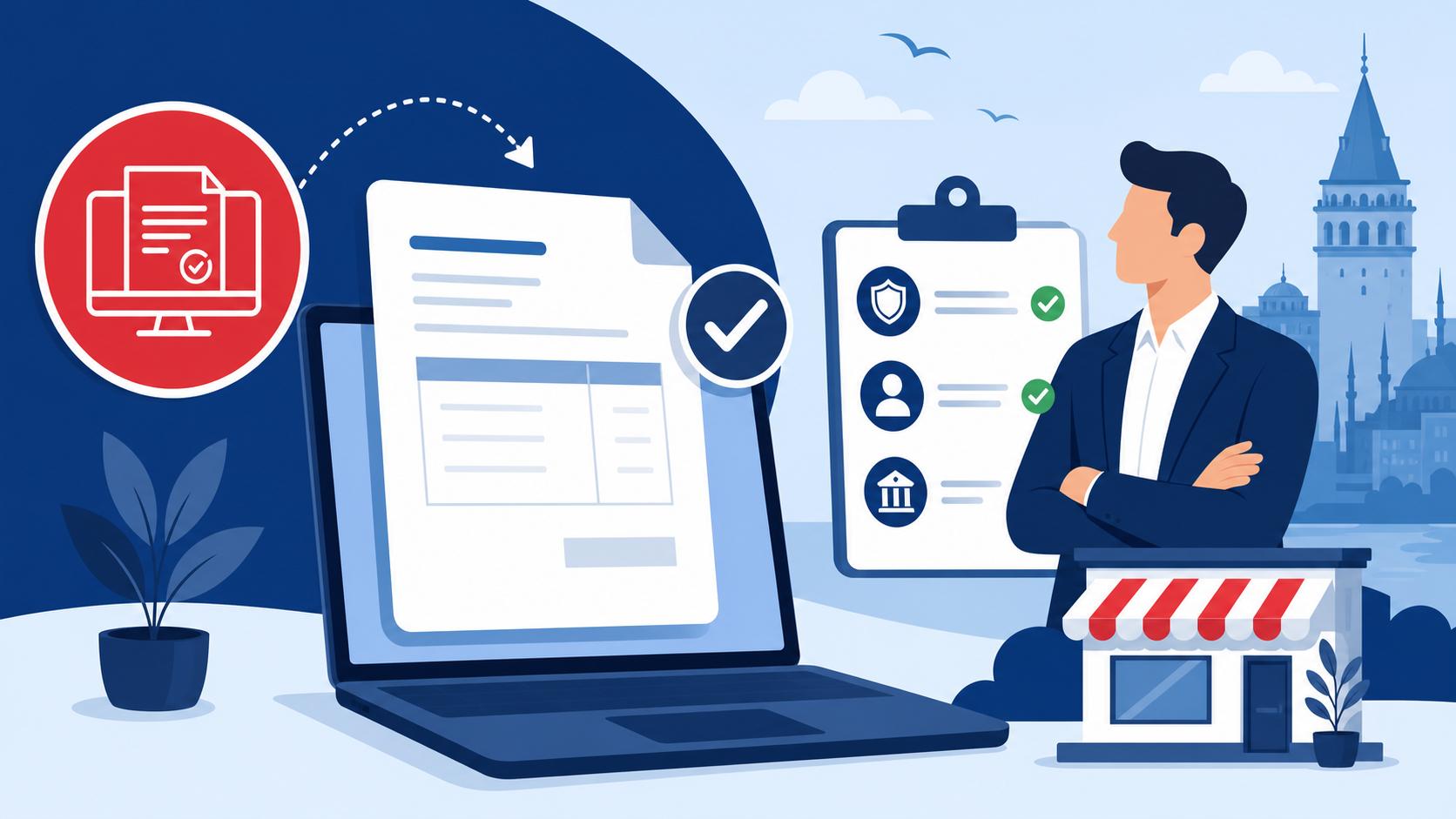
The e-Fatura system is a closed-loop network. It is used exclusively for transactions between two companies that are both registered in the e-Fatura system. Think of it like a secure, internal messaging system where the invoice is "pushed" from your portal directly to your client’s portal. The government sees this transaction in real-time.
On the other hand, e-Arşiv is what you use when your client is not in the e-Fatura system. This includes individual consumers (B2C) or businesses that haven't hit the mandatory registration thresholds yet. If you are billing a client abroad—say, a tech firm in London or a consulting group in New York—you will almost always be issuing an e-Arşiv invoice. This is a crucial distinction for digital nomads and exporters who often receive their payments through apps like Wise and need to back those transfers with legal documentation.
The GİB Portal: Your Digital Gateway
The government provides a free portal for businesses to issue these invoices. While it’s "free," it is notoriously clunky and often requires specific versions of Java to run. As someone who has spent hours troubleshooting browser settings just to send a simple bill, I can tell you that the GİB portal is best suited for businesses with very low invoice volumes. If you’re sending more than five invoices a month, you’ll likely want to look into a "Special Integrator" (Özel Entegratör). These are private companies that provide a much cleaner user interface and often offer mobile apps so you can bill a client while sitting at a café in Kadıköy.
Mandatory Enrollment: Who Actually Needs E-Invoicing?
The net has tightened significantly. In the early days, only massive industrial giants had to worry about digital billing. Today, even small-scale entrepreneurs are being pulled into the system. The requirements are generally based on your annual gross sales revenue, but there are certain sectors where you must enroll regardless of how much you earn.
If you are just starting out, you might find that Accounting Services for Foreign SMEs are your best resource for tracking these moving goalposts. The thresholds often change annually, and missing the transition deadline can lead to your business license being flagged.
Revenue Thresholds for 2026
Currently, the mandatory transition to e-Fatura and e-Arşiv is triggered if your gross sales revenue for the previous fiscal year exceeds 3 million TL. While that might sound like a lot, with the current inflation rates and the weakening Lira, many successful Freelancing and Self-Employment in Turkey operations find themselves hitting this ceiling sooner than expected.
Once you hit this threshold, you are legally required to transition to the e-invoice system by July 1st of the following year. It is not an overnight process. You have to apply for digital certificates, which can take weeks to arrive by post. If you wait until June 30th, you are going to have a very stressful week.
Specific Industries Forced into the System Early
There are certain "high-risk" or high-volume sectors that GİB monitors more closely. If your business falls into any of the following categories, you likely need to be in the e-invoice system regardless of your turnover:
- E-commerce service providers and those who facilitate online sales.
- Real estate internet advertising platforms.
- Automobile dealers and those involved in the rental of motor vehicles.
- Businesses involved with the production or import of construction materials.
For expats running niche e-commerce sites or managing Real Estate Taxes and Fees in Turkey for foreign investors, this means you are likely on the radar for mandatory e-transformation from day one.
| Requirement Type | E-Fatura (Inter-system) | E-Arşiv (External/B2C) |
|---|---|---|
| Recipient | Another e-Fatura user | Non-system users/Individuals |
| Delivery Method | Direct portal-to-portal | Email or PDF download |
| Reporting | Real-time to GİB | Daily summary report to GİB |
| Archiving | Digital (10 years) | Digital (10 years) |
| Mandatory Limit | >3M TL Revenue (General) | Required if using e-Fatura |
The Administrative Toolkit: Mali Mühür and E-Imza
Before you can click "Send" on your first digital invoice, you need a way to prove that you are who you say you are. In Turkey, this is done through two different types of digital signatures. If you are a Choosing a Turkish Bank regular, you might be used to SMS verification, but for tax purposes, the government requires hardware-based security.
Getting Your Financial Seal (Mali Mühür)
If you have a Limited Company (LTD) or a Joint Stock Company (AŞ), you must obtain a Mali Mühür (Financial Seal). This is essentially a USB stick that contains your company’s digital identity. You apply for this through "Kamu SM," a government-run certification authority.
The application process is entirely in Turkish, and the device is sent via PTT (the national post office) to your registered business address. One "I've-been-there" tip: the PTT courier will only hand this over to the authorized manager of the company. If you aren't home or at the office when they arrive, they won't leave it with a neighbor. You'll have to trek to the local PTT branch to claim it. Once you have it, you plug it into your computer whenever you need to sign and "seal" your monthly invoices or your Filing an Annual Tax Return in Turkey (Mart Ayı Beyannamesi) documents.
E-Signatures for Sole Proprietors
If you are operating as a Şahıs Şirketi (Sole Proprietorship), you have a bit more flexibility. Instead of a Mali Mühür, you can often use a personal e-imza (E-Signature). These are also USB-based devices but are tied to your T.C. Kimlik number (or your 99-number for foreigners).
The e-signature is a versatile tool for any expat. Beyond just invoicing, you’ll use it to sign contracts, access the e-Devlet portal for deep administrative tasks, and even for Setting Up Electricity and Water in Your Name via e-Devlet. It is generally wise to get a 3-year subscription for your e-signature; the 1-year version expires faster than you’d think, and the renewal process is just as tedious as the initial application.
Setting Up the Workflow: Integrators vs. Direct Portal
Once you have your digital signature in hand, you need to decide how you will actually generate the invoices. This is where your daily workflow is won or lost. Most expats I know who value their sanity eventually abandon the government’s free portal in favor of a "Special Integrator."
Why Most Expats Use a Special Integrator
Special Integrators are licensed third-party platforms like Paraşüt, Logo İşbaşı, or EDM. They act as the middleman between you and the GİB servers. The benefit is huge: they offer English-friendly (sometimes) or at least modern interfaces, they automatically archive your data for the legally required 10 years, and they allow you to design professional-looking invoices with your company logo.
Crucially, these integrators can link up with your Opening a Bank Account in Turkey to show you when an invoice has been paid. They also handle the "Stopaj" (withholding tax) calculations automatically. If you’ve ever tried to manually calculate the 20% withholding on a rental invoice or a professional service fee, you know how easy it is to make a 1-Lira mistake that ruins your entire monthly balance sheet.
Integrating with Global Tools and Financial Apps
While the Turkish e-invoice system is a local requirement, your business likely interacts with the global economy. You might be investing your surplus business profits into global markets via Trade Republic or managing your company’s crypto assets through Binance.
While the GİB system doesn't "talk" directly to these international platforms, your integrator will allow you to export your data in formats that your accountant can use to reconcile these accounts. It’s also worth noting that if you are paying for global services like NordVPN to secure your business's digital footprint, you can often enter these as expenses in your integrator, provided you have a proper receipt that matches your company details.
Compliance, Audits, and Penalties
Turkey does not take kindly to late or incorrect invoicing. The "rules of the road" are strict, and the fines are calculated per invoice. If you are audited and found to have issued 50 invoices incorrectly, the total penalty can be enough to put a small business out of commission.
The 7-Day Rule for Issuing Invoices
This is the rule that catches most foreigners off guard. Under Turkish Tax Law, an invoice must be issued within 7 days of the delivery of goods or the performance of a service. You cannot wait until the end of the month to "catch up" on all your billing for the past 30 days.
If you are providing ongoing consulting services, your "performance" date is usually the end of the month, but if you ship a product, the clock starts the second that product leaves your door. Some expats have got into hot water because they waited for the client to pay before issuing the invoice. In Turkey, the invoice comes first, then the payment. If you are receiving funds through Wise, make sure the date on your e-invoice matches the service period, regardless of when the SWIFT transfer actually lands in your account.
Archiving and Data Security
By law, you must keep copies of your e-invoices for 10 years. If you use the GİB portal, you are responsible for downloading and backing up these XML files yourself. If your laptop dies and you don't have a backup, those invoices are legally "lost," which is a nightmare during a tax inspection.
This is another reason to use an integrator, as they include cloud storage. However, since you are dealing with sensitive financial data, it is wise to use a secure connection like NordVPN when accessing your invoicing portal from a public network or even from your home office. Data breaches in the fintech space are real, and as a business owner, you are responsible for protecting your clients' TCKN and VKN (tax identification) numbers.
Step-by-Step Guide to Issuing Your First E-Invoice
Let’s walk through the actual process of sending a bill. It feels intimidating the first time, but it becomes muscle memory after a few tries.
Collecting Customer Information (VKN/TCKN)
In your home country, you might just need a name and an address to send a bill. In Turkey, you need the "Tax ID."
- For Businesses: You need their VKN (Vergi Kimlik Numarası) and their registered Tax Office name.
- For Individuals: You need their TCKN (Turkish ID Number).
- For Foreign Clients: If you are billing a company outside Turkey, you use the generic VKN "2222222222" and select the country code.
Without these numbers, the system will reject the invoice immediately. You can't just leave it blank. This is a common hurdle when Finding English-Speaking Doctors in Istanbul or other professionals who might need to bill you; they will ask for your ID number before they even treat you.
Managing Tax Withholding (Stopaj) on Invoices
If you are a freelancer (Serbest Meslek Makbuzu) billing a Turkish company, you will usually be subject to Stopaj. This means the client pays a portion of your tax directly to the government on your behalf, and you receive the "net" amount.
Your e-invoice must clearly show the Gross Amount, the VAT (KDV) amount—usually 20% in 2026—the Stopaj deduction, and the final "Net to be Paid." If you mess up these calculations, your Understanding Your Turkish Payslip (Bordro) logic will be entirely different from your business's actual cash flow.
Managing Business Finances as an Expat
The ultimate goal of all this bureaucracy is to make sure your business is "clean." Once your e-invoicing is automated, you can focus on the more interesting parts of running a business, like managing your Cost of Living in Turkey 2026.
Handling International Payments and Forex
For many of us, our clients are abroad. When you issue an e-Arşiv invoice for $1,000, the Turkish system requires you to record the "TL Equivalent" based on the Central Bank (TCMB) exchange rate of that day.
This is where things get tricky with the exchange rate. You might invoice at a rate of 34 TL/USD, but by the time the money hits your account via Wise or a traditional bank, the rate might be 33.5 TL/USD. This "exchange rate difference" (Kur Farkı) must also be accounted for by your SMMM (accountant).
If you are savvy, you might move some of your business savings into Cryptocurrencies in Turkey using Binance or explore Investing in Turkey options to hedge against Lira volatility. Just remember that while your "invoice" is the legal proof of income, your actual bank statements are what the tax office will use to verify that income.
Useful Resources for Digital Compliance
Transitioning to e-invoicing is just one piece of the puzzle. To stay fully compliant and financially healthy, you should keep an eye on your overall tax residency status and the Double Taxation Treaties between Turkey and your home country.
| Tool/Entity | Purpose in the E-Invoice Ecosystem |
|---|---|
| GİB Interactive Tax Office | To check for any "unissued" invoice flags or tax debts. |
| Kamu SM | The only place to order your Mali Mühür. |
| E-Devlet | To track your business registration and address. |
| Your SMMM | The licensed accountant who must "approve" your monthly ledgers. |
Running a business here is a marathon, not a sprint. The first year is always the hardest as you learn the rhythms of the Turkish Business Culture. But once you have your USB seal plugged in and your integrator app running, you’ll find that Turkey’s digital system is actually quite efficient—once you know how to speak its language.
Disclaimer
The information provided in this guide is for informational purposes only and does not constitute legal, financial, or tax advice. Turkish tax regulations, revenue thresholds, and e-transformation requirements are subject to frequent changes by the Revenue Administration (GİB). Always consult with a certified public accountant (SMMM) or a qualified legal professional in Turkey before making business decisions or applying for digital certificates. The author and publisher are not responsible for any penalties or legal issues arising from the use of this information.