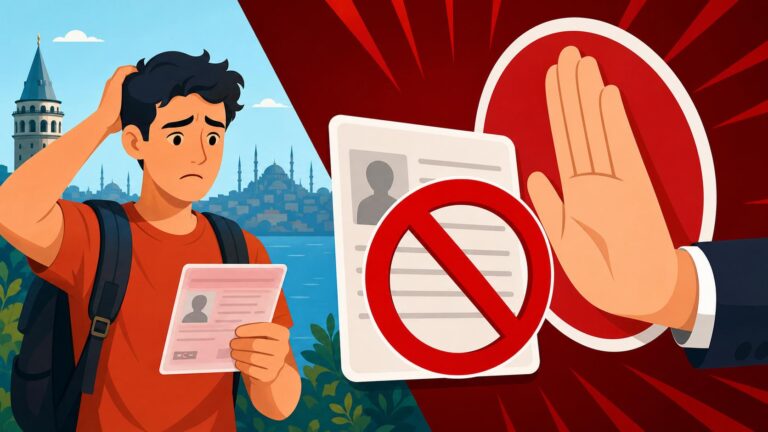
G-87 and Ç-114 Codes: Understanding Severe Entry Ban Restrictions at Borders
Imagine standing at the passport control desk at Istanbul Airport, heart racing as the officer stares at the screen for a second too long, only to be ushered into a quiet back room because of a code you’ve never heard of. I remember the cold sweat of my first minor bureaucratic hiccup in Ankara years ago, and while mine was just a paperwork error, codes like G-87 and Ç-114 are the heavyweights of Turkish immigration hurdles. This guide breaks down what these severe entry ban restrictions actually mean and how you can navigate the daunting path toward clearing your name.
Decoding the Alphabet Soup of Turkish Restriction Codes
When you deal with the Turkish Directorate General of Migration Management (Göç İdaresi), your file is often assigned specific "tahdit kodları" or restriction codes. Most expats are familiar with the "V" codes, such as V-160 for failing to provide an address, but the "G" and "Ç" series are an entirely different animal. These aren't just administrative slaps on the wrist; they are red flags that signify the Turkish state perceives a risk to national security, public order, or has identified a serious legal violation.
Understanding these codes is the first step toward resolution. A code is essentially a digital tag attached to your passport and your foreign identity number. If you are curious about how this number integrates into your daily life, you might want to look at The 99-Number: What Your T.C. Kimlik Number Gives You Access To in Daily Life. These codes effectively block your ability to enter the country or renew a residence permit until they are formally lifted or the time limit expires.
It is a common misconception that these codes disappear automatically. In reality, while some have a five-year or ten-year expiration, many—especially the G-series—require active legal intervention. If you find yourself flagged, the "wait and see" approach is usually the worst strategy you can take. You need to understand the gravity of the specific alphanumeric sequence assigned to you.
The G-87 Code: General Security and Public Order
The G-87 code is perhaps the most dreaded entry in the Turkish immigration database. In official terms, it stands for "Persons Who May Pose a Threat to General Security." This is a broad umbrella that the authorities use to flag individuals suspected of having links to prohibited organizations, involvement in activities against the state, or participation in events that are deemed a threat to public order.
One of the most frustrating aspects of the G-87 code is how vaguely it can be applied. There are cases where people have been flagged simply for being in the vicinity of a protest that turned violent, or for having their name appear in an investigation where they were never even a primary suspect. Because this code is tied to "intelligence," the specific evidence against you is often shielded from the public, making it incredibly difficult to defend yourself without specialized legal counsel.
If you are currently outside Turkey and hit with a G-87, your entry will be blocked immediately at the border. If you are inside the country, it usually triggers a deportation order. At this stage, having comprehensive coverage is vital for managing the stress of these situations; for instance, Health Insurance Requirements: Securing a Policy for First-Time Ikamet Applications is a standard part of residency, but specialized providers like Cigna Global are often preferred by those navigating complex international legal statuses because of their global reach and reliability.
The Ç-114 Code: Judicial Proceedings and Entry Bans
While G-87 focuses on security threats, the Ç-114 code is typically linked to legal issues. Specifically, it refers to "Foreigners Against Whom Judicial Action Has Been Taken." If you have been involved in a criminal case in Turkey—even as a defendant who was later acquitted—this code might still be attached to your file as a lingering administrative record.
The Ç-114 code is often accompanied by a temporary entry ban, usually ranging from one to five years. Unlike a simple fine for staying too long on a tourist visa, which you can read about in Overstays, Fines, and Deportation: Navigating Harsh Immigration Rules in Turkey, a Ç-114 indicates that the state has a record of you being a party to a court case or a police investigation. The presence of this code suggests that the authorities want to keep you out until they are satisfied that the legal matter is fully resolved or the "cool-off" period has passed.
It is important to note that a Ç-114 can be issued even if you haven't been convicted of a crime. Sometimes, just being the subject of an ongoing investigation (soruşturma) is enough for the local Emniyet (police) to request a restriction code from the Migration Office. This "guilty until proven innocent" approach in the administrative sphere is a frequent source of frustration for the expat community.
Comparison of Severe Restriction Codes and Their Implications
Navigating these codes requires a clear understanding of how they differ in severity and the typical pathway to resolution. Below is a comparison table to help you distinguish between the common "heavy" codes.
| Code | Meaning | Typical Duration | Primary Cause |
|---|---|---|---|
| G-87 | Threat to General Security | Often Indefinite | Intelligence reports, suspected organization links |
| Ç-114 | Subject to Judicial Action | 1 to 5 Years | Criminal investigations, court cases, public order issues |
| Ç-115 | Released from Prison | 2 to 10 Years | Completion of a criminal sentence in Turkey |
| G-42 | Drug Crimes | Indefinite/Permanent | Suspected or proven involvement in narcotics |
| Ç-141 | International Security (Interpol) | Indefinite | Flagged by foreign governments via Interpol |
The Legal Pathway: How to Lift an Entry Ban
Lifting a G-87 or Ç-114 code is rarely a simple "fill out a form" process. In almost every case, you will need to file a lawsuit in the Turkish Administrative Court (İdare Mahkemesi) to challenge the grounds of the restriction. This is known as an "annulment lawsuit." You essentially argue that the code was issued without sufficient evidence or that the underlying reason for the code is no longer valid.
The process usually looks like this:
- Identification: You officially learn of the code, usually at the border or during a residency appointment.
- Consultation: You hire a lawyer who specializes in foreigners' law. Don't skip this; the language and procedures are far too complex for a layperson.
- Information Request: Your lawyer files a request to the Ministry of Interior to learn the "basis" of the code.
- Lawsuit Filing: You have 60 days from the date of notification to file your annulment case.
- Annotated Visa: In some cases, while the lawsuit is ongoing, you might apply for a "meşruhatlı vize" (annotated visa) for work or family reasons to enter the country legally.
During this process, you will likely need to provide a mountain of paperwork from your home country to prove your "clean" status. This is where services like RushTranslate become essential, as all foreign documents—from police clearance certificates to character references—must be professionally translated and notarized. You can find more details on how this works in Sworn Translators (Yeminli Tercüman): Expected Costs for Official Documents. If your case reaches the court, you will find it useful to study Filing an Appeal in the Turkish Administrative Court After an Ikamet Denial for a deeper look at the judicial timeline.
Navigating the Administrative Hurdles from Abroad
If you are outside Turkey when you discover a Ç-114 or G-87 code, you cannot simply fly back and hope for the best. You will be stopped at the "Inadmissible Passenger" (INAD) desk and sent back on the next available flight. Instead, you must act through the Turkish Consulate in your current country or grant power of attorney (vekaletname) to a lawyer in Turkey.
The consulate can provide an "entry-exit record" which will show the codes, but they often cannot tell you the "why." To get to the bottom of the mystery, your lawyer in Turkey will need to visit the Provincial Migration Office. If you need help communicating with these offices, Navigating YİMER 157: How to Use the Foreigner Helpline for Immigration Queries is a great resource for getting initial pointers, though they cannot lift security codes over the phone.
Be wary of anyone who promises they can "delete" your code for a flat fee without a court process. The Turkish immigration system has become increasingly digitized and transparent internally; "fixing" things through unofficial channels is a recipe for a permanent ban or a "V-codes" nightmare. Stick to the legal route, even if it takes 12 to 18 months for a court decision.
Why Some Neighborhoods and Addresses Trigger Red Flags
Interestingly, your physical location in Turkey can sometimes play a role in how the authorities perceive your "risk." In recent years, Turkey has implemented a list of "closed neighborhoods" where foreigners can no longer register their addresses. Living or being associated with certain high-scrutiny areas can sometimes lead to increased monitoring or, in extreme cases, administrative flags if the address is suspected of being a "ghost" residence for multiple people.
To stay on the right side of the law, always ensure your address is registered correctly at the Nüfus (Civil Registry) office. You can learn more about this in Navigating Closed Neighborhoods: A Guide to Areas Where Foreigners Cannot Register. If you move, the 20-day notification rule is non-negotiable. Failure to update your location can lead to "V" codes that, while not as severe as G-87, can still result in the cancellation of your residency. For the exact steps, see Address Registration (Nüfus): The Most Critical Post-Arrival Step for Foreigners.
Final Thoughts for the Flagged Expat
Discovering a G-87 or Ç-114 code is a traumatic experience. It feels like the country you've made your home has suddenly turned its back on you. However, it is important to remember that these codes are often the result of broad-stroke administrative policies rather than a personal vendetta. Many foreigners have successfully cleared their names by being patient, following the legal process, and ensuring every document—supported by reliable partners like RushTranslate for translations or Cigna Global for necessary insurance—is meticulously prepared.
If you are currently facing a code, your first priority should be securing a Power of Attorney for a reputable lawyer. Do not attempt to cross the border "just to see if it works." It won't, and it will only result in more "V" codes for attempting to circumvent an entry ban. Take a deep breath, gather your evidence, and start the formal appeal process. The Turkish legal system is slow, but it does provide a mechanism for correction.
Disclaimer
The information provided in this article is for informational purposes only and does not constitute legal advice. Immigration laws and restriction code policies in Turkey are subject to frequent change. Always consult with a qualified Turkish immigration attorney before taking any legal action or attempting to resolve a restriction code.