Will Unpaid Utility Bills or Taxes Prevent Me from Exiting Turkey at the Airport?
The moment you hand your passport to the officer at Istanbul Airport, a tiny surge of adrenaline is normal, but for many expats, it is replaced by a cold dread that an overlooked electricity bill or a forgotten traffic fine will flash red on their screen. I once spent a three-hour layover in a cold sweat because I realized I’d left an unpaid water bill from my old apartment in Kadıköy, convinced the police would pull me out of the boarding queue. This guide clarifies exactly which financial obligations can legally prevent you from leaving Turkey and how to ensure your record is spotless before you head to the gate.
The Critical Distinction Between Public and Private Debt
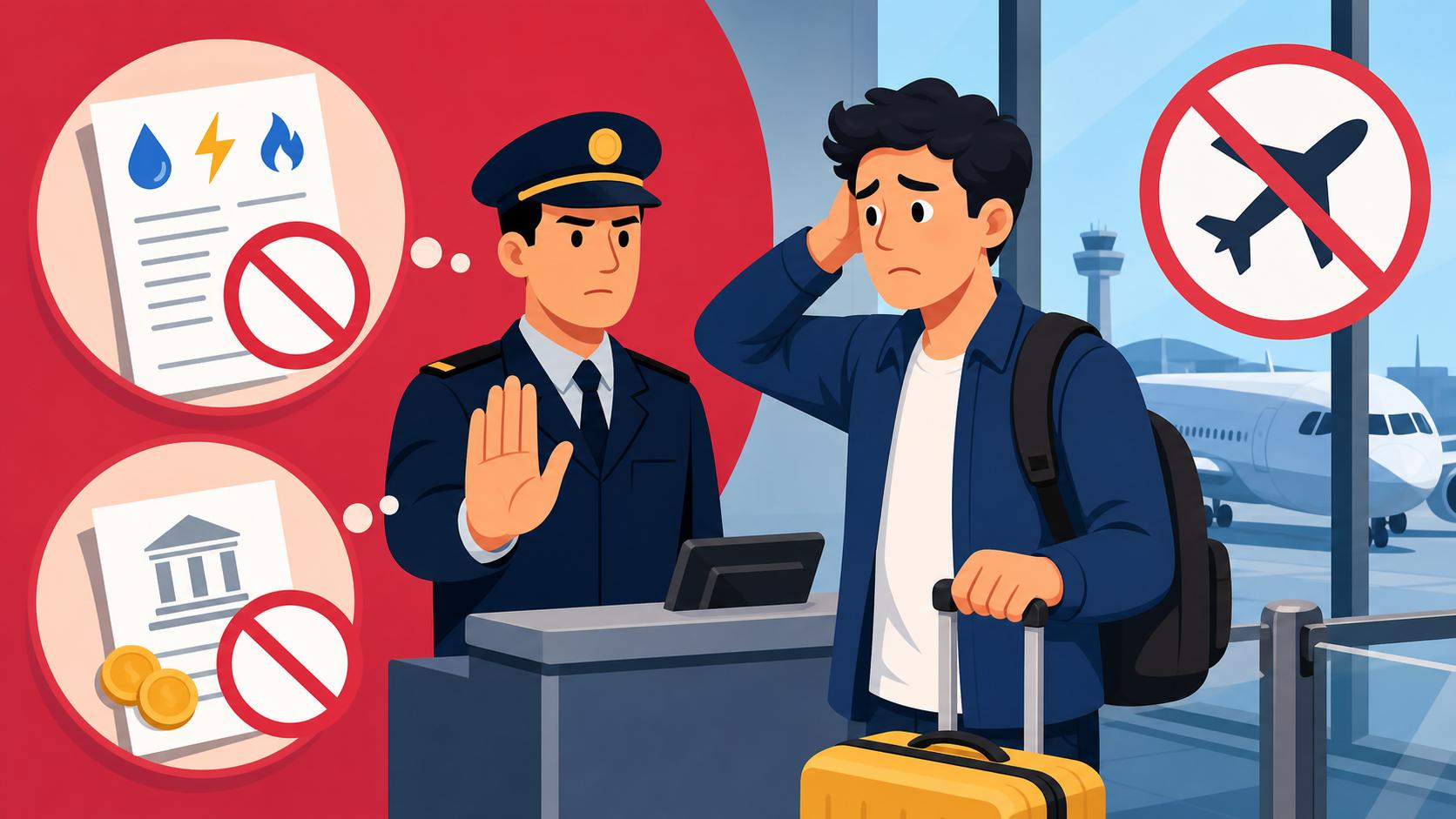
In Turkey, not all debts are created equal when it comes to the Ministry of Interior’s passport control systems. The most important thing to understand is that the computer system at the airport is primarily linked to government databases, not the private ledgers of telecommunications or utility companies. If you owe money to a private entity, the consequences are usually civil and financial rather than immediate travel restrictions.
Private debts include things like your monthly internet bill, your mobile phone contract, or your electricity and gas payments. If you move out of an apartment and leave a 1,000 TL balance on your EnerjiSA bill, the company does not have the authority to place an automatic "exit ban" on your passport. What they can do, however, is initiate a legal "icra" (execution) process. This involves a lawyer and a court order to freeze your Turkish bank accounts. While this is a massive headache—especially if you plan to return—it rarely results in you being stopped at the terminal unless the debt is massive and has escalated into a criminal fraud case, which is exceptionally rare for standard utility arrears.
Public debt, on the other hand, is a different beast entirely. These are debts owed directly to the Turkish state. This includes income tax, Corporate Tax, Value Added Tax (VAT), Motor Vehicle Tax (MTV), and administrative fines such as those for traffic violations or overstaying a visa. Because the Tax Office (Vergi Dairesi) and the Border Police operate under the same national digital infrastructure, these debts are visible. However, even with public debt, you aren't typically stopped at the border for a few hundred liras. The state is much more likely to block your bank account or prevent you from selling a car than they are to physically prevent you from boarding a plane.
When Taxes and Fines Become a Border Issue
While a standard tax debt won't usually stop you from leaving, it can certainly prevent you from coming back or renewing your residency. More importantly, specific types of "public debt" are flagged immediately during the exit process. The most common scenario where an expat is pulled aside involves visa overstay fines. If you have stayed past your 90-day tourist limit or your residence permit has expired, the system will flag you. You will be sent to the "Violation Office" at the airport to pay a fine before you are allowed to pass through.
Another area of concern is the SGK system. If you are enrolled in the state health insurance, you should be aware of your SGK Monthly Premiums 2026: Payment Methods and Coverage for Expats to ensure you don't have a mounting debt. While unpaid SGK premiums don't typically trigger a travel ban, they are a significant liability. If you are a business owner or freelancer, Filing an Annual Tax Return in Turkey (Mart Ayı Beyannamesi) Before March 31 is essential. If the state believes you are fleeing a massive tax obligation, they can, in theory, apply for a judicial "Yurt Dışı Çıkış Yasağı" (International Travel Ban). This is a court-ordered restriction that is usually reserved for major tax evasion, criminal investigations, or significant legal disputes.
Traffic fines are another common worry. Many foreigners wonder How to Check Your Traffic Fines (Trafik Cezası) and Pay Safely on e-Devlet because they fear a speeding ticket from a summer trip to Kaş will haunt them at the airport. Generally, you can exit with unpaid traffic fines, but you will be unable to perform any transactions related to your vehicle, and the interest rates on those fines are notoriously high. If you want to clear these quickly, using an app like Wise to transfer funds into your Turkish account for payment is often the most efficient route.
Understanding the Judicial Exit Ban (Yurt Dışı Çıkış Yasağı)
The only way a financial debt will absolutely, 100% prevent you from passing through the gate is if there is a judicial exit ban placed on your name. This is not something that happens automatically because you forgot to pay your rent or missed a credit card payment. A travel ban is a legal measure taken by a prosecutor or a judge, usually during an ongoing court case.
If you are involved in a civil lawsuit—perhaps a landlord-tenant dispute that has turned ugly—your opponent could technically ask the court for an interim injunction to prevent you from leaving the country if they can prove you are a "flight risk" with significant unpaid liabilities. For most expats, Renting in Turkey: Lease Contracts, Deposits, and Tenant Rights Explained provides enough protection to avoid such escalations, but it is a reminder that legal disputes should never be ignored. If you have an active court case in Turkey, you should always check your status on the UYAP (National Judicial Network) system via e-Devlet.
| Debt Type | Entity | Likely to Stop You at Airport? | Consequence of Non-Payment |
|---|---|---|---|
| Electricity / Water | Private Utility | No | Service cut-off, bank account freeze (icra) |
| Internet / Mobile | Turkcell / Vodafone | No | Contract termination, credit score damage |
| Traffic Fines | Government | No | High interest, car sale/inspection blocked |
| Visa Overstay Fine | Göç İdaresi | Yes (Must pay to leave) | Re-entry ban, immediate fine payment |
| Income Tax | Vergi Dairesi | Only if "Exit Ban" is issued | Bank account freeze, property lien |
| SGK Premiums | Social Security | No | Loss of health coverage, debt accumulation |
| Credit Card / Loans | Turkish Banks | No | Legal action, bank account freeze |
How to Verify Your Financial Status via e-Devlet
The "e-Devlet" portal is an expat’s most powerful tool for avoiding airport surprises. It is a centralized system where almost every interaction with the Turkish state is recorded. Before you head to the airport, I highly recommend logging in to check your "Vergi Borcu" (Tax Debt) and your "Adli Sicil Kaydı" (Judicial Record). Knowing how to use E-Devlet Financial Services: Tracking Taxes, SGK Debts, and Bank Accounts can save you hours of stress.
Once logged in, search for "GİB" (Gelir İdaresi Başkanlığı) to see if you have any outstanding tax liabilities. You should also search for "İcra Dosyası Sorgulama" to see if any private companies have started a legal execution process against you. If you are abroad and trying to check these systems, you might find that some Turkish government sites are geo-blocked or behave erratically. Using a service like NordVPN to set your location to Istanbul can help you access these portals smoothly from anywhere in the world.
If you do find a debt, it is best to pay it immediately. Most taxes and fines can be paid directly through the e-Devlet portal using a Turkish credit card or through the mobile apps of major banks. If you have shifted your investments into international platforms like Trade Republic or keep your liquid assets in Binance, you may need to transfer some funds back into the Turkish Lira system to settle these debts. Always ensure you keep a digital receipt of the payment, just in case the airport system hasn't synced by the time you reach the desk.
What Happens if You Are Flagged at Passport Control?
If the unthinkable happens and the officer tells you there is an issue, stay calm. In 99% of cases involving foreigners, the "issue" is a visa overstay fine or a technicality regarding your residence permit. You will be directed to a small office, usually labeled "Vize İhlal" (Visa Violation) or "Maliye" (Finance). Here, an official will calculate the fine based on how long you have overstayed.
The process is bureaucratic but usually functional. You will be given a paper showing the amount owed, you pay it at a nearby bank window or desk (often cash only or Turkish cards only), and then you return to the officer with your receipt. If the issue is a judicial travel ban, however, you will not be allowed to fly. The police will take you to a station within the airport to explain the court order. This is why it is vital to stay on top of your Ikamet Rejections: Exact Steps on What to Do If Your Residence Permit is Denied and ensure you aren't accidentally falling into an illegal status.
For those who are worried about more serious immigration codes, it is worth researching G-87 and Ç-114 Codes: Understanding Severe Entry Ban Restrictions at Borders. While these are usually related to security or repeated visa violations rather than a simple unpaid phone bill, they represent the more serious end of the "airport flag" spectrum.
Proactive Financial Management for Expats
Living in Turkey requires a proactive approach to "cleaning your slate," especially if you are leaving permanently or for an extended period. Many expats make the mistake of just "switching off" and leaving. However, Turkey’s digital tracking is becoming increasingly sophisticated. Even if you aren't stopped at the airport today, an unpaid debt can double or triple with interest over a few years, making it impossible to return to Turkey in the future without paying a small fortune.
When I moved between apartments, I made it a point to go to the local water and gas offices to "kapatmak" (close) my accounts and get a "borcu yoktur" (no debt) paper. If you can't do this in person, try to manage it through the company’s mobile app. For managing my global finances while dealing with Turkish Lira volatility, I found that keeping a balance in Wise allowed me to pay these final bills in Lira without getting crushed by bank exchange rates. It also provides a clear paper trail in English, which is helpful if you ever need to prove to a future landlord or official that you settled your accounts.
If you are a frequent traveler, consider the following checklist before your flight:
- Check e-Devlet for any "Vergi Borcu" (Tax Debt).
- Verify that your SGK Monthly Premiums 2026: Payment Methods and Coverage for Expats are up to date.
- Check for any "İcra" (Legal Execution) files on your name.
- Ensure your address registration is current; failing to do so can lead to fines which appear on your record, as explained in Address Registration Penalties: The 4,000+ TL Fine for Missing the 20-Day Window.
- Pay any outstanding HGS (toll) or traffic fines.
Final Thoughts on Leaving Turkey Financially Clean
The fear of the airport "red light" is often worse than the reality, but it serves as a good motivator to keep your affairs in order. Turkey is a country that runs on documentation and digital records. While an unpaid internet bill from 2023 likely won't see you handcuffed at the gate, the peace of mind that comes from knowing your e-Devlet is "clean" is worth the effort of a few clicks.
If you are leaving Turkey for good, don't just walk away. Close your bank accounts properly after your final bills are paid, settle your taxes, and ensure your residency status is closed out correctly at the airport. By being diligent, you ensure that your exit from this beautiful country is as smooth as your arrival was, leaving the door open for a return without the shadow of debt hanging over your passport.
Disclaimer
The information provided in this guide is for informational purposes only and does not constitute legal or financial advice. Turkish immigration and tax laws are subject to frequent changes. While we strive to provide the most current information for 2026, you should always consult with a qualified Turkish attorney or a certified public accountant regarding your specific legal or financial situation. We are not responsible for any actions taken based on the contents of this article.