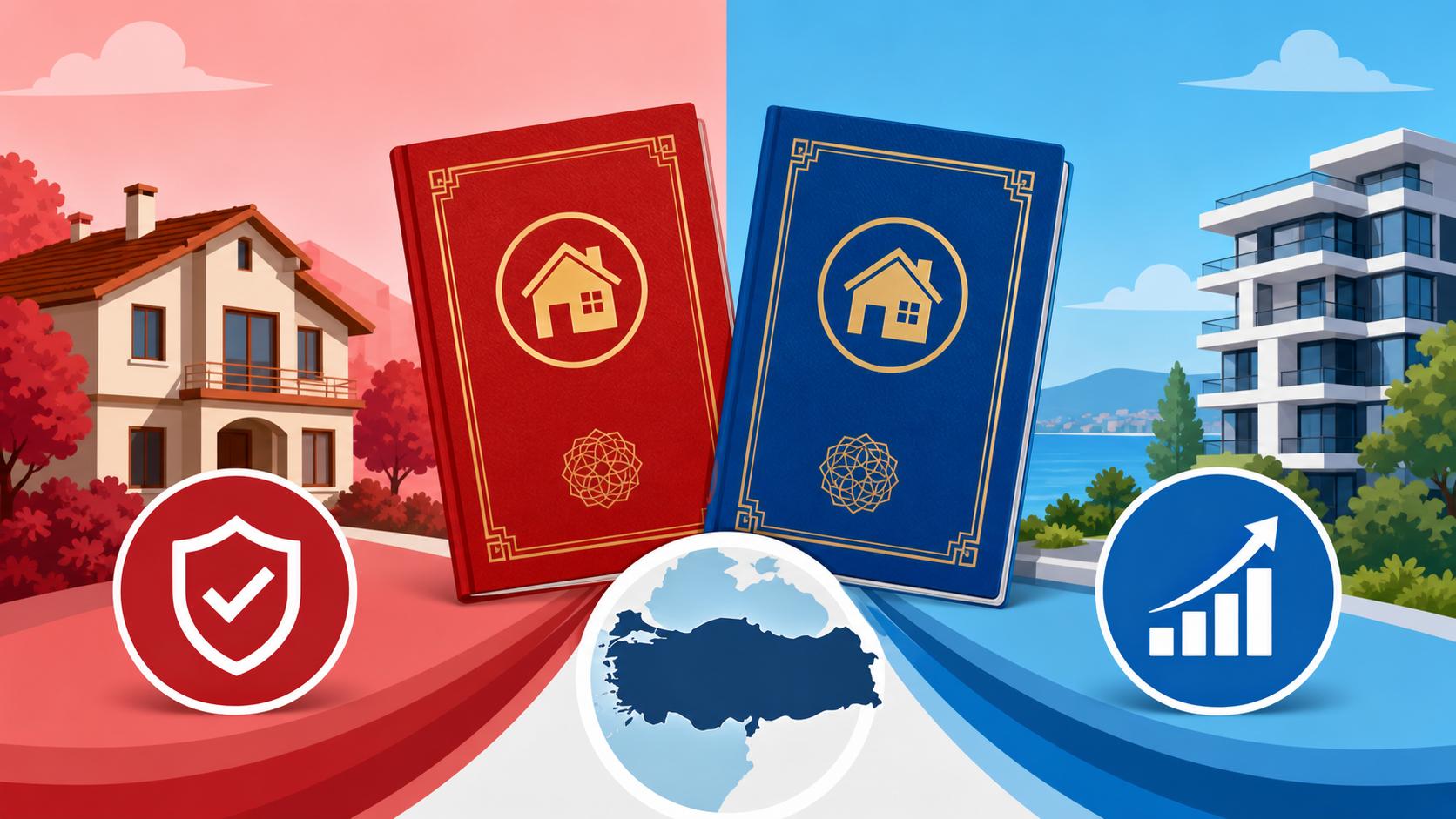
Title Deed Colors: What a Red Tapu vs Blue Tapu Means in Turkey
Walking into a Turkish Land Registry office feels like stepping into a high-stakes puzzle where the wrong piece of paper could cost you your life savings. I remember my first property hunt in Kadıköy; I was shown a "garden floor" apartment that looked perfect, but the deed was a shade of blue that the agent claimed was just a minor administrative detail. This guide decodes exactly what red and blue title deeds mean so you can navigate the Turkish real estate market with your eyes wide open.
Decoding the Visual Language of the Tapu Senedi
The Tapu Senedi, or title deed, is the most important document you will handle when moving to Turkey. In the Turkish system, the color of the border on this document is not a stylistic choice; it is a legal classification that tells you everything you need to know about what you actually own. When I first started looking at listings, I assumed a deed was a deed, but the reality is much more nuanced.
A title deed represents your legal right to a property, and it is issued by the General Directorate of Land Registry and Cadastre (Tapu ve Kadastro Genel Müdürlüğü). Before you even consider transferring funds, you need to understand that the color of the paper dictates your future ability to get a residence permit, sell the property, or even legally live in it. Many foreigners are caught off guard because they don't realize that Real Estate Taxes and Fees in Turkey: Buying, Selling, and Renting Costs can vary depending on the type of deed you are holding.
If you are currently in the middle of a property search, staying connected is vital for checking live listings or translating documents on the fly. It is usually advisable to get an e-sim from Airalo as soon as you land so you aren't tethered to patchy cafe Wi-Fi while trying to verify a deed status with your lawyer. Having reliable data ensures you can cross-reference the information provided by an agent against official government portals in real-time.
The Blue Tapu: Land Ownership and Potential Pitfalls
If the document handed to you has a blue border, it generally signifies land ownership (Arsa) or agricultural land (Tarla). This means that, in the eyes of the government, the "independent units"—meaning the actual apartments or houses built on that land—have not yet been officially recognized as separate dwellings. This is where most expats run into trouble.
A blue deed is common for empty plots or for buildings that are still under construction. If you are buying a plot to build your dream home, a blue deed is exactly what you want. However, if you are looking at a finished apartment and the owner produces a blue deed, you need to proceed with extreme caution. It often means the building hasn't received its Iskan (habitation certificate). Without this, you might struggle with utility connections or find that Can Foreigners Buy Agricultural Land in Turkey or Only Residential Property? rules apply, which are much stricter for non-citizens.
In some cases, a blue deed represents Kat İrtifakı, or construction servitude. This is a "middle-ground" status where the project is approved, and your specific unit is theoretically designated, but the building isn't officially finished or inspected. While buying a property with a blue deed can be cheaper, the risks regarding future permits and legal status are significantly higher. If your goal is to secure residency, you must verify if the property meets the current valuation requirements, as outlined in the guide on Real Estate Residence Permits: Understanding the Strict USD 200,000 Tapu Rule.
The Red Tapu: The Gold Standard for Homeowners
A red-bordered title deed is what every expat buyer should ideally be aiming for. This color indicates that the property is an "independent unit" (Kat Mülkiyeti), such as an apartment, a villa in a complex, or an office space. When you hold a red tapu, it means the building has passed all municipal inspections, the habitation certificate (Iskan) has been issued, and the land has been subdivided into individual ownership shares.
Holding a red deed provides a level of security that a blue deed simply cannot match. It proves that the structure is legal, built according to approved plans, and ready for occupancy. From my experience, banks are also much more willing to provide mortgages or financial services to properties with red deeds. If you are navigating the Buying Property in Turkey: Understanding Title Deeds (Tapu) and Valuation process, always insist on seeing the red deed before signing a preliminary sales contract.
If you have just arrived and aren't ready to commit to a red tapu purchase yet, many expats choose to stay in managed apartments provided by Blueground. This allows you to live in a high-quality, fully furnished home while you take the necessary time to vet different neighborhoods and verify deed colors without the pressure of a ticking clock. Once you finally do secure that red deed and move into your permanent home, you’ll likely find yourself spending a lot of time on Amazon Turkey ordering the essentials to turn a shell of an apartment into a home, from kitchenware to home security cameras.
Key Comparisons Between Blue and Red Title Deeds
To make it easier to visualize the differences, I have put together a table that summarizes the core distinctions between these two types of documents. This is a simplified view, but it covers the essential legal standing you need to be aware of during your negotiations.
| Feature | Blue Border Tapu (Mavi Tapu) | Red Border Tapu (Kırmızı Tapu) |
|---|---|---|
| Primary Classification | Land, Field, or Garden (Arsa/Tarla) | Independent Residential/Commercial Unit |
| Iskan (Habitation Certificate) | Usually missing or not yet applied | Must be present for full Kat Mülkiyeti |
| Legal Status | Construction Servitude or Agricultural | Full Ownership (Condominium) |
| Residence Permit Risk | Higher risk; might not be recognized | Preferred for Ikamet and Citizenship |
| Utility Connections | Often billed at "Construction" rates (Expensive) | Standard Residential Rates |
| Resale Value | Generally lower; harder to finance | Higher; standard market value |
Crucial Steps Before Finalizing Your Purchase
Before you head to the Land Registry office, there are several "invisible" checks you must perform. The color of the deed is a great start, but it doesn't tell the whole story. You need to ensure there are no Haciz (liens) or İpotek (mortgages) on the property. I have seen many people get to the final stage of The Tapu Transfer Process: What Happens at the Land Registry Office only to find out the seller has unpaid debts that prevent the transfer.
Another modern requirement is the Döviz Alım Belgesi (DAB), or Foreign Exchange Document. Since 2022, foreigners must sell their foreign currency to a Turkish bank, which then sells it to the Central Bank, to obtain this document before the title deed can be transferred. If you skip this step, the land registry will not process your application. You can find more detail on this in the How to Get a Foreign Exchange Document (DAB) for Real Estate Purchases guide.
If you are buying a home in a more sensitive area, such as a coastal town or near a military installation, you might also need to look into Understanding the Military Clearance Process for Foreign Property Buyers. While this process has been simplified in recent years, it is still a hurdle that can delay the transition from a "pending" status to holding that physical red deed in your hands.
Final Advice for Navigating the Turkish Property Market
Living in Turkey is an incredible experience, but the administrative side requires a thick skin and a lot of patience. Don't let an eager real estate agent rush you into a blue deed if you are looking for a residential apartment. It is advisable to treat a blue deed on a finished building as a red flag until a lawyer has thoroughly checked the municipal records.
While you are doing your due diligence, keep your tools sharp. Use Airalo to stay in touch with your legal counsel, and if the search takes longer than a few weeks, don't settle for a sub-par hotel. A service like Blueground gives you the "local" feel without the long-term commitment of a lease, allowing you to walk the streets of potential neighborhoods at different times of the day. And when the day finally comes that you are holding your red tapu, you can start the fun part—shopping on Amazon Turkey for the furniture and decor that will make your new Turkish life comfortable.
One final pro tip: always ensure you have your tax ID ready before the big day. You can follow the Step-by-Step: Applying for a Tax ID Number at the Interactive Tax Office guide to get this sorted in minutes. Having all your ducks in a row makes the difference between a smooth transfer and a bureaucratic nightmare.
Disclaimer
This guide is for informational purposes only and does not constitute legal, financial, or professional real estate advice. The Turkish property market and its regulations are subject to frequent changes. Always consult with a qualified Turkish lawyer and a licensed real estate professional before making any significant financial investments or signing legal documents in Turkey.