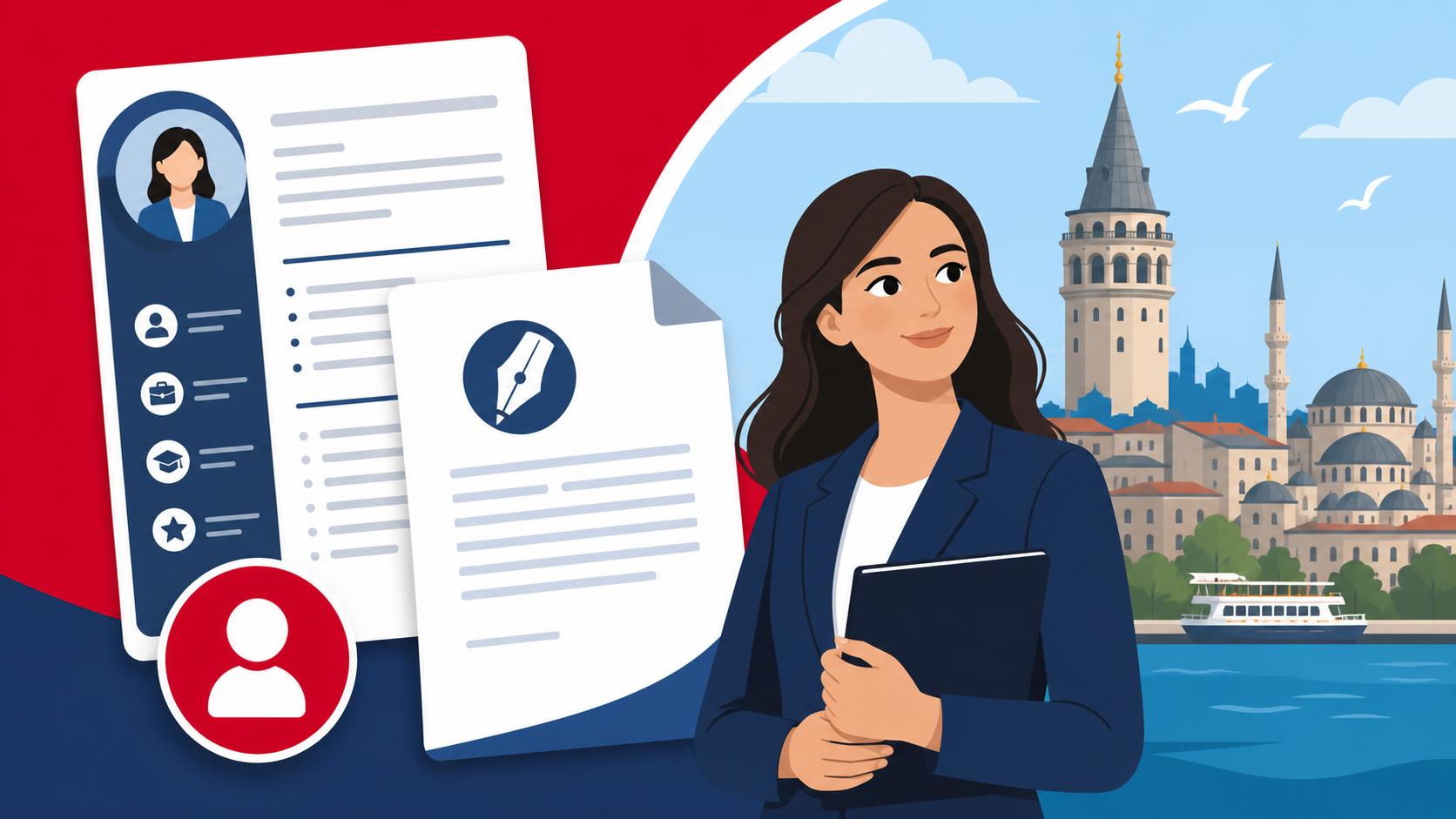
How to Write a CV and Cover Letter Tailored for Turkish Employers
Landing a job in Turkey often feels like shouting into a void where your impressive international background just doesn't seem to translate. I spent months sending out my standard Western-style resume only to receive absolute silence, and I eventually learned that the Turkish recruitment world has its own set of unwritten rules and specific formatting expectations. This guide solves the mystery of the Turkish application process, helping you pivot your materials to catch the eye of local hiring managers.
The Essential Anatomy of a Turkish CV
In many Western countries, including personal details like your age or a photograph is considered a major HR taboo. In Turkey, the opposite is true. If you submit a "blind" resume without a photo or basic personal data, your CV might be set aside simply because it looks incomplete. Turkish recruiters often use these details to build a mental profile of the candidate before they even read about your work history. It is about familiarity and trust, which are cornerstones of the local professional culture.
The Mandatory Photograph and Professionalism
The photograph is perhaps the most striking difference for those coming from the US or UK. In Turkey, a professional headshot is almost universally expected. This isn't just a suggestion; it’s a cultural standard. I remember feeling incredibly uncomfortable adding my face to my CV, fearing it would lead to bias, but I soon realized that without it, I wasn't even getting past the initial screening. The photo should be recent, taken against a plain background, and you should be dressed in business attire.
Avoid using "vacation shots" where you’ve clearly cropped out a friend, or selfies taken in a car. Turkish employers value a sense of "ciddiyet"—seriousness and solemnity—in professional documents. A high-quality photo signals that you are a serious professional who understands local norms. If you are applying for a corporate role in Levent or Maslak, your photo should reflect that high-stakes environment. Even for creative roles, a polished, professional image is better than something overly casual.
Beyond the aesthetics, the photo serves as a memory aid for recruiters who may be interviewing dozens of people. When they sit down to discuss candidates, having a face to connect to the name helps them recall the nuances of your conversation. While it may feel intrusive, try to view it as your first opportunity to project a professional and approachable "Bey" or "Hanım" persona to your future employer.
Personal Information: What to Share and What to Hide
A Turkish CV often includes a "Personal Information" section that would make a Western HR manager faint. It is common to see date of birth, marital status, and even military service status for male candidates. While as a foreigner you aren't expected to have done Turkish military service, stating your nationality and residency status clearly is vital. This helps the employer immediately understand the logistical hurdles, such as The 5-to-1 Rule: Why Turkish Employers Struggle to Sponsor Foreigners.
You should also clearly list your "Ikamet" (residence permit) status if you already have one. Employers are often hesitant to start the work permit process from scratch for someone who isn't even in the country yet. Mentioning that you already have a valid permit can significantly lower their perceived risk. For those still learning the ropes, using a resource like TurkishPod101 to understand the terminology for different types of residency and permits can help you accurately describe your legal status on your CV.
Lastly, don't forget to include your full contact information, including a Turkish phone number. Using a foreign number can be a subtle deterrent, as it implies you might not be fully committed to life in Turkey or that you are currently abroad. If you are serious about the move, getting a local SIM and listing that number, along with your neighborhood of residence, shows that you are locally "grounded" and ready to start.
Structuring Your Experience for the Turkish Market
The way you describe your previous roles needs a slight "localization" to resonate with Turkish HR professionals. While your titles might be clear in your home country, they may not carry the same weight here unless you provide context. Turkey is a very title-conscious society, and the hierarchy within a company is often more rigid than in the startup-heavy cultures of the West. You need to ensure your experience reflects a clear trajectory of growth and responsibility.
Emphasizing Institutional Reputation and Titles
In Turkey, the "name brand" of your previous employers and universities matters immensely. If you worked for a global giant like Google or Unilever, make that prominent. However, if your previous employers were smaller firms that are unknown in Turkey, you need to provide a one-sentence description of the company’s size and industry. For example, instead of just "Marketing Manager at Smith & Co.," write "Marketing Manager at Smith & Co. (Leading UK-based Fintech firm with 500+ employees)."
Your job titles should also be translated or adapted to their Turkish equivalents if they are confusing. For instance, a "Product Evangelist" might be better described as a "Senior Product Marketing and Communications Lead" to ensure the recruiter understands the seniority level. Turkish companies often look for a linear career path. If you have gaps in your CV or have made major career pivots, be prepared to explain these in a way that emphasizes the skills gained rather than the "instability" of the change.
Educational background is also highly scrutinized. If you have a degree from a top-tier international university, highlight it. You should also be aware that for certain regulated professions, you may eventually need to discuss your Diploma Equivalence (Denklik): Validating Your Foreign Degrees in Turkey. Even if you haven't started that process yet, knowing where your degree stands in the eyes of the Turkish Higher Education Council (YÖK) can be a strong talking point during the recruitment phase.
Language Skills and the Power of Turkish Proficiency
For an expat, your language section is perhaps the most important part of your CV. Do not just say "English – Native." You need to break down your Turkish language level with total honesty. Using the Common European Framework of Reference for Languages (A1, A2, B1, etc.) is the standard in Turkey. Even if your Turkish is only at a "Survival" level, showing that you are actively learning through platforms like TurkishPod101 demonstrates cultural integration and a long-term commitment to the country.
If you are applying for an English-speaking role, emphasize any experience you have working in multicultural environments. Many Turkish firms want to "internationalize" and are looking for expats who can bridge the gap between their local operations and global partners. If you speak a third language, such as German, French, or Arabic, make sure it is prominent, as Turkey’s geographical and economic position makes multilingualism a massive asset.
Beyond just listing the languages, you can add a small note about your "Business Turkish" capabilities. If you can handle a basic meeting or write a simple email in Turkish, that puts you miles ahead of other foreign candidates who refuse to learn the local tongue. Mentioning that you are studying Business Turkish: Essential Vocabulary and Phrases for Emails and Meetings shows a proactive attitude that Turkish managers deeply respect.
Crafting a Cover Letter That Resonates Locally
The cover letter, or "Niyet Mektubu" (Letter of Intent), is your chance to break the "foreigner" barrier. In Turkey, a cover letter is not just a summary of your CV; it is a formal introduction that should convey respect, enthusiasm, and a clear reason for why you want to work in Turkey specifically. It is the place to address the "elephant in the room"—why an expat is applying for a role that a local could potentially fill.
Formal Tones and Respectful Salutations
Turkish business culture is significantly more formal than what you might find in North America or Northern Europe. Your cover letter should reflect this through its tone and structure. Start with a formal salutation like "Sayın İlgili" (To whom it may concern) or, if you know the name of the hiring manager, "Sayın [Surname] Bey/Hanım." Avoid overly casual openings like "Hi Team" or "Hey there."
The body of the letter should be polite and somewhat deferential without losing your professional confidence. Use "Siz" (the formal "You") if you are writing in Turkish. Even if the company has a "cool" startup vibe, the initial HR screening is often done by people who appreciate traditional professional etiquette. Using resources like TurkishPod101 can help you master the formal sentence structures and honorifics necessary to sound like a seasoned professional rather than a casual tourist.
Conclude your letter with a formal closing such as "Saygılarımla" (With my respects) or "Bilgilerinize arz ederim" (I submit for your information). This level of formality shows that you have taken the time to understand Turkish Business Culture: Communication Styles, Meetings, and Etiquette, which is often the first thing a recruiter looks for in a foreign candidate. It signals that you won't be a "cultural liability" in client meetings or internal communications.
Bridging the Cultural Gap: Why Turkey?
One of the biggest fears Turkish employers have when hiring foreigners is "flight risk." They worry that you will get homesick, struggle with the bureaucracy, or leave as soon as the Lira fluctuates. Your cover letter must convincingly explain why you are in Turkey and why you intend to stay. If you have a Turkish spouse, have lived here for several years, or have a deep professional interest in the Turkish market, say so.
Connect your international expertise to the specific needs of the Turkish company. For example, if they are looking to expand into the EU, explain how your background in those markets, combined with your growing knowledge of Turkish business norms, makes you a unique "bridge" candidate. This moves the narrative away from "I need a job to stay in Turkey" to "You need me to succeed in your global goals."
Be specific about your commitment to the local culture. Mentioning that you have been Learning Turkish for Life and Work: TÖMER, Language Schools, and Self-Study shows that you are investing in a future here. A recruiter who sees that you are making a genuine effort to integrate is much more likely to take a chance on your work permit sponsorship than one who sees a generic application that could have been sent to a company in any country.
Technical Logistics and the Turkish Recruitment Cycle
Understanding where to send your CV is just as important as how you write it. Turkey has a very specific digital ecosystem for recruitment. While LinkedIn is growing in popularity, especially for corporate and tech roles, local platforms still hold significant weight. Furthermore, the timeline for hiring can be unpredictable, ranging from lightning-fast to agonizingly slow.
Navigating Local Job Portals (Kariyer.net vs LinkedIn)
If you are serious about working in Turkey, you must have a profile on Kariyer.net. This is the "LinkedIn of Turkey" for many local HR departments, particularly in traditional industries like manufacturing, textiles, and local retail. The platform is largely in Turkish, so you may need to use a browser translator or get help from a local friend to set up your profile correctly. Having a presence here shows that you are looking at the market through a local lens.
LinkedIn is the go-to for international companies, NGOs, and the booming Turkish tech scene (Getir, Trendyol, Dream Games, etc.). For these roles, an English CV is usually sufficient and even preferred. However, many "headhunters" in Istanbul still scan local databases first. I recommend maintaining an updated profile on both. When you apply through LinkedIn, try to find the HR manager’s name and send a personalized message. In Turkey, "torpil" (connections/nepotism) is a reality, but "referans" (legitimate professional referrals) is the polite version you should aim for.
Don't ignore smaller, niche boards if you are in specific sectors. For example, NGOs often use Secretcv.com or specialized portals. Regardless of the platform, ensure your CV is uploaded as a PDF. Word documents can lose their formatting, and in a country where "ciddiyet" matters, a messy-looking CV is a quick ticket to the "rejected" pile.
Translation vs. Localization of Documents
A common question is whether you should translate your CV into Turkish. My advice is: only if you can actually work in Turkish. If you submit a perfect Turkish CV but can't handle a basic interview in the language, it will backfire. However, a "bilingual" CV—where headings are in both languages or you include a Turkish summary—can be a great middle ground. It shows effort without being misleading about your fluency.
Localization is more than just translation. It means converting your achievements into terms a Turkish employer understands. For instance, instead of listing your GPA on a 4.0 scale, you might mention your class rank or equivalent percentage if you are a recent graduate. If you have worked on projects with specific budget sizes, convert them to USD or Euro, as Turkish business people often use these currencies as benchmarks for large-scale operations due to Lira volatility.
Using TurkishPod101 to find the right verbs for your "Professional Experience" section can make a huge difference. Using the correct Turkish terminology for "coordinated," "managed," or "developed" shows a level of sophistication that a generic Google Translate version will lack. You want to sound like an expert who happens to be a foreigner, not a foreigner who is trying to sound like an expert.
| Feature | Standard Western CV | Tailored Turkish CV |
|---|---|---|
| Photograph | Strictly No | Mandatory (Professional) |
| Personal Info | Minimal (Name/Contact) | Extensive (Age/Nationality/Permit Status) |
| Length | 1-2 Pages | 2 Pages is common |
| Language | English Only | English + Turkish Level (CEFR) |
| Tone | Achievement-oriented | Respectful + Institutional Reputation |
| Key Portal | LinkedIn / Indeed | Kariyer.net / LinkedIn |
Common Pitfalls and How to Avoid Being Discarded
Even with a great CV, expats face specific "filters" in the Turkish hiring process. You need to be proactive in addressing these before the recruiter even asks. The goal is to make hiring you as easy as possible for the HR department, removing any potential "headaches" they might associate with foreign staff.
Overcoming the Yabancı Filter
The "Yabancı" (Foreigner) filter is often an automated or semi-automated process where HR skips candidates who don't already have work authorization. To beat this, you must be very clear about your legal status in your header or summary. If you are a Working in Turkey as a Foreigner: Jobs, Permits, and Hiring Trends (2026) expert, you know that having a "Short-Term Residency" makes it much easier for a company to "convert" you to a work permit than if you were abroad.
If you don't need a work permit (for example, if you are a Turquoise Card holder or have a Turkish spouse), put this in bold. This removes the single biggest barrier to your employment. If you do need a permit, emphasize your "niche" skills that are hard to find in the local market. Turkish law generally requires a company to prove they couldn't find a local for the role; help them write that justification by highlighting your unique international certifications or specific regional expertise.
Be prepared for a different pace of communication. In Turkey, follow-up is expected. If you haven't heard back in a week, a polite email or even a phone call is often seen as a sign of "istek" (desire/ambition) rather than pestering. This is part of the Job Interview Expectations in Turkey: Dress Code, Greetings, and Norms that you should prepare for once your CV gets you through the door.
Handling Salary Expectations and References
Turkish recruiters will almost always ask for your "Current Salary" and "Expected Salary" early in the process. This can be tricky due to inflation. It is often best to discuss salary in "Net" monthly terms, as that is how most Turkish employees think, whereas employers think in "Gross." Make sure you understand the difference in your Understanding Your Turkish Employment Contract (Belirsiz Süreli Sözleşme) before you sign anything.
References in Turkey are taken very seriously. Often, they want to speak to someone directly rather than just receiving a letter. If your references are abroad, provide their LinkedIn profiles and warn them that they might receive an email or a call (usually in English). If you have a local professional reference—even from a volunteer project or a language teacher—include them. A "local voice" vouching for your character can be the deciding factor.
Finally, keep your social media clean. Turkish HR is very likely to "stalk" your Instagram or Facebook. While they aren't necessarily looking for "corporate" content, they are looking for "uyum" (harmony). They want to see that you are a person who fits into a team and respects the local social fabric. A balanced, professional-yet-human online presence will complement the hard work you’ve put into your tailored CV.
Professional Advice Disclaimer
This guide is intended for informational purposes for expats and tourists navigating the Turkish job market. Recruitment practices can vary significantly by industry and company size. While I have lived through the administrative hurdles of Turkey and strive to provide the most up-to-date facts, I am not a legal or HR professional. Always consult with a qualified Turkish labor lawyer or a certified HR consultant before making major career decisions or signing employment contracts.