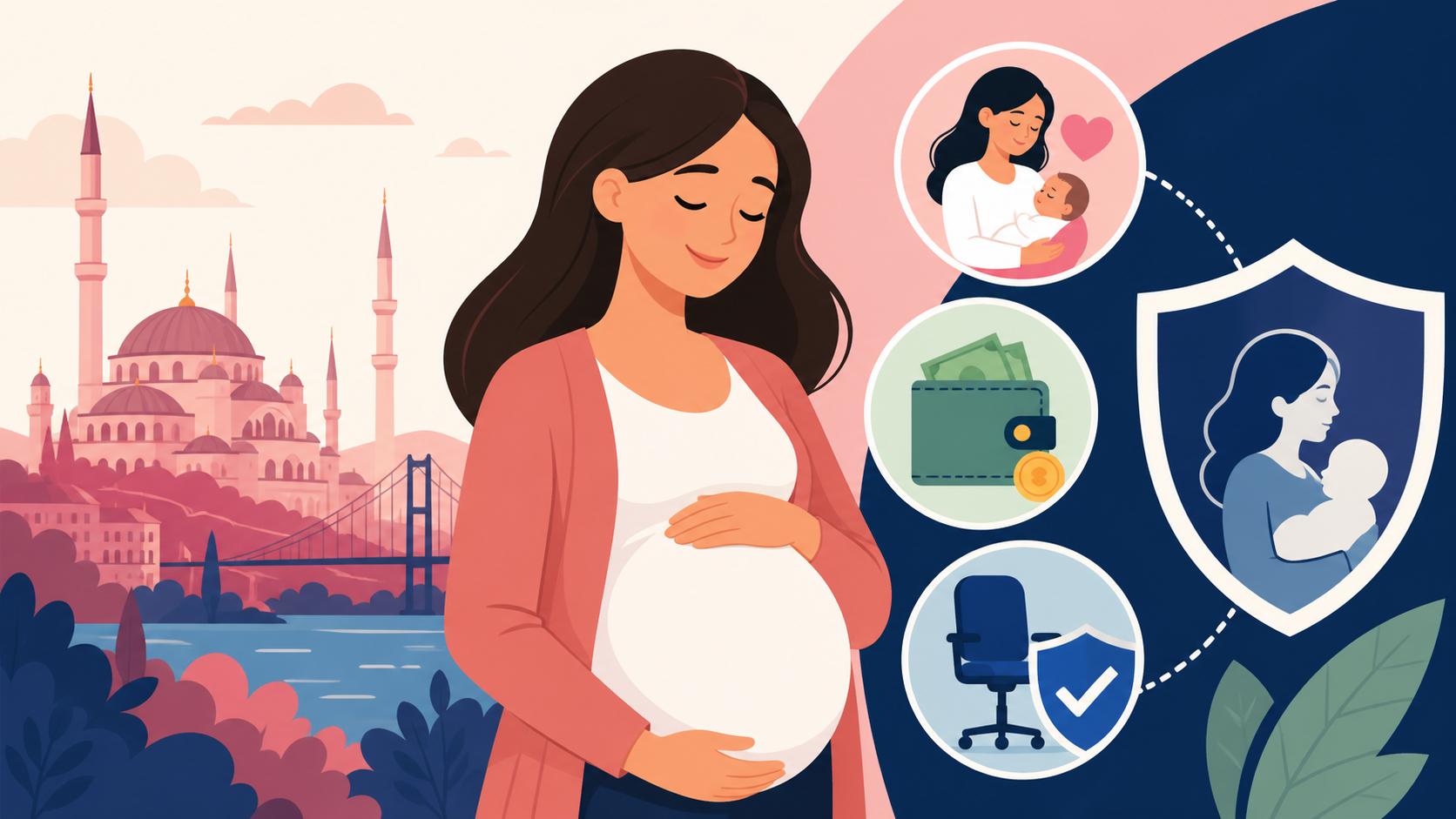
Maternity Leave in Turkey: Paid Time Off, Allowances, and Job Protection
Finding out you are expecting a baby while navigating a foreign career path can feel like a mountain of paperwork has just landed on your chest. I remember the sheer panic of seeing those two lines on a test while working a corporate job in Levent, wondering if my residency would be at risk or if my boss would suddenly find a reason to let me go. This guide solves the mystery of your rights, breaking down exactly how much paid time off you get, how to claim your government allowances, and why your job is legally safer than you might think.
Understanding Your Legal Entitlements: The 16-Week Standard
In Turkey, maternity leave is not a suggestion or a company perk; it is a statutory right protected by Labor Law No. 4857 (İş Kanunu). As a foreign worker with a valid work permit and active SGK (Social Security) contributions, you are entitled to the exact same protections as a Turkish citizen. The foundation of this right is a total of 16 weeks of paid maternity leave. Typically, this is split into eight weeks before the expected date of birth and eight weeks after.
If you are expecting more than one bundle of joy—twins, triplets, or more—the law recognizes the extra physical toll. In these cases, your pre-childbirth leave is extended by an additional two weeks, giving you a total of 18 weeks of protected leave. For many of us who are used to more "flexible" or perhaps less generous systems in our home countries, this 16-to-18-week block is a non-negotiable period where you are legally barred from working. Your employer cannot ask you to "just check a few emails," and the government expects you to be resting.
One of the most common questions I get from fellow expats is whether they have to stop working precisely at the eight-week mark before the due date. The answer is no, provided your health allows it. If your doctor at a local hospital or clinic provides a medical report stating you are fit to work, you can stay at your desk until three weeks before the birth. Those five "saved" weeks are then tacked onto your post-birth leave, giving you more time at home with your newborn. However, you must stop working by the 37th week of pregnancy, regardless of how great you feel. Navigating these conversations with your manager requires a bit of linguistic finesse; using a resource like TurkishPod101 can help you master the specific business terminology needed to discuss your "Rapor" (medical report) and leave schedule with HR without things getting lost in translation.
Financial Support and Allowances: How the SGK Payout Works
While you are on maternity leave, your employer is not actually the one paying your salary. Instead, you receive a "Temporary Incapacity Allowance" (Geçici İş Göremezlik Ödenek) from the Turkish Social Security Institution (SGK). To qualify for this payment, you must have at least 90 days of short-term insurance premiums paid within the year preceding the birth. This is a crucial detail for newer arrivals; if you have just started Working in Turkey as a Foreigner: Jobs, Permits, and Hiring Trends (2026), you need to ensure those 90 days are clocked in before your leave begins.
The amount you receive is generally two-thirds of your gross daily earnings for outpatient status, which essentially covers your time at home. It is paid out after the birth, once all the medical reports have been processed through the system. You can track this payment through the e-Devlet portal, which will become your best friend during this process. In addition to the salary replacement, there is a small one-time payment known as the "Breastfeeding Allowance" (Süt Parası). While the amount isn't life-changing—usually enough to cover a few packs of high-quality diapers—it is a right you should claim.
Beyond the 16 weeks of paid leave, many expats find they aren't quite ready to return to the office. Turkish law allows for up to six months of unpaid leave following the expiration of your 16-week paid period. While you won't receive a salary or SGK allowance during this time, your employer is legally required to keep your position open for you. This is a vital part of Labor Rights in Turkey: Employment Contracts, Minimum Wage, and Severance that many foreigners overlook because they fear they will be replaced. Understanding these nuances is easier if you have spent time learning the cultural expectations of the Turkish workplace through tools like TurkishPod101, which can prepare you for the social dynamics of returning to work after a long absence.
| Leave Type | Duration | Payment Source | Eligibility |
|---|---|---|---|
| Standard Maternity Leave | 16 Weeks (8 pre / 8 post) | SGK (2/3 of Gross Salary) | 90 days of premiums in last year |
| Multiple Birth Leave | 18 Weeks (10 pre / 8 post) | SGK (2/3 of Gross Salary) | 90 days of premiums in last year |
| Unpaid Leave Option | Up to 6 Months | None | Completion of paid maternity leave |
| Breastfeeding Hour | 1.5 hours/day | Employer (Full Pay) | Until the child is 1 year old |
| Part-Time Work Right | Variable | Employer/SGK Pro-rated | After maternity leave ends |
Job Protection and Workplace Rights for New Mothers
One of the biggest fears for any expat is that a pregnancy will lead to a "restructuring" that coincidentally eliminates their role. In Turkey, the law is incredibly protective of pregnant women. It is illegal to terminate an employment contract based on pregnancy or the use of maternity leave. If an employer tries to do this, they face significant legal penalties, and the burden of proof is on them to show the termination was for a completely unrelated, valid reason.
Even before you give birth, your workplace must adapt to your needs. You are entitled to paid time off for regular prenatal checkups. I highly recommend familiarizing yourself with Family Health in Turkey: Pregnancy, Maternity Care, and Pediatrics so you can schedule your appointments efficiently. Furthermore, pregnant employees cannot be forced to work night shifts (between 8:00 PM and 6:00 AM) and cannot be made to work more than 7.5 hours per day. If your job involves heavy lifting or exposure to chemicals, your employer must move you to a safer role without any reduction in your salary.
Once you return to work, the support doesn't stop. The "Breastfeeding Hour" (Süt İzni) is a famous right in Turkish offices. Until your child turns one year old, you are entitled to 1.5 hours of nursing leave per day. You get to decide when these hours are taken—perhaps you come in late, leave early, or take a long lunch. These hours are considered part of your working day, meaning your employer must pay you for them. If you prefer to combine these hours into one full day off per week, many companies are open to this, though it technically requires mutual agreement. If you find yourself struggling to explain these preferences to a traditional boss, brushing up on your conversational skills with TurkishPod101 can give you the confidence to negotiate a schedule that actually works for your new family life.
Navigating the Administrative Hurdles as a Foreigner
The "administrative hurdle" in Turkey usually comes in the form of the medical report system. Every stage of your maternity leave must be documented by a doctor and uploaded into the SGK digital system. This usually happens at the hospital where you plan on Giving Birth in Turkey: Comparing Public Hospital and Private Maternity Suites. If you are using a private hospital, ensure they are integrated with the SGK system; otherwise, you might have to take your papers to a state doctor to get them "verified," which is a headache you don't need in your third trimester.
Once the doctor issues the report at the 32nd week (or 37th week if you are continuing to work), it automatically alerts your employer's HR system. However, don't rely on automation alone. Always provide a physical or digital copy of your "Rapor" to your HR department and keep a copy for yourself. If you are also managing Social Security (SGK) for Employees: What Deductions Your Employer Must Pay, you’ll want to double-check that your premium payments have been consistent, as any gaps could delay your allowance.
Lastly, don't forget the importance of address registration. You must ensure your current residence is correctly registered in the Nüfus system. If your address is outdated, you might run into issues when the PTT (Turkish Post) tries to deliver notifications regarding your payments or when you try to register the baby's birth. This is part of the essential Post-Arrival Step for Foreigners that keeps your legal status in Turkey "clean." Being prepared with the right vocabulary to handle these government offices is where TurkishPod101 truly shines, offering lessons specifically tailored to handling bureaucracy and official appointments.
After Maternity Leave: Part-Time and Flexible Options
Turkey has recently introduced more flexible options for parents who want to balance work and home life. After your maternity leave ends, you can choose to work half-time for a certain period while still receiving a portion of your salary from the government's unemployment fund. For the first child, you can work half-time for 60 days; for the second, 120 days; and for the third, 180 days. This is an excellent middle-ground for expats who don't want to jump back into a 40-hour week immediately.
Beyond the half-time option, there is also a right to request part-time work until the child reaches the age to begin mandatory primary school (usually around 5.5 to 6 years old). While this is a legal right, it's important to check if your specific industry is exempt from this rule, as certain sectors like healthcare or heavy industry have different regulations. Most corporate and office roles are fully covered.
Navigating the return to work also involves thinking about your child's future documentation. Make sure you are clear on Registering Newborns Born in Turkey to Foreign Parents with the Authorities to avoid any issues with your baby's own residency or passport. It might seem like a lot to manage, but the Turkish system is designed to keep mothers in the workforce while respecting the cultural value placed on family. With a bit of preparation and a basic grasp of the language, you can enjoy this transition with far less stress than you might imagine.
Disclaimer
This article is for informational purposes only and does not constitute legal or professional medical advice. Turkish labor laws and SGK regulations are subject to frequent changes. Always consult with a qualified legal professional, your HR department, or the Ministry of Labor and Social Security to verify the most current rules and individual eligibility requirements.