ATM Fees in Turkey: Which Banks Offer Free Cash Withdrawals for Expats?
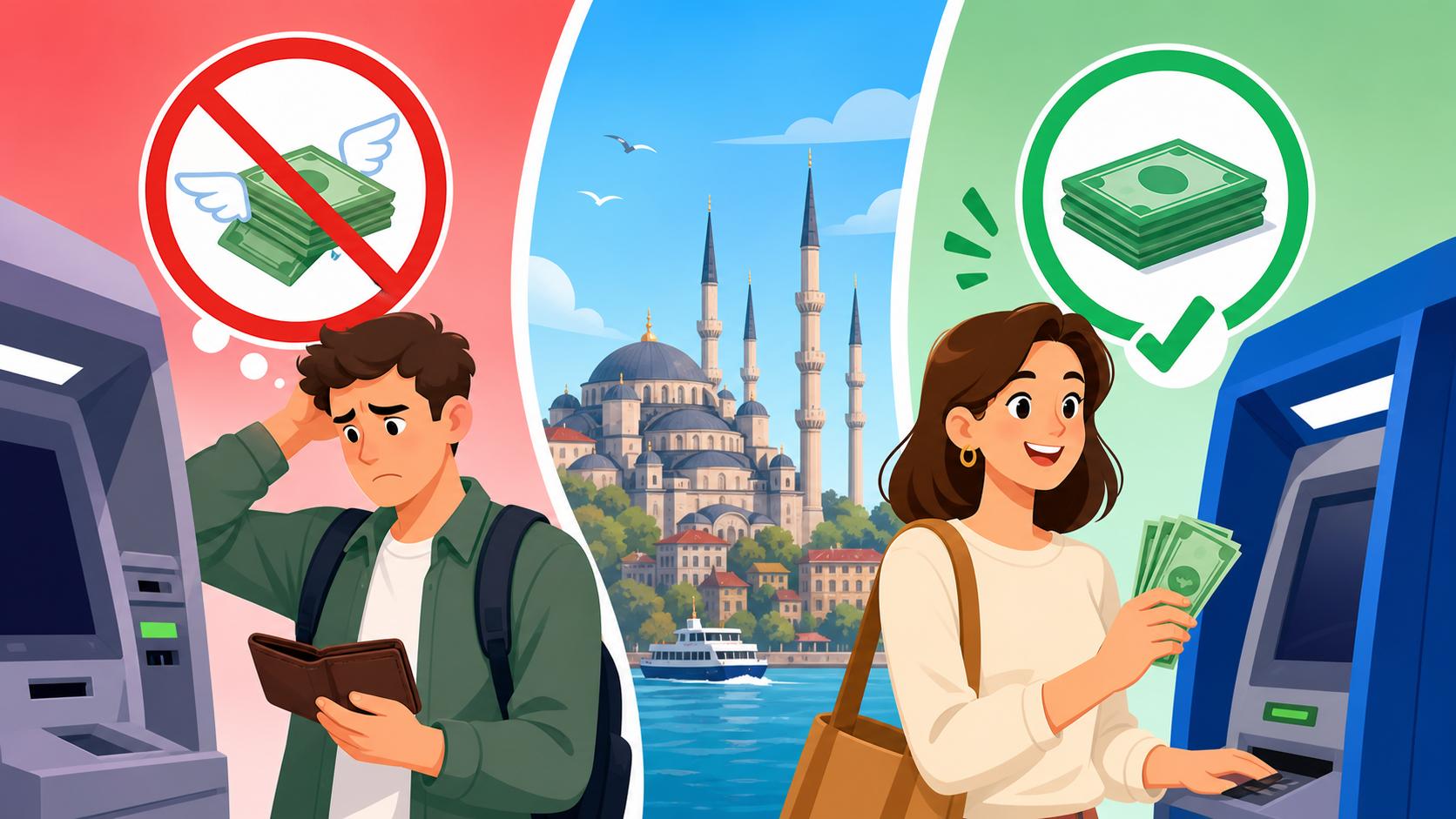
Standing in front of a Turkish ATM and seeing a 7% commission fee pop up just to access your own money is a heart-sinking moment every foreigner knows. I remember my first month in Istanbul, losing enough in fees to pay for a week’s worth of baklava simply because I didn't know which machines were "friendly." This guide solves that frustration by identifying the specific banks that still offer free or low-fee withdrawals and how to avoid the hidden traps of the Turkish banking system.
Navigating the Turkish ATM Landscape as an Expat
The ATM landscape in Turkey has changed dramatically over the last few years, especially as we move forward. What used to be a fairly straightforward process has become a minefield of "convenience fees" and predatory exchange rates. If you are using a foreign-issued card from a traditional bank back home, you are the primary target for these fees. Most private Turkish banks have realized that tourists and new arrivals are often too tired or confused to hit the "cancel" button when a 150 TL fee is suggested.
I’ve spent years testing different machines from the bustling streets of Kadıköy to the quiet corners of Fethiye. The first thing you need to understand is that not all ATMs are created equal. You have state-owned banks, large private banks, and independent "hole-in-the-wall" machines. In our Money in Turkey for Expats: Banking, Payments, and Finance Guide (2027), we often discuss how the economy dictates these shifting fees. As inflation persists, banks are looking for every possible way to claw back margins, and ATM commissions on international cards are an easy win for them.
When you approach an ATM, your goal is to find a machine that belongs to a state-owned entity first. These are generally more regulated and less aggressive with their fee structures. Private banks like Garanti BBVA or Akbank often have the slickest interfaces and the most English-language support, but that convenience frequently comes with a "tourist tax" in the form of a withdrawal fee that can range from 3% to 8% of the total amount. If you are still in the process of Opening a Bank Account in Turkey: Rules for Expats, Tourists, and Investors, relying on these machines is a necessary evil, but one you can manage with the right strategy.
Top Banks for Low or No-Fee Withdrawals
If you want to keep your hard-earned Lira in your pocket, your first stop should always be a PTT machine. PTT is the national post office of Turkey, and their yellow-and-navy ATMs are scattered across every neighborhood. Historically, PTT has been the most "fee-friendly" option for foreign cardholders. While some private banks started charging for foreign card use as early as 2022, many PTT machines still offer fee-free withdrawals for major networks like Visa and Mastercard, provided your home bank doesn't charge you on their end.
Next on your list should be the big state-owned banks: Ziraat Bankası, VakıfBank, and Halkbank. Ziraat is the "old faithful" of the Turkish banking world. You will recognize them by their deep red branding and the "Z" logo. Because these banks are government-backed, they often have different mandates regarding service fees. While they have started introducing small flat fees for some international transactions in 2026, they remain significantly cheaper than the private alternatives. They are also the most reliable machines when you are trying to navigate Cost of Living in Turkey 2026: Detailed Budgets for Singles and Families, as they usually have higher daily withdrawal limits.
Wait times at these ATMs can be a bit longer, especially on the 15th and 1st of the month when locals are withdrawing pensions or salaries. However, the five-minute wait is worth the 200 or 300 Lira you’ll save in commission. If you are living a digital nomad lifestyle and moving between cities, I highly recommend using Wise to hold your funds. By using a Wise card at a Ziraat or PTT machine, you are getting the mid-market exchange rate and only paying the minimal (if any) local ATM fee. This combination is the "pro-move" that seasoned expats use to bypass the predatory rates offered by high-street banks.
Avoiding the DCC Trap and Hidden Costs
The biggest "scam" you will encounter isn't actually a fee from the Turkish bank, but something called Dynamic Currency Conversion (DCC). When you insert your card, the ATM will often ask, "Would you like to be charged in your home currency (USD/EUR/GBP) or the local currency (TRY)?" It will show you a "guaranteed" exchange rate that looks convenient. Always choose TRY (Local Currency).
If you choose your home currency, the ATM provider applies their own exchange rate, which is almost always 5% to 10% worse than the actual market rate. This is how they make their real money. By choosing to be charged in TRY, you are letting your own bank or a service like Wise handle the conversion. When you are Sending Money to and from Turkey: SWIFT, IBANs, and International Apps, you learn quickly that the middleman always takes a cut; the ATM's DCC offer is just the most expensive version of that cut.
Another thing to watch for is the "fee notification" screen. In Turkey, the ATM must disclose the fee before you finalize the transaction. It will usually say something like, "A commission of 145.50 TRY will be charged for this transaction. Do you wish to continue?" If you see this, hit "Cancel" and walk to the next bank down the street. In major areas like Taksim or Sultanahmet, you might have to try three or four machines before you find one that is fee-free. Using Best International Money Transfer Apps for Turkey: Using Wise and Remitly can help you avoid ATMs altogether for large bills, but for the daily pazar (market) run, cash is still king.
| Bank Name | ATM Color | Typical Fee for Foreign Cards (2026) | Best Feature for Expats |
|---|---|---|---|
| PTT | Yellow/Navy | Often 0% | Most consistent for fee-free withdrawals |
| Ziraat Bankası | Dark Red | 0% to 2% | Highest density of machines in rural areas |
| Halkbank | Blue/White | Low Flat Fee | Reliable English menu options |
| VakıfBank | Yellow/White | Low Flat Fee | Good for Withdrawing Foreign Currency (USD/EUR) Directly from Turkish ATMs |
| İş Bankası | Blue | 3% – 5% | Very modern UI, high security |
| Garanti BBVA | Green | 5% – 8% | Convenient but expensive for foreigners |
| QNB Finansbank | Purple/Blue | 4% – 6% | Fast machines, often located in malls |
Financial Safety and Connectivity for the Tech-Savvy Expat
When you are walking around with a pocket full of Lira, safety should be your priority. Turkish ATMs are generally very safe, but "skimming" devices still pop up in high-tourist areas. Always tug on the card reader before inserting your card. If it feels loose, move on. Additionally, many expats are now moving toward a "cash-lite" lifestyle by using local apps and digital wallets. However, managing these apps requires a secure internet connection. I never check my banking balance or move money between accounts while sitting in a local Kahveci without turning on NordVPN.
Public Wi-Fi in Turkey is notoriously insecure, and the last thing you want is someone snooping on your credentials while you are trying to fix a transaction error. Using NordVPN ensures that your connection to your home bank or your Wise account is encrypted, regardless of the local network quality. For those who have moved beyond simple savings and are looking at Navigating High Inflation: Budgeting Strategies for Expats Earning Turkish Lira, keeping some of your wealth in more stable assets is a common strategy. Many expats use Trade Republic to keep their Euro savings earning interest while they live off their Lira day-to-day.
Furthermore, if you find yourself in a situation where your foreign card is swallowed or blocked, having a backup is essential. Many younger expats and tech-focused nomads have started using Binance P2P services to get cash. You can sell a small amount of USDT for Lira and have it sent directly to a local friend’s bank account or your own Turkish account if you have completed Setting up Automatic Bill Payments (Otomatik Ödeme Talimatı) with Your Bank and have a local IBAN. This bypasses the ATM system entirely when fees get too high. Just remember that while Binance is a great tool for liquidity, the ATM remains the most direct way to get physical cash for those small, local transactions that make life in Turkey so vibrant.
Strategies for High-Volume Cash Users
If you are a heavy cash user—perhaps you are paying rent in cash or buying furniture for a new apartment—the ATM fee problem becomes an even bigger headache. Most Turkish ATMs have a daily withdrawal limit for foreign cards, often around 5,000 to 10,000 TRY. If you have to make four withdrawals to get the amount you need and each one hits you with a 150 TL fee, you’ve just lost 600 TL for no reason.
In these cases, it is advisable to look for "Multi-Currency" ATMs. Banks like TEB (which is partnered with BNP Paribas) or VakıfBank often have machines that allow you to withdraw USD or EUR directly. You can then take that "hard currency" to a local Döviz (Exchange Office) in a neighborhood like Laleli or Cağaloğlu, where the spreads are incredibly tight. You will often get a much better total value than by letting a machine do a direct TRY withdrawal.
Lastly, always keep an eye on the screen for any mention of "Tax" or "BSMV." These are government-mandated taxes on banking transactions that sometimes get tacked onto ATM fees. While they are usually small, they contribute to the "death by a thousand cuts" feeling of Turkish banking. By staying disciplined, using state-owned ATMs, and always declining the DCC conversion, you can save thousands of Lira over the course of a year. It takes a little more effort to find that specific Ziraat or PTT machine, but your wallet will thank you every time you walk away without seeing that dreaded "Commission" line item on your receipt.
Disclaimer
The information provided in this guide is for informational purposes only and does not constitute financial, legal, or investment advice. Banking fees, ATM policies, and exchange rates in Turkey are subject to frequent change due to economic conditions and updated bank regulations. Always verify the current fee structure on the ATM screen before confirming any transaction. The author is not responsible for any financial losses or errors resulting from the use of the services mentioned.