Tourist SIM Cards vs Resident Plans: Why Data Prices Drop After Getting Ikamet
Landing at Istanbul Airport and seeing SIM card prices that look like a monthly rent payment is a frustrating rite of passage for every newcomer. I remember my first week in Kadıköy, wandering from shop to shop, desperately trying to find a plan that didn't expire in 30 days or cost three times the local rate. This guide solves the connectivity puzzle, explaining how to transition from overpriced tourist "Welcome Packs" to the significantly cheaper resident plans once you have your ikamet.
The Great Tourist SIM Markup: Why You Are Paying Triple
The moment you step off the plane, you are greeted by bright kiosks from Turkcell, Vodafone, and Türk Telekom. While convenient, these are the most expensive places in the country to buy a SIM card. These "Tourist Welcome Packs" are designed for short-term visitors who don't have the legal residency status required to access standard Turkish consumer rates. Because you lack a 99-series Foreigner Identity Number at this stage, the carriers classify you as a temporary guest, which subjects you to different tax brackets and administrative fees.
The airport trap is real, but it is often a necessary evil. A common choice is to use a temporary E-SIM like Airalo to get through the first few days. Airalo allows you to have data the second you land without standing in line or overpaying for a physical card you will eventually throw away. However, if you do buy at the airport, realize you are paying for the physical chip and a "special" tourist tax that locals never see. These packs often include massive amounts of data—think 20GB to 50GB—but they come with a hard expiration date.
Tourist SIM cards in Turkey typically have a lifespan of 60 to 90 days. After this period, if you haven't provided a valid residence permit to the service provider, the line will be "frozen" or completely deactivated. Many expats lose their local phone numbers because they forgot this deadline. When you are staying in a flexible living arrangement through a provider like Blueground, you have the luxury of time to sort out your paperwork, but the clock on that tourist SIM is always ticking. Do not treat these cards as long-term solutions; they are expensive band-aids.
The Ikamet Effect: Unlocking Resident Only Telecom Deals
The dynamic changes completely once you hold that plastic residence permit card in your hand. The 99-number printed on your permit is the key that unlocks the domestic market. With this number, you are no longer a "tourist" in the eyes of the Information and Communication Technologies Authority (BTK). You can walk into any branch of a major carrier and request a "postpaid" (faturallı) or a "standard prepaid" (faturasız) plan at the same prices a Turkish citizen pays.
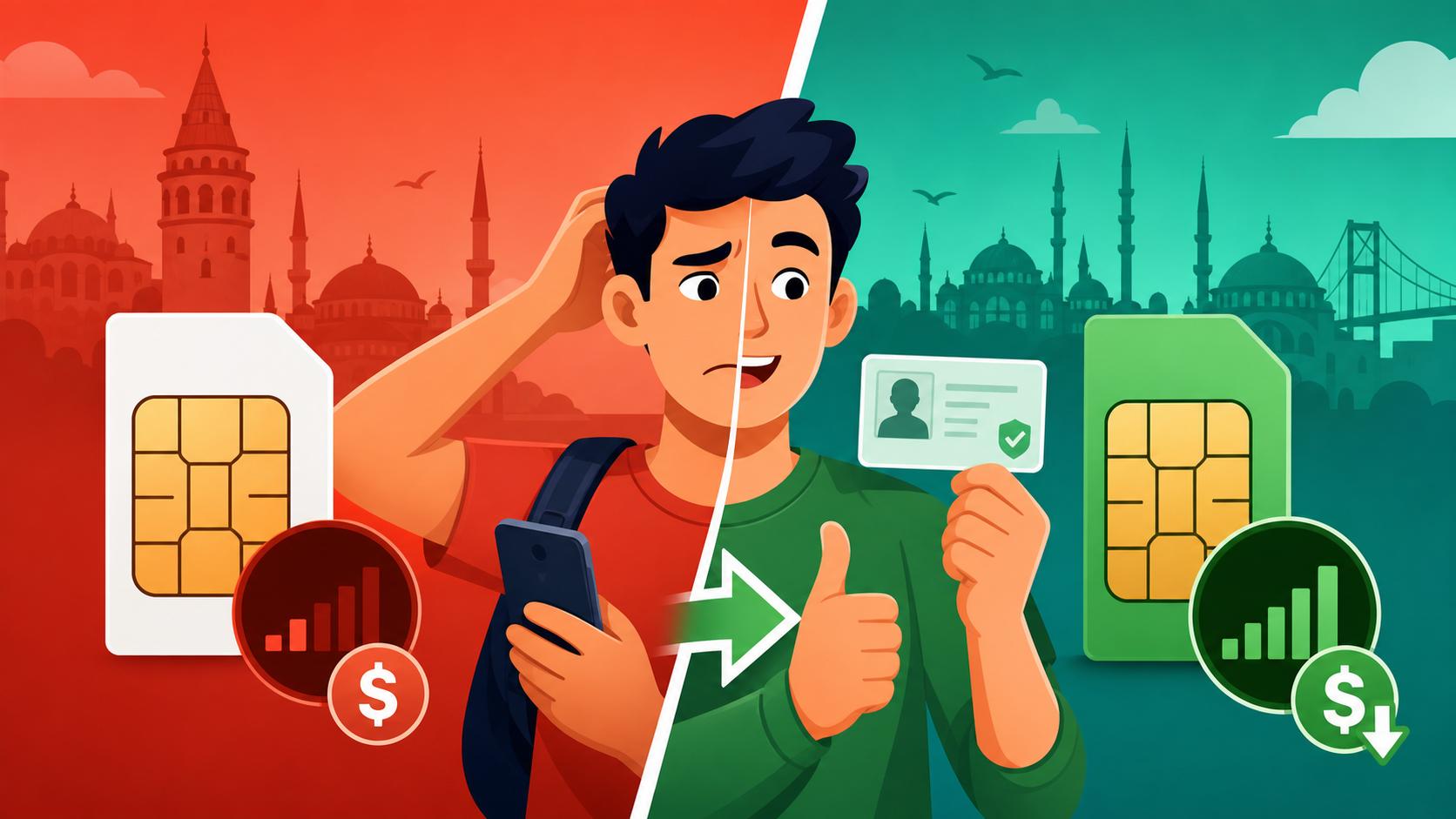
Why do data prices drop so significantly? It comes down to the Special Communication Tax and the risk profile of the customer. Carriers view residents as stable customers who will pay monthly bills, whereas tourists are transient. Once you have your permit, you can link your phone line to your Turkish bank account for automatic payments. This is where you see the real savings. While a tourist pack might cost 800 to 1,200 TL for a one-off 20GB boost, a resident plan might offer the same data for 250 to 400 TL per month on a recurring basis.
To truly maximize these savings, you need to understand The 99-Number: What Your T.C. Kimlik Number Gives You Access To in Daily Life. This number allows you to sign contracts. If you are living in a long-term rental or a premium serviced apartment from Blueground, having a consistent, cheap data plan makes navigating the city and ordering essentials much easier. You’ll also find that many resident-only apps, such as local banking or e-government services, require a Turkish number registered to a valid ID to function correctly.
Navigating the Three Pillars: Turkcell, Vodafone, and Türk Telekom
Choosing a carrier in Turkey is a bit like choosing a football team; everyone has a strong opinion based on where they live. Turkcell is generally considered the "premium" option. It has the best coverage in rural areas and the fastest 4.5G speeds in crowded cities. However, Turkcell also tends to be the most expensive. If you are frequently traveling between Istanbul and coastal towns, the extra cost is often worth it for the stability. You can even find Turkcell-compatible hardware and signal boosters on Amazon Turkey if you are setting up a home office in a stone house in Muğla where signals might struggle.
Vodafone Turkey is the middle ground. They often have aggressive marketing campaigns targeting expats and younger residents. Their "Red" plans frequently include free roaming in European countries or extra data for social media apps like WhatsApp and Instagram. I’ve found that Vodafone works excellently in urban centers like Ankara or Izmir, but it can be spotty in the deep valleys of the Kaçkar Mountains. If you are looking for a balance between price and performance, Mobile Networks in Turkey: Comparing Turkcell, Vodafone, and Türk Telekom provides a deeper dive into their specific network bands and coverage maps.
Türk Telekom is often the budget leader. Because they own much of the landline infrastructure in the country, they offer aggressive bundles. If you are already Choosing an Internet Provider in Turkey: Fiber vs VDSL (Turk Telekom, Superonline), you might get a significant discount by moving your mobile line to Türk Telekom as well. Their mobile speeds can be slower during peak hours in Istanbul, but for a standard user who just needs to browse and use navigation, the savings are hard to ignore. Many expats starting out on a budget find Türk Telekom to be the most accessible.
The Hidden Complexity: Phone Registration and the IMEI Rule
The biggest shock for most foreigners isn't the price of the SIM card, but the "IMEI Tax." Turkey has a very strict policy regarding mobile phones brought from abroad. Any foreign device with a foreign IMEI (the unique identification number of the phone) will be blocked from the Turkish cellular networks after 120 days of use with a local SIM card. This timer starts the moment you insert a Turkish SIM into your foreign phone.
To keep using your iPhone or Samsung from home beyond those four months, you must pay a registration tax. In 2026, this fee has reached levels that often exceed the price of a brand-new mid-range phone. Many expats decide to simply buy a local device from a reputable seller or through Amazon Turkey to avoid this astronomical fee. If you do choose to pay the tax, you must have a residence permit and pay the fee through the E-Devlet Financial Services: Tracking Taxes, SGK Debts, and Bank Accounts portal.
If you aren't ready to commit to the IMEI tax, you can use a temporary bridge. Using an Airalo E-SIM on your foreign phone's secondary slot can sometimes help you stretch your connectivity, but the 120-day rule eventually catches up to everyone. Some people choose to carry a "cheap" Turkish phone (bought locally on Amazon Turkey) as a hotspot and keep their "nice" foreign phone for Wi-Fi use only. If you are staying in a professionally managed apartment through Blueground, you will have high-speed Wi-Fi, which reduces your reliance on cellular data, but for life on the go, The Turkey IMEI Rule: How to Register Foreign Phones in 2026 remains the single biggest hurdle for connectivity.
Transitioning Your Service: Step-by-Step Guide for Expats
Once you have your Turkish Residence Permits (Ikamet): The Complete Application Guide (2027), you should visit a main branch (not a small franchised kiosk) of your chosen carrier to update your status. Do not wait for your tourist SIM to expire. If the line expires, you might lose the phone number, which can be a nightmare if that number is linked to your bank account.
The process is called "status change" or "ID update." You will need your passport, your original physical residence permit, and your current SIM card. The staff will scan your permit and update the BTK database. In some cases, they might actually have to cancel your tourist line and issue a new "resident" SIM card with the same number. This usually costs a small administrative fee, but it immediately grants you access to the lower-cost monthly packages.
| Feature | Tourist SIM (Welcome Pack) | Resident SIM (Ikamet Plan) |
|---|---|---|
| Duration | 30 – 90 Days | Indefinite (Monthly) |
| Data Cost | High (Up to 1,200 TL / month) | Low (250 – 450 TL / month) |
| ID Required | Passport Only | Ikamet (99-Number) |
| IMEI Rule | 120-Day Timer Starts | 120-Day Timer Applies |
| Payment | Cash/Card Upfront | Monthly Invoice or Auto-pay |
| Plan Options | Limited "Packs" | Full range of 4.5G/5G plans |
Alternative Connectivity Strategies for Digital Nomads
For those who are not planning to stay long enough to get an ikamet, or for those in the "limbo" period waiting for their appointment, there are other ways to stay connected without getting fleeced at the airport. It is wise to have an Airalo E-SIM as your "Day 0" plan. It allows you to call a taxi, message your landlord, and find your way to your apartment without being dependent on unstable airport Wi-Fi. Airalo is incredibly user-friendly and avoids the need for physical ID registration entirely for short-term data.
Another strategy is the use of "Superboxes" or mobile Wi-Fi routers. These are devices that use the cellular network but provide Wi-Fi for multiple devices. If you are Opening a Bank Account in Turkey: Rules for Expats, Tourists, and Investors, you might find that having a stable mobile hotspot is easier for banking security than using public Wi-Fi. You can purchase these routers on Amazon Turkey and then find a SIM plan that offers "data only." This is particularly useful for digital nomads living in Airbnbs or short-term rentals that might have sub-par internet.
Lastly, consider the value of local hardware. Because of the IMEI tax, the secondary market for used phones in Turkey is very active. However, buying a used phone from a random shop can be risky. I suggest looking for new, lower-cost Turkish-made or locally-distributed phones on Amazon Turkey. Having a dedicated "Turkish phone" ensures you are never cut off from the network, and you can keep your expensive foreign phone for photography and apps that don't require a constant cellular connection. Whether you are moving into a sleek apartment from Blueground or a cozy flat in Beşiktaş, your digital life depends on getting these basics right.
Essential Steps for Updating Your Mobile Status
- Receive Your Physical Ikamet Card: You cannot use the "Application Document" for most resident mobile plans; you need the physical card with the 99-number.
- Visit a Corporate Branch: Look for a "Turkcell İletişim Merkezi" or a "Vodafone Cep Merkezi" that is a flagship store, not a small sub-dealer.
- Bring a Proof of Address: Sometimes, carriers ask for a utility bill or a notarized rental contract. If you are staying with Blueground, your digital contract is usually sufficient.
- Register on the App: Download the Turkcell (Digital Operator), Vodafone Yanımda, or Türk Telekom app. These apps allow you to track your Step-by-Step Guide to Registering Your Phone's IMEI on e-Devlet and buy extra data "shakes" for cheap.
- Check for Automatic Payments: Link your Turkish credit or debit card to the app. Most carriers offer an extra 5GB to 10GB of data just for setting up an "Otomatik Ödeme Talimatı" (Automatic Payment Order).
- Verify Your IMEI Status: Use the e-Devlet portal to check how many days you have left on your device. Even with a resident SIM, your foreign phone will still be blocked unless you pay the registration tax.
- Monitor Your Usage: Local plans are much cheaper, but they are also more strictly metered. Overrunning your data on a resident plan can lead to surprising "overage" charges on your next bill.
I’ve lived through the era where we had to wait in long lines at the Tax Office just to pay a mobile fee. Today, almost everything can be done via your smartphone, provided you have the right ID. If you're currently budgeting for your move, check out the Cost of Living in Turkey 2026: Detailed Budgets for Singles and Families to see how much you should set aside for all your utility and connectivity needs. Don't let the initial "foreigner prices" discourage you; Turkey's telecom market is actually quite competitive and high-quality once you have passed the initial residency hurdle.
Disclaimer
This guide is for informational purposes only and reflects the personal experiences of the author and current market conditions in Turkey as of 2026. Laws regarding IMEI registration, SIM card taxes, and residence permit requirements change frequently. Always verify the latest regulations via official government channels or at an authorized service provider branch. This article contains mentions of brands for contextual purposes and does not constitute a legal or financial guarantee of service.