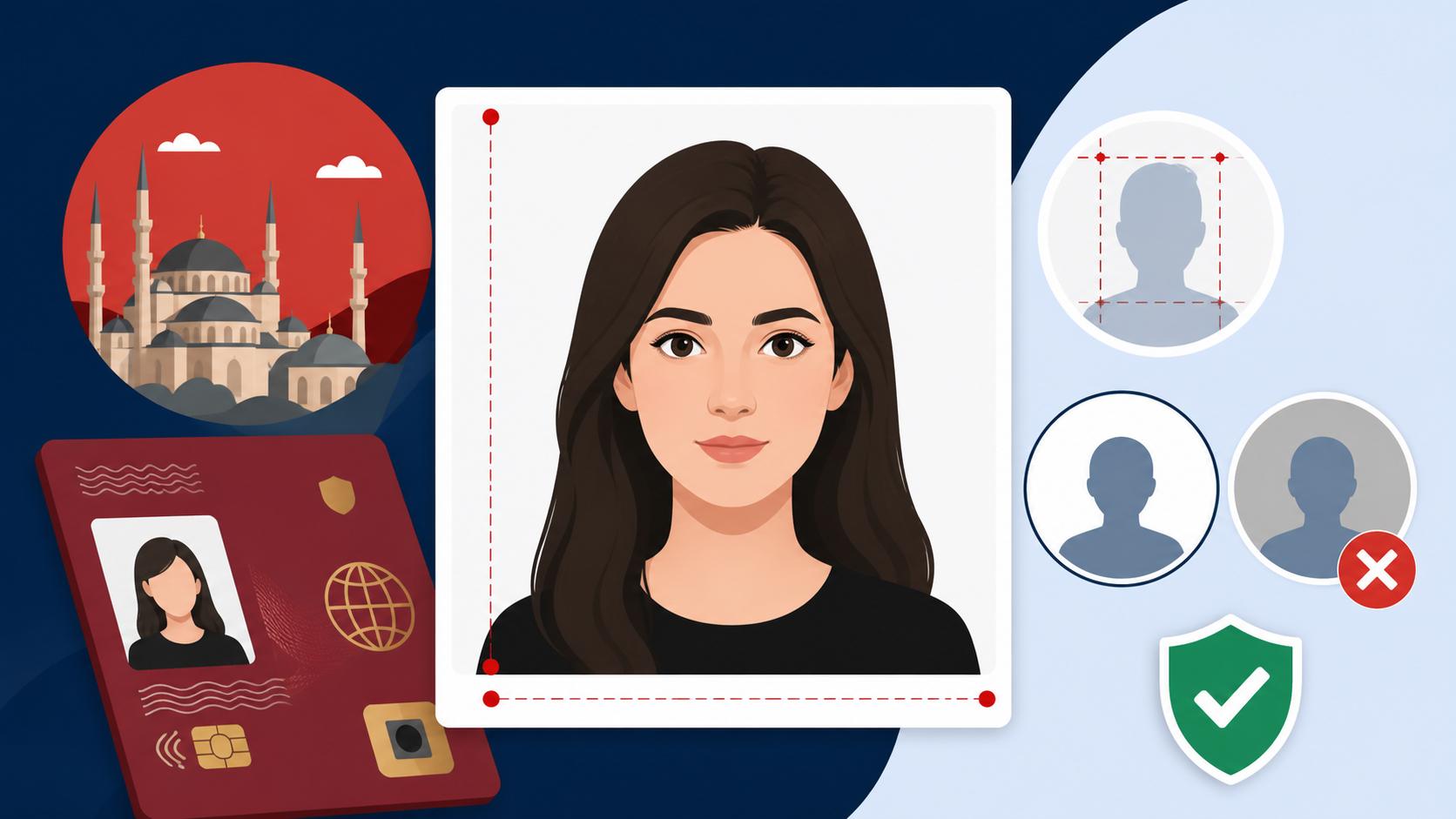
What Exact Size and Background is Needed for Turkish Biometric Ikamet Photos?
One of the most frustrating experiences at a Turkish migration office is being turned away after a three-hour wait because your biometric photo is 5 millimeters too small or your background isn't "white enough." I remember standing in the humid hallway of the Istanbul Migration Office, clutching a folder of perfectly translated documents, only to have the officer point dismissively at my headshot and grunt, "Geçersiz" (invalid). This guide ensures that never happens to you by breaking down the exact, non-negotiable biometric photo requirements for your Turkish residence permit.
The Non-Negotiable Dimensions: 50mm x 60mm
When you walk into a Turkish photo studio (locally known as a Fotoğrafçı), the first thing you must say is "Ikamet için biyometrik fotoğraf." Unlike the standard 35mm x 45mm photos used for many European visas or the 2×2 inch squares common in the United States, the Turkish General Directorate of Migration Management (Göç İdaresi) requires a specific size: 50mm in width and 60mm in height.
Why Precision Matters for the e-Ikamet System
The e-Ikamet System: How to Apply, Renew, and Track Your Residence Permit relies on a facial recognition algorithm that cross-references your uploaded digital photo with the physical copies you bring to your appointment. If the dimensions are off, the system may fail to process your application or, worse, allow you to submit it only for a human officer to reject it weeks later. Some expats try to trim larger photos with scissors in the waiting room—don't be that person. The proportions of the face within that 50x60mm frame are strictly monitored; your face should occupy about 70% to 80% of the total vertical space.
The Six-Month Recency Rule
Turkey is incredibly strict about the "recentness" of your photo. The rule is that the photo must have been taken within the last six months. Officers are trained to compare your photo against the one in your passport or your previous residence permit. If you try to use the same photo you used two years ago for your first renewal, they will notice. It is always safer to spend the extra 150-200 TL to get a fresh set of prints than to risk an Ikamet Rejections: Exact Steps on What to Do If Your Residence Permit is Denied.
Background and Lighting Standards
The background of a Turkish biometric photo must be plain, solid white. There is no room for negotiation here. Light gray, cream, or off-white backgrounds that might pass in other countries are frequently rejected here. The goal is to create a sharp contrast between the subject and the background so that the edges of the head are clearly defined for scanning software.
Eliminating Shadows and Glare
Lighting must be uniform across your face. Professional studios in Turkey are well-versed in this, using softbox lights to eliminate shadows behind the ears or under the chin. If you are taking a photo in a smaller town, double-check that there are no "hot spots" (bright white glares) on your forehead or cheeks from a harsh flash.
What to Wear for Maximum Contrast
Since the background is white, I highly recommend wearing a dark-colored shirt or blazer. If you wear a white or very light-colored top, your shoulders might "blend" into the background, making the photo look like a floating head. This can sometimes trigger a manual review or rejection. While you are preparing your folder, ensure you have all other items ready, including your Health Insurance Requirements: Securing a Policy for First-Time Ikamet Applications. Many expats choose providers like Cigna Global to ensure their coverage meets the high standards required by the Migration Office alongside their paperwork.
Facial Expression and Composition
The "biometric" part of the photo refers to the measurable distances between your eyes, nose, and chin. To keep these measurements accurate, you must maintain a neutral facial expression. This means no smiling, no frowning, and certainly no showing teeth. Your mouth must be firmly closed, and your eyes must be looking directly at the camera lens.
Head Positioning and Eyes
Your head must be centered and not tilted in any direction. Even a slight "portrait-style" tilt of the head can result in a rejection. Both ears should ideally be visible, though the most important factor is that the "line" of the face is unobstructed. Your eyes must be open and clearly visible; red-eye is an automatic disqualification. If you are also busy getting your legal documents in order, remember that companies like RushTranslate can help with the certified translations of your birth certificates or marriage licenses that accompany these photos.
Glasses and Headwear Rules
The rules for glasses have become even stricter. While the law technically allows for non-tinted prescription glasses, many officers will reject photos if there is even a tiny reflection on the lens or if the frames obscure any part of the eye. My advice? Take your glasses off for the photo. It’s a 30-second inconvenience that prevents a potential three-month delay. Regarding headwear, it is only permitted for religious reasons (such as a hijab), provided that the entire face from the bottom of the chin to the top of the forehead is clearly visible.
Technical Specifications for Digital Uploads
Before you even get to your Biometric Appointments (Randevu) at the Provincial Migration Office (Göç İdaresi), you have to upload a digital version of your photo to the online portal. This is where many expats struggle. The system has very specific file size and resolution limits that can be frustrating to navigate.
File Format and Size Limits
The digital file must be in JPEG or JPG format. The file size usually needs to be under 1MB, but high enough resolution that it doesn't look pixelated. Most Turkish photographers will offer to send you the digital file via WhatsApp or email. I strongly recommend having them send it via email to preserve the quality. If the upload on the e-Ikamet site keeps failing, it’s usually because the aspect ratio doesn't match the 5:6 requirement.
Scan Quality vs. Digital Originals
If you didn't get a digital file from the photographer and are trying to scan a physical print, make sure your scanner is set to at least 600 DPI. A low-quality scan of a physical photo often results in "banding" or graininess that the Turkish immigration software cannot process. This is a critical step in Turkish Residence Permits (Ikamet): The Complete Application Guide (2027), as a failed photo upload can sometimes prevent you from even finishing the online application form.
Quick Reference Table: Ikamet Photo Specs
| Requirement | Specification |
|---|---|
| Dimensions | 50mm x 60mm (5cm x 6cm) |
| Quantity | At least 4 physical prints (bring 6 to be safe) |
| Recency | Taken within the last 6 months |
| Background | Solid, plain white (no patterns or shadows) |
| Face Coverage | Face must occupy 70% – 80% of the frame |
| Facial Expression | Neutral, eyes open, mouth closed, no teeth |
| Digital Format | JPEG / JPG |
| Headwear | Religious only; face must be fully visible |
Where to Get Your Photos Taken in Turkey
You will find a "Fotoğrafçı" in almost every neighborhood in Turkey. You don't need a high-end fashion studio; the small shop on the corner is usually better because they do these dozens of times a day.
Finding the Right Studio
Look for shops that have signs saying "Biyometrik Fotoğraf." In major cities like Istanbul, Ankara, or Izmir, you can simply walk in without an appointment. If you are in a tourist-heavy area like Antalya or Fethiye, most photographers will even know the specific requirements for different nationalities' passports, but always double-check they are giving you the 50x60mm size specifically for the Turkish ikamet.
Cost and Delivery
As of mid-2026, a set of 4 to 8 biometric photos typically costs between 150 TL and 300 TL. Most studios can have them printed and cut within 15 to 20 minutes. Don't leave without asking for the digital version! They might charge an extra 50 TL for it, but it is essential for the online application. Once you have your photos, you're one step closer to finishing your paperwork, which might also include Where to Find Public Notaries to Authenticate Your Passport and Rental Lease.
Common Pitfalls to Avoid
Even with the right size and background, small details can trip you up. One common issue is excessive makeup or "filters." The photo needs to look like you on a standard day. If you use a photo that has been "retouched" to remove moles, scars, or wrinkles, the biometric software may flag it as a mismatch when you show up at the office.
The "Staple" Mistake
When you finally have your folder ready for the Göç İdaresi, never staple your photos to the application form. Use a paperclip or keep them in a small plastic baggie. The officers need to scan these photos, and a staple hole through your forehead or the white background can render the photo useless. They will usually take two of the four photos and return the rest to you.
Address Registration Links
Remember that having the right photo is just one piece of the puzzle. You also need to ensure your physical residence is properly recorded in the government database. Many people forget that they need their UETS Setup: Getting Your PTT Electronic Mailbox as a Foreign Resident to receive official notifications regarding their permit status. Having your biometric photos ready early allows you to focus on these more complex administrative tasks without rushing at the last minute.
Final Tips for a Smooth Experience
To ensure you are fully prepared, it is wise to get your photos taken before you even start the online application. This way, you have the digital file ready to upload immediately. It saves you the stress of having to "save and exit" the application, which is notorious for glitching out and losing your data.
While you are at the photo studio, it's also a good time to check if you need any other documents scanned or copied. Turkish bureaucracy loves paper, and having extra copies of your passport's photo page and last entry stamp is always a wise move. When you combine perfect biometric photos with a comprehensive insurance plan like those from Cigna Global, you significantly lower the "stress floor" of your residency journey.
Disclaimer
This guide is intended for informational purposes only and reflects the typical requirements for Turkish residence permit biometric photos as of 2026. Immigration policies and photo specifications can change without notice. Always verify the latest requirements on the official Goç İdaresi website (e-ikamet.goc.gov.tr) or consult with a qualified legal professional before submitting your application.