How to Transfer Money Safely and Quickly Using the Turkish IBAN System
Sending money in Turkey often feels like navigating a labyrinth where one wrong turn—or in this case, one wrong digit—could leave your funds floating in digital limbo. I remember the genuine panic I felt during my first month in Izmir, staring at a 26-character string of numbers for a landlord who didn't speak English, wondering if my rent would actually arrive or simply vanish. This guide demystifies the Turkish IBAN system, ensuring you can transfer money safely and quickly while avoiding the common administrative traps that catch most newcomers.
Anatomy of the Turkish IBAN Structure
In Turkey, the International Bank Account Number (IBAN) is the gold standard for all transactions. Unlike some countries where you might use a combination of sort codes and account numbers, the IBAN here is a comprehensive 26-character alphanumeric code that contains every piece of information a bank needs to route your money. If you are still in the early stages of your relocation, consult our Financial Checklist for Your First 30 Days as a Newly Arrived Expat in Turkey to see how this fits into your overall setup.
The structure always begins with "TR," the ISO country code for Turkey. This is followed by two check digits, which act as a mathematical safeguard against typing errors. If these digits don't match the rest of the string, the banking app will usually throw an error before you even hit send. The next five digits represent the Bank Code (for example, Garanti BBVA uses 00062). The remaining digits consist of a single reserved digit and the 16-digit account number. Because of this length, never attempt to type an IBAN manually. Always copy and paste from a WhatsApp message or a banking PDF. Turkish landlords and businesses are accustomed to sending their IBANs as plain text for this very reason.
When you are Opening a Bank Account in Turkey: Rules for Expats, Tourists, and Investors, your bank will provide you with a "Hesap Cüzdanı" (Account Booklet) or a digital equivalent. This document prominently displays your IBAN. It is worth noting that for international transfers, simply having the IBAN is often not enough; you will also need the BIC/SWIFT code of your specific bank branch. While the IBAN system is highly automated within Turkey, cross-border transfers require that extra layer of routing information.
Domestic Transfers: Differentiating FAST, EFT, and Havale
Once you have your account and your recipient's IBAN, you need to understand the three distinct ways money moves within the Turkish borders. Many expats make the mistake of assuming all transfers are the same, only to find their money hasn't arrived because they sent it after 5:00 PM on a Friday. For a broader overview of these systems, you can read more about Money in Turkey for Expats: Banking, Payments, and Finance Guide (2027).
The first and most common for same-bank transfers is "Havale." If you are sending money from your İş Bankası account to another İş Bankası user, this is a Havale. It is instantaneous, 24/7, and usually free. The second is "EFT" (Electronic Funds Transfer), which is used for moving money between different banks, such as from Ziraat Bank to Akbank. Traditionally, EFTs only processed during business hours. If you sent an EFT at 6:00 PM, it wouldn't move until the next morning.
However, the game-changer in recent years is "FAST" (Fonların Anlık ve Sürekli Transferi). This system allows for instant interbank transfers 24/7, though it currently has a transaction limit (often around 100,000 TL, though this fluctuates with inflation and central bank policy). You can learn more in our dedicated post on What is FAST? Sending Instant Interbank Transfers 24/7 in Turkey. When using FAST, you can often use a "Kolay Adres" (Easy Address) like a phone number or TR ID number instead of the full IBAN, provided the recipient has linked them.
| Transfer Type | Speed | Availability | Best For |
|---|---|---|---|
| Havale | Instant | 24/7 | Transfers within the same bank |
| EFT | 5-30 Minutes | Business Hours Only | Large amounts between different banks |
| FAST | Instant | 24/7 | Small to mid-sized urgent interbank transfers |
| SWIFT | 1-5 Days | Business Hours | International transfers in foreign currency |
International Transfers and the Expat Reality
For most of us, the real headache isn't moving Lira within Turkey, but getting our home currency into the country without losing a fortune to "hidden" exchange rate markups. Traditional Turkish banks are notorious for offering poor rates on the app compared to the "Döviz" (Exchange) offices you see in neighborhoods like Kadıköy or Alsancak. This is where using third-party services becomes essential. When you are Sending Money to and from Turkey: SWIFT, IBANs, and International Apps, the goal is to bypass the high fees of traditional banks.
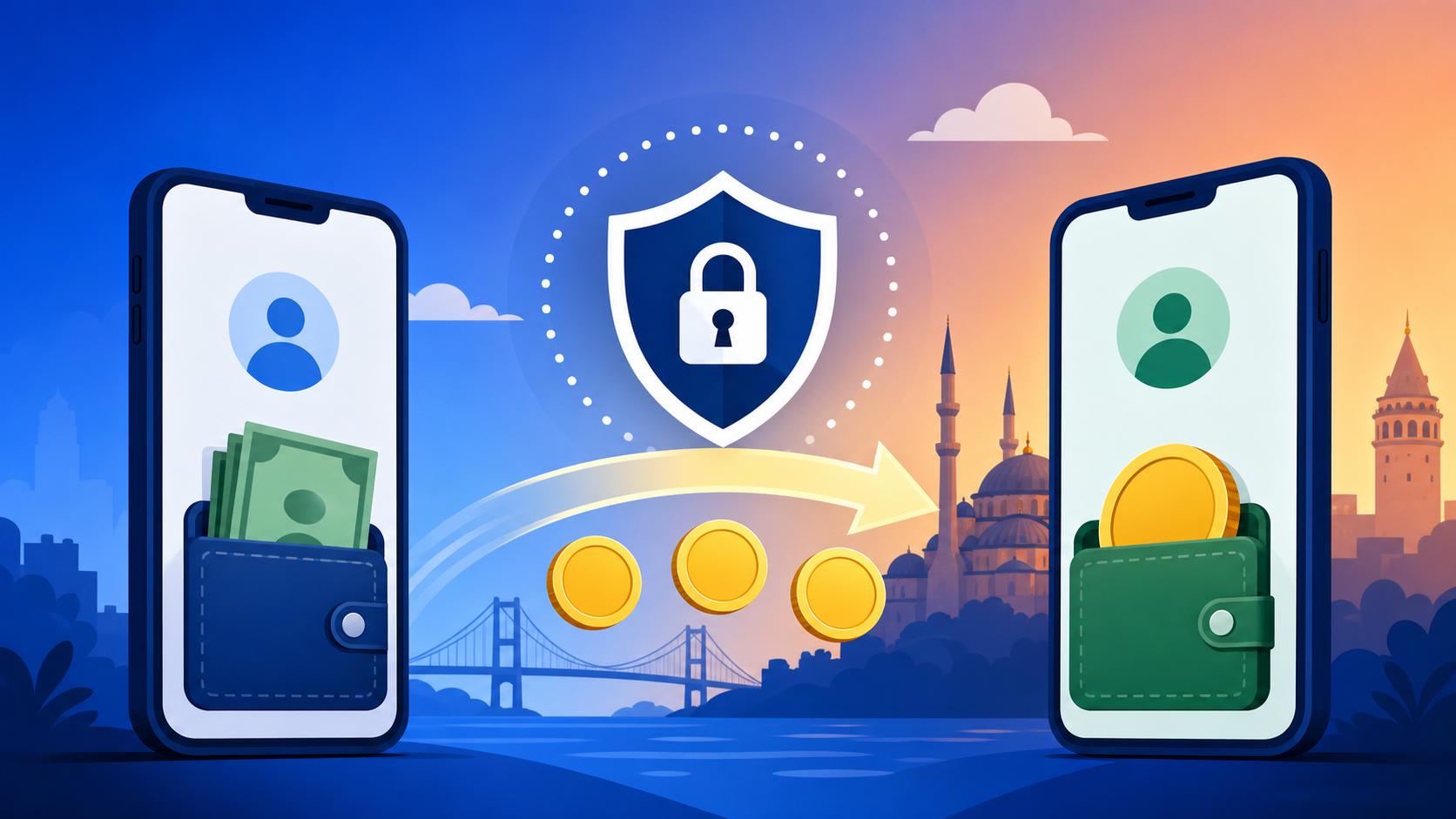
Wise remains a top-tier recommendation for expats because it allows you to send money to a Turkish IBAN as a local transfer. You send your USD, EUR, or GBP to Wise, and they use their local Turkish accounts to send Lira to your Turkish bank via the EFT or FAST system. This usually results in the money arriving within minutes at a much better rate than a standard SWIFT transfer. If you are Receiving Foreign Salary via Deel or Payoneer while Living in Turkey, you might also use these platforms to bridge the gap between your employer and your local Turkish spending.
For those looking to grow their savings while living abroad, Trade Republic offers a way to manage investments and earn interest on uninvested cash in Euros, which can be a vital hedge against Lira volatility. When you need to move those funds into Turkey, you would typically route them through a service like Wise to ensure the conversion to Lira is handled fairly. Additionally, some tech-savvy expats utilize Binance to move funds via stablecoins like USDT. By selling USDT for Lira on the Binance TR platform, you can then withdraw that Lira directly to your Turkish IBAN. This is often one of the fastest ways to move money on weekends when traditional forex markets are closed, though it requires comfort with crypto platforms.
Safety Protocols and Preventing Transfer Errors
The Turkish banking system is surprisingly advanced, but it is also unforgiving. One of the most important safety features is the "Name/IBAN Matching" check. When you paste an IBAN into a banking app like Garanti or Akbank, the system will often partially mask the recipient's name (e.g., A**** K***). You must ensure this matches the person you intend to pay. If you are Choosing a Turkish Bank: Comparing Ziraat, Garanti, İş Bankası, and Akbank, check which ones offer the most intuitive English-language interfaces, as this reduces the risk of clicking the wrong button during a high-value transfer.
Security is another major concern. Whenever you are accessing your Turkish banking app or a platform like Binance, always use a secure connection. I personally never check my balances or initiate transfers over public Wi-Fi in a coffee shop without NordVPN. Turkish banking apps are frequent targets for phishing, and a VPN adds a layer of encryption that is non-negotiable for anyone handling significant sums. NordVPN also helps if you need to access your home country's banking services, which might block logins from Turkish IP addresses due to fraud flags.
Finally, always pay attention to the "Açıklama" (Description) field. In Turkey, this isn't just for your own records; it is often a legal requirement. When paying rent, you must include the month and the words "Kira Ödemesi" (Rent Payment) to ensure it is registered correctly for tax purposes. If you are paying a fee to a government office, they will often require a specific reference number in this field. You can track your official records and any potential debts related to these payments using E-Devlet Financial Services: Tracking Taxes, SGK Debts, and Bank Accounts. Failing to fill this out correctly can lead to disputes with landlords or delays in government processing.
Troubleshooting Common IBAN Issues
What happens if a transfer doesn't arrive? First, check the "Dekont" (Receipt). Every transaction in a Turkish banking app generates a PDF Dekont. This is your proof of payment. If you've sent an EFT after hours, the Dekont will show a "Pending" or "Scheduled" status. If the name and IBAN did not match, the bank will usually reject the transfer, and the funds will return to your account within 24 to 48 hours. However, the bank will often deduct a small "EFT fee" for the failed attempt.
If you are using Wise or Trade Republic and the money hasn't hit your Turkish account, the most common culprit is a middle name mismatch. If your Turkish bank account is registered as "John Quincey Public" but your transfer service only lists you as "John Public," the Turkish bank's automated system might flag it for manual review. In such cases, you may need to visit your local branch—the one where you first opened the account—and speak to a customer representative. Bringing your residence permit (Ikamet) and a printout of the transaction is usually enough to clear the bottleneck.
For those managing larger portfolios or crypto assets, ensure that your Binance account name exactly matches your Turkish bank account name. Turkish law is very strict about "third-party transfers" in the crypto space; you cannot withdraw money from a crypto exchange to a friend's IBAN. It must be your own. By following these hyper-local rules and using tools like NordVPN for security and Wise for fair rates, you can master the Turkish IBAN system and focus on enjoying your life in this beautiful country rather than stressing over digits.
Disclaimer
This guide is for informational purposes only and does not constitute financial, legal, or investment advice. Banking regulations, transfer limits, and exchange rates in Turkey are subject to frequent change. Always verify current procedures with your official banking provider or a certified financial advisor before conducting large transactions.