Why Turkish Banks Ask for a Translated Utility Bill From Your Home Country
You walk into a sleek bank branch in Levent or Bursa, passport in hand and a stack of cash ready to deposit, only to be told you cannot open an account without a translated electricity bill from your "home country." I remember standing in a bustling Garanti branch three years ago, staring at a clerk who insisted my British water bill from six months ago—translated into Turkish and notarized—was the only key to my financial freedom in Turkey. This guide explains the complex regulatory reasons behind this specific demand and provides a roadmap to satisfying Turkish banks without losing your patience.
The Global Regulatory Framework: Why Your Address Matters
At first glance, it feels like a personal affront or a bureaucratic hurdle designed to slow you down. However, the requirement for a utility bill from your home country is deeply rooted in international banking standards known as "Know Your Customer" (KYC) and "Anti-Money Laundering" (AML) protocols. Turkish banks are under immense pressure from the Financial Action Task Force (FATF) and the Turkish Banking Regulation and Supervision Agency (BDDK) to ensure they aren't inadvertently facilitating the movement of "gray money."
When you are a foreigner in Turkey without a long-term residence permit (Ikamet), you are classified as a non-resident. To the bank's compliance department, you are a ghost until you can prove where you actually come from. A utility bill acts as a "tether" to a physical location. While a passport proves who you are, it doesn't prove where you live. Turkish banks need to document your permanent tax residency to satisfy international reporting standards like the Common Reporting Standard (CRS). This is why even a temporary visitor must often provide proof of their overseas life before they can access the local financial system.
If you are just starting your journey, checking a Financial Checklist for Your First 30 Days as a Newly Arrived Expat in Turkey can help you organize these documents before you even land. Without a verified address, the bank cannot assign you a risk profile, which is a mandatory step in their internal software before a new account number can even be generated.
Understanding the "Translated and Notarized" Requirement
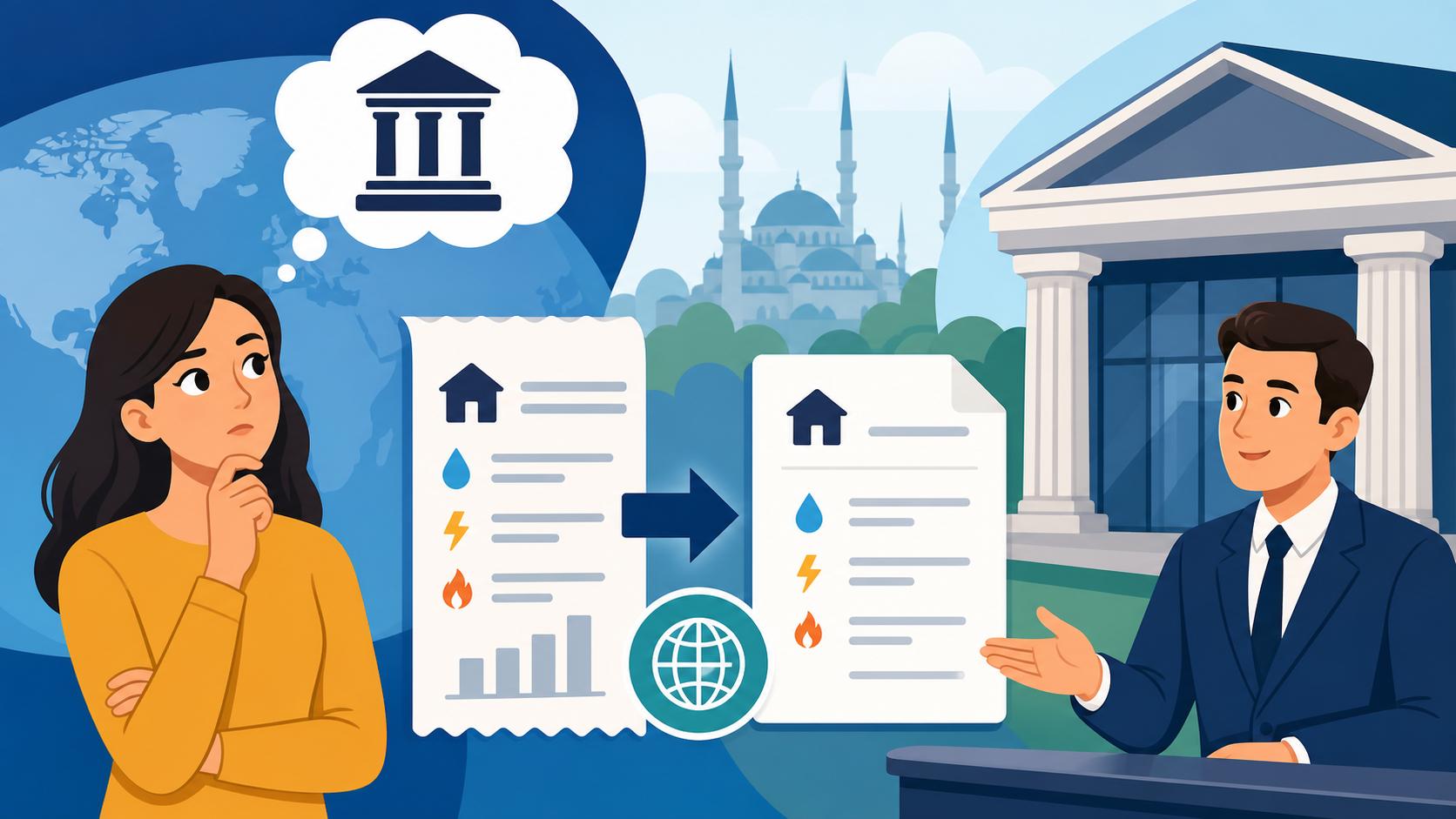
The most frustrating part isn't finding the bill; it's the fact that the bank usually won't accept it in English, French, or Arabic. Turkish is the only official language of the republic, and for a document to be legally recognized by a bank's head office, it must be processed by a "Yeminli Tercüman" (Sworn Translator). This isn't just a suggestion; it is a rigid legal requirement.
The process usually looks like this: you download your digital bill (which can be tricky if your home utility portal is geoblocked, often requiring a tool like NordVPN to access your accounts from a "home" IP address), take it to a sworn translator, and then—in many cases—take that translation to a Turkish Notary Public for a "Noter Tasdiki." The notary's seal is what gives the document "official" status in the eyes of the bank clerk.
Keep in mind that this is often the very first step in Opening a Bank Account in Turkey: Rules for Expats, Tourists, and Investors. Without that notarized translation, the bank's system literally will not allow the clerk to move to the next screen. Expats often try to argue that "everyone knows what 'Electricity' means in English," but the bank employee is following a script that, if deviated from, could cost them their job during an audit.
The Link Between Your Address and Your Turkish Tax ID
You cannot open a bank account in Turkey without a Potential Tax Number (Vergi Numarası). When you apply for this number, the tax office asks for an address. If you provide a Turkish address, the bank might ask for your Turkish residence permit. If you don't have one yet, you must use your foreign address, which brings us back to the utility bill.
The bank needs to see that the address on your translated utility bill matches the address you provided when Getting a Turkish Tax ID (Vergi Numarası) Online via Dijital Vergi Dairesi. If there is even a minor discrepancy—like a typo in your street name or a missing apartment number—the bank's compliance software may flag the application.
Once you have your tax ID and your translated bill, you are finally ready to interface with the Turkish banking system. After your account is active, you can use services like Wise to move your initial capital into the country at much better rates than traditional SWIFT transfers. I personally found that having my home country bill ready saved me at least three trips to the tax office and the bank.
Common Alternatives if You Cannot Provide a Utility Bill
What happens if you are a digital nomad who hasn't had a utility bill in your name for years? Or perhaps you lived in a house where utilities were included in the rent? This is a common pain point that requires a bit of "soft negotiation" with the branch manager. While the utility bill is the "Gold Standard," some banks may accept alternatives if you are persistent.
Bank Statements as Proof of Address
Some private banks, like Garanti or Akbank, may accept a recent bank statement from your home country if it clearly shows your name and residential address. However, this too will almost certainly need to be translated and notarized. The logic is the same: the document must be an "official" correspondence from a regulated entity.
Official Government Letters
A letter from your tax authority (like the IRS or HMRC) or a voter registration card can sometimes work. If you are struggling to find a document, it is worth Choosing a Turkish Bank: Comparing Ziraat, Garanti, İş Bankası, and Akbank and visiting multiple branches. In Turkey, "No" often means "I don't know how to do this," and a different branch of the same bank might be more flexible.
| Document Type | Acceptance Rate | Translation Required? | Notarization Required? |
|---|---|---|---|
| Electricity/Water Bill | High | Yes | Usually |
| Bank Statement | Medium | Yes | Yes |
| Rental Contract (Home) | Low | Yes | Yes |
| Driver's License | Very Low | Yes | No |
The Branch Lottery: Why Location Matters
In my experience, opening an account in a tourist-heavy area like Sultanahmet or a high-end expat district like Nişantaşı is vastly different from trying to do so in a quiet residential neighborhood. Branches in international hubs are more accustomed to seeing foreign documents and may even have an in-house list of "preferred" translators.
If one branch insists on a notarized translation and you think it’s overkill, try a branch in a different neighborhood. However, don't be surprised if the demand remains. The BDDK has tightened regulations significantly in 2026, and banks are now more afraid of fines than they are of losing a single foreign customer. If you find the process too cumbersome, you might consider using Wise to manage your Turkish Lira needs in the short term, although a local bank account is eventually necessary for things like paying How to Transfer Money Safely and Quickly Using the Turkish IBAN System.
Managing Your Finances After the Account is Open
Once you have jumped through the hoops of translating your home country utility bill and finally have your Turkish IBAN, a new world of financial management opens up. You aren't just limited to keeping cash in a savings account. Many expats use their Turkish residency and bank accounts to diversify their portfolios.
For instance, you might use your local funds to invest in global markets via Trade Republic or manage your cryptocurrency assets through Binance. Having a local bank account makes it much easier to off-ramp your crypto into Lira for daily expenses.
Why You Should Keep a Digital Copy
Once you have gone through the trouble of getting that translation and notary stamp, keep the originals in a safe place and scan them immediately. You may need that same document again if you decide to buy a car, apply for a residence permit, or even set up home internet. If you are worried about accessing your sensitive financial documents from public Wi-Fi in a Turkish cafe, using NordVPN can provide an extra layer of security for your digital file storage and banking apps.
Digital Nomads and the Utility Bill Paradox
The rise of the digital nomad has created a bit of a paradox for Turkish banks. Many nomads haven't lived in their "home country" for years. If you fall into this category, the bank may ask for your most recent "official" residence proof. If you've been living in various Airbnbs, you might need to provide a copy of your last official tax return or a bank statement that is linked to a permanent family address.
If you are entering the country under the new visa rules, check the Step-by-Step: Applying for a Tax ID Number at the Interactive Tax Office to see how your residency status affects your banking rights. Sometimes, having a larger initial deposit can also "grease the wheels" and make the bank more willing to accept alternative documents, though this is never a guarantee.
Final Advice for a Smooth Banking Experience
The key to surviving Turkish bureaucracy is "Sabır" (Patience). When the clerk asks for a translated utility bill, don't argue about the logic. Instead, ask them for the name of a nearby sworn translator they trust. Often, using a translator known to the branch can speed up the "verification" process because the clerk is familiar with their work.
Also, ensure your passport is valid for at least six months. If your passport is near expiration, the bank might refuse to open the account regardless of how many utility bills you bring. Once your account is live, you can start exploring more advanced financial tools like Trade Republic for your long-term savings or Binance for local crypto trading.
Remember, this hurdle is a one-time event. Once your address is in the system and your account is active, you won't have to show that old electricity bill ever again. You'll be free to navigate the Turkish economy with the same ease as a local.
Legal Disclaimer
The information provided in this guide is for informational purposes only and does not constitute legal, financial, or professional advice. Banking regulations in Turkey are subject to frequent changes by the BDDK and other regulatory bodies. Always consult with a qualified financial advisor or a legal professional before making significant financial decisions in a foreign country. Under no circumstances shall the author or publisher be held liable for any financial losses or legal issues arising from the use of this information.