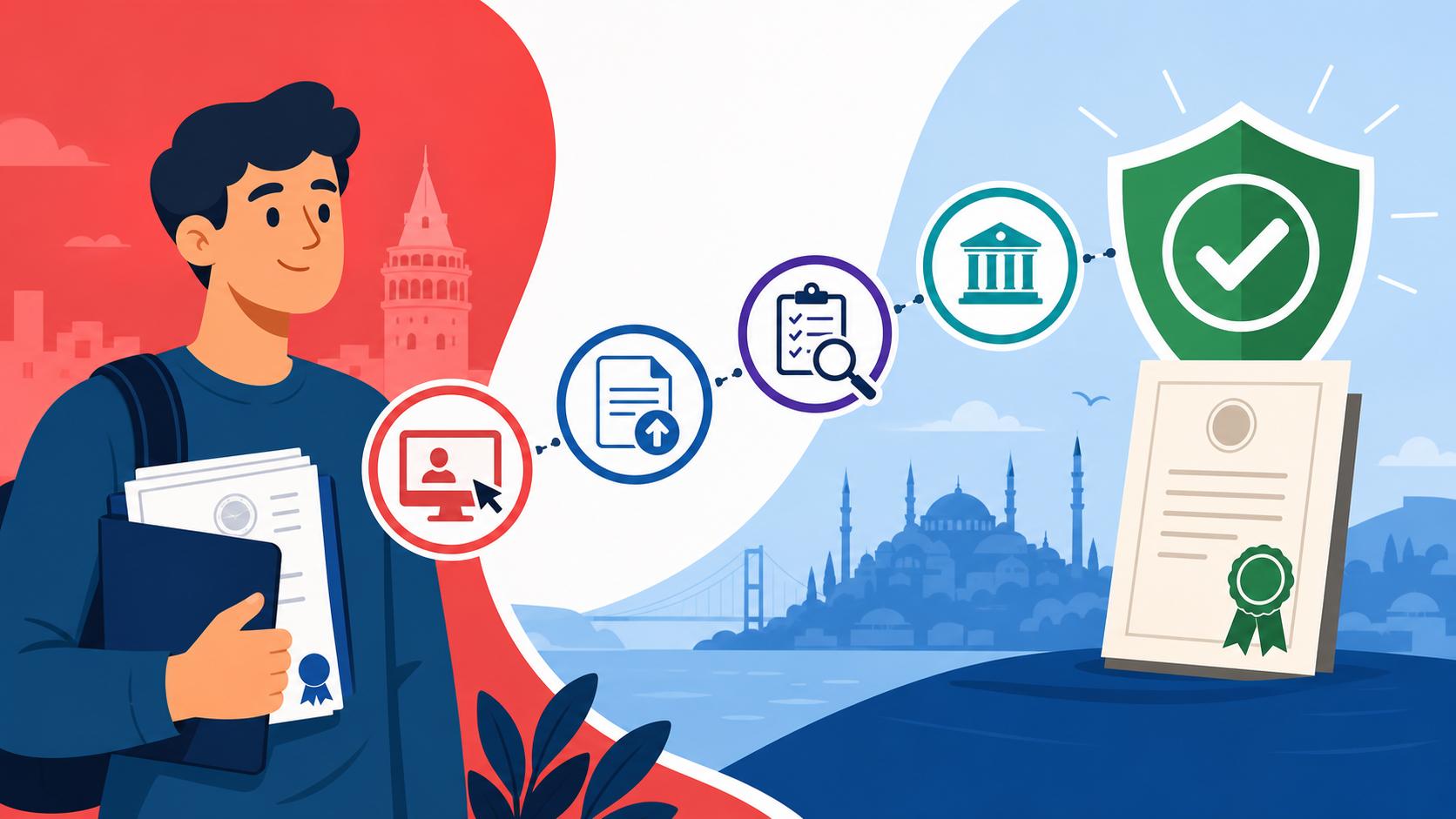
The Denklik Process: Step-by-Step Equivalency Guide via e-Devlet and YÖK
Trying to explain to a Turkish employer that your hard-earned foreign degree is legitimate often leads to a single, dreaded word: Denklik. I remember standing in a crowded hallway in Ankara, clutching my original diploma and wondering why my years of study weren't enough. This guide solves the complex puzzle of Turkish diploma recognition, walking you through every bureaucratic turn.
Understanding the Concept of Denklik in Turkey
If you are planning to build a professional life here, the term "Denklik" will soon become a central part of your vocabulary. In its simplest form, it refers to the process of obtaining a "Certificate of Equivalence." This document proves that your foreign education is equal to the education provided by Turkish institutions. Without it, your degree is essentially a decorative piece of paper in the eyes of many state bodies and regulated professions.
The process is managed by two different entities depending on the level of your education. For primary and high school diplomas, the Ministry of National Education (MEB) is your point of contact. For associate, undergraduate, and graduate degrees, you will deal with the Council of Higher Education, known locally as YÖK. This distinction is vital because the paperwork and the digital portals used for each are entirely separate.
Navigating these portals requires a decent grasp of administrative terminology. I found that using TurkishPod101 to learn specific "office and administration" vocabulary saved me from dozens of translation mishaps during the early stages. You don't need to be fluent to start, but knowing the difference between "aslı" (original) and "onaylı örneği" (certified copy) is a lifesaver when you are staring at a complex government form.
Why You Might Need Your Diploma Recognized
Most foreigners assume Denklik is only for those who want to work for the government. That is a common misconception. If you are entering a regulated profession—think medicine, law, engineering, or teaching—the equivalence is mandatory for you to legally practice. Even in the private sector, many companies require it to satisfy the requirements for Turkish Work Visas and Permits: Employer Sponsorship and Quotas Explained. If the Ministry of Labor sees an "Engineer" title on a work permit application, they will almost certainly demand a Denklik certificate.
Furthermore, if you are an expat parent, your children will need this process to transition from an international school or a school in your home country into the Turkish system. Without high school equivalency, a student cannot sit for the national university entrance exams. It is a gatekeeping mechanism that ensures everyone in the system meets the same academic standards, regardless of where they started their journey.
The Difference Between High School and University Equivalency
High school equivalency is generally faster and can often be handled through local directorates (İl Milli Eğitim Müdürlüğü) in major cities like Istanbul or Izmir. The focus here is on the number of years studied and the curriculum's breadth. It is less about "validating" the institution and more about placing the student in the correct grade level.
University equivalency, on the other hand, is a much deeper dive. YÖK doesn't just look at your diploma; they examine the credits you earned, the specific courses you took, and whether your university is recognized in international rankings. This is the stage where many professionals feel the most frustration, as YÖK might decide your 3-year degree from one country doesn't quite match the 4-year requirements of the Turkish system. For those aiming for high-tier roles, check out Corporate Tech Jobs in Istanbul: Salaries, Culture, and Remote Work Trends to see how vital these credentials are for landing a competitive salary.
Preparing Your Documents: The Apostille and Translation Phase
Before you even touch a computer or enter a government building, you have to play the document preparation game. This is where most people fail on their first attempt. Turkey is a stickler for "officialdom." An original diploma is rarely enough on its own; it must be "legalized" for use in Turkey. This usually means obtaining an Apostille from the country where the document was issued.
If your country is not a member of the Hague Apostille Convention, you have to go through a much more tedious process of "consular legalization," which involves multiple stamps from your home country’s Ministry of Foreign Affairs and the Turkish Embassy there. I cannot stress this enough: do not leave your home country without getting your documents apostilled. Trying to do this via mail from Antalya or Bodrum is a logistical nightmare that can take months.
Once you have the apostilled documents, the next step is translation. You cannot just use any translator. It must be a "Sworn Translator" (Yeminli Tercüman) recognized by a Turkish notary. To make your life easier during these interactions, I’d suggest reviewing the business modules on TurkishPod101 to handle the specific dialogue you’ll encounter at the notary’s office. You will be asked for your passport, the original document, and the translation, all of which will then be "notarized" (noter tasdikli).
Navigating the Apostille Requirement
The Apostille is a square stamp that verifies the signature of the person who signed your diploma. In the US, this is usually done by the Secretary of State; in the UK, it’s the Foreign, Commonwealth & Development Office. Many expats make the mistake of apostilling a copy of the diploma rather than the original. In Turkey, the YÖK officials often insist on seeing the Apostille on the original parchment or a very specific type of certified copy.
Always check the current Apostille Rules: Preparing and Stamping Your Foreign Diplomas for Turkey to ensure you aren't following outdated advice. Regulations can shift, and the authorities have become even more focused on digital verification. If your home country offers an "e-Apostille," make sure to print the verification page, as the Turkish system is increasingly integrated with international digital registries.
Working with Sworn Translators and Notaries
A "Yeminli Tercüman" is a translator who has taken an oath before a notary. When they translate your diploma and transcripts, they sign a document that the notary then "approves." This approval is what makes the document legally valid in Turkey. Be prepared for the costs; notaries in Turkey are not cheap. They charge by the page or by character count, and a full transcript with multiple pages can easily set you back several thousand Turkish Lira.
When you go to the notary, bring a Turkish-speaking friend if your level isn't quite there yet. Alternatively, the "Survival Phrases" section of TurkishPod101 can give you the confidence to ask for "Noter onayı" (notary approval) and "Aslı gibidir" (certified as the original). Most notaries in expat-heavy areas like Kadıköy or Çankaya have seen these documents a thousand times, but you still need to be precise about what you need.
The e-Devlet and YÖK Application Path for University Degrees
For those with degrees in hand, the e-Devlet portal is your new best friend—and occasionally your worst enemy. e-Devlet is Turkey’s centralized digital government system. To use it, you first need a password from any PTT (post office) by showing your residence permit (Ikamet). Once you’re in, the Denklik application for higher education is handled through the "Yükseköğretim Kurulu Başkanlığı" (Council of Higher Education) section.
The online application is a prerequisite. You will upload scans of your diploma, your transcripts, your passport, and your translation/notary files. The system is relatively modern, but it can be finicky with file sizes and formats. Once the online portion is submitted, you are usually given a tracking number. However, don't think your job is done just because you clicked "submit." Turkey still loves physical paper.
Starting the Online Application via e-Devlet
When you log into e-Devlet, search for "Okul Tanıma" or "Diploma Denklik Başvurusu." The system will guide you through a series of screens where you input your university's name, the dates of your study, and the degree obtained. Be very careful with the spelling of names; they should match your passport and your translated documents exactly. Any discrepancy can lead to a rejection months down the line.
While waiting for your digital submission to be processed, it's a great time to brush up on Learning Turkish for Life and Work: TÖMER, Language Schools, and Self-Study. The process can take anywhere from three months to over a year, and having a solid foundation in the language will make the eventual follow-up calls or visits to the YÖK office much more productive. If you are struggling with the interface, TurkishPod101 offers great lessons on navigating Turkish websites and common digital terminology.
Submitting Physical Documents to the Council of Higher Education (YÖK)
After the online pre-application, you will typically need to send your physical documents to Ankara. You can either go in person to the YÖK building—located in the Bilkent neighborhood—or send them via PTT "İadeli Taahhütlü" (registered mail with return receipt). I personally recommend the trip to Ankara if you can afford it. Handing your documents to a human being and getting a stamped "receipt of delivery" provides a level of peace of mind that mail simply cannot.
The officers will verify your originals against the copies. In some cases, they will take your original diploma for a few weeks to perform "authentication" with your home university. They send a verification email or letter to your university's registrar's office. This is often where the delay happens. If your university back home is slow to respond to an email from Turkey, your application will sit in a pile. It is often helpful to contact your university's registrar yourself and tell them to look out for an inquiry from "YÖK Turkey."
High School Equivalency (MEB Denklik) for Students and Parents
For high school students or those needing to prove they finished secondary education, the process is slightly more streamlined but no less important. The Ministry of National Education (MEB) now uses a portal called "e-Denklik." This is particularly crucial for students looking into Applying to Turkish Universities: State vs Foundation (Private) Institutions. Without that high school certificate, the university registration cannot be finalized.
The MEB process focuses on the "12-year" rule. Turkey requires 12 years of primary and secondary education. If you come from a country with an 11-year system, you might be required to take additional classes or exams to bridge the gap. The paperwork is similar to the university process: original diploma/leaving certificate, apostille, and sworn translation.
Using the e-Denklik Portal for Schools
The e-Denklik website allows you to upload your documents and choose the city where you want to pick up your certificate. Unlike the university process, you often don't have to send documents to Ankara. You can select a local "Denklik Merkezi" (Equivalency Center) in your city. Once the online evaluation is done, you will receive an SMS or email telling you to bring your original documents to the center for a final check and to collect your "Denklik Belgesi."
For parents, this can be an emotional rollercoaster. You’re trying to get your kid settled into a new culture, and the last thing you want is a fight over a report card. Knowing the right phrases to use with the education officers is key. I found that TurkishPod101 has specific content for families and school-related scenarios that really helped me navigate these meetings without sounding like a confused tourist.
Dealing with Local National Education Directorates
If the online portal isn't working—which happens more often than it should—you’ll find yourself at the "İl Milli Eğitim Müdürlüğü." These offices are usually busy and can be intimidating. Always go early in the morning, around 8:30 AM, and make sure you have every single document in a clear folder. The officers appreciate organization.
One unique thing about the MEB process is the "Grade Conversion." They won't just say your diploma is valid; they will convert your GPA into the Turkish 100-point scale. This is vital if you are applying for scholarships. If you need a high score to qualify for Turkish Scholarships (Türkiye Bursları): How to Apply and Secure Funding, ensure your translations clearly show your grades and the grading scale used by your home school.
Common Hurdles, Wait Times, and Realistic Expectations
Let’s be real: the Denklik process is a marathon, not a sprint. The average wait time for a university degree recognition is between 6 to 12 months. For high school, it’s usually 15 to 30 days. The frustration usually stems from the "Black Box" nature of the evaluation. You submit your papers, and then… nothing for months.
One of the most common hurdles is the "Institution Recognition." If your university isn't in a major global ranking (like QS or Times Higher Education), YÖK may take longer to investigate its status. Another issue is "missing credits." If they feel your degree is too narrow, they might issue a "Conditional Equivalency," requiring you to take specific classes at a Turkish university or sit for a national exam.
Why Applications Get Rejected or Delayed
Rejections aren't usually because your degree is "bad," but because the paperwork is "wrong." The most common reason for delay is a lack of response from the foreign university during the verification stage. Other reasons include:
- Missing the Apostille stamp.
- The notary stamp is from a city different from where the translator is registered (occasionally an issue).
- The degree was obtained through 100% distance learning (Turkey has historically been very strict about online degrees, though this is slowly changing).
- The name on the diploma doesn't match the passport (common for those who changed names after marriage).
If you do hit a wall, you might need to prove your language skills to show you can even follow the process. Gaining a TÖMER Certification: Proving Your Turkish Language Proficiency for University is often a requirement if you are asked to take bridge courses at a local university.
The Level Determination Exam (SYBS) Requirement
For certain professions—especially health sciences and engineering—YÖK may not give you direct equivalence. Instead, they will ask you to take the "Seviye Tespit Sınavı" (STS) or "SYBS." This is a grueling exam in Turkish that tests your professional knowledge. It’s a massive barrier for many expats.
If you are a doctor or a nurse, you cannot escape this. You will need to achieve a very high level of Turkish to pass these exams. This is where a long-term study plan with TurkishPod101 becomes indispensable. You'll need to move beyond "daily life" Turkish and into technical, academic language. You can also look into Finding English-Speaking Doctors in Istanbul: Top International Clinics to see where fellow expats have managed to navigate the system and find work.
Living and Working During the Process
What do you do while you wait for 10 months? This is the "grey zone." Technically, you cannot work in a regulated profession without the Denklik. However, many private companies will hire you for a "consultant" or "specialist" role while the process is pending, provided your work permit is handled correctly. You should be transparent with your employer about the status of your application.
During this time, focus on networking and building your local reputation. Join professional groups in Istanbul or Ankara. Use your time to master Business Turkish: Essential Vocabulary and Phrases for Emails and Meetings. The more integrated you are, the easier it will be to hit the ground running once that official paper arrives in your mailbox.
Legal Status and Employment While Waiting
It is important to remember that a Denklik application does not give you a right to stay in Turkey. You still need a valid Turkish Residence Permits (Ikamet): The Complete Application Guide (2027) or a work permit. The Denklik is a professional validation, not an immigration status.
Some employers might offer to help with the Denklik process, but ultimately, it is a personal application. No one can do it for you because it involves your personal educational history. If a "consultancy" tells you they can "guarantee" a Denklik for a high fee, walk away. There is no shortcut through the YÖK or MEB committees.
Language Proficiency and Social Integration
The transition from being a "foreigner with a degree" to a "recognized professional in Turkey" is as much about culture as it is about paperwork. Even with your Denklik in hand, the way you conduct yourself in a Turkish office matters. Understanding Turkish Business Culture: Communication Styles, Meetings, and Etiquette will help you apply your recognized degree effectively.
I found that the most successful expats are the ones who don't wait for the certificate to start "being" a professional in Turkey. They learn the language, they understand the hierarchy, and they use resources like TurkishPod101 to bridge the gap between their old life and their new one.
| Feature | MEB (High School) | YÖK (University) |
|---|---|---|
| Portal | e-Denklik | e-Devlet (YÖK section) |
| Typical Duration | 2 – 4 Weeks | 6 – 12 Months |
| Primary Location | Local Education Directorates | Ankara (Central Office) |
| Common Requirement | 12 Years of Education | University Recognition & Credits |
| Exam Needed? | Rarely (Only if years don't match) | Often (For Health/Engineering) |
| Physical Submission | At local center | Mail or In-Person in Ankara |
Important Disclaimer
The information provided in this guide is for informational purposes only and is based on expat experiences and current regulations. Turkish immigration and education laws are subject to frequent changes. Always verify the latest requirements on the official e-Devlet portal, the YÖK website (yok.gov.tr), or the Ministry of National Education website (meb.gov.tr) before submitting your application or paying any fees.