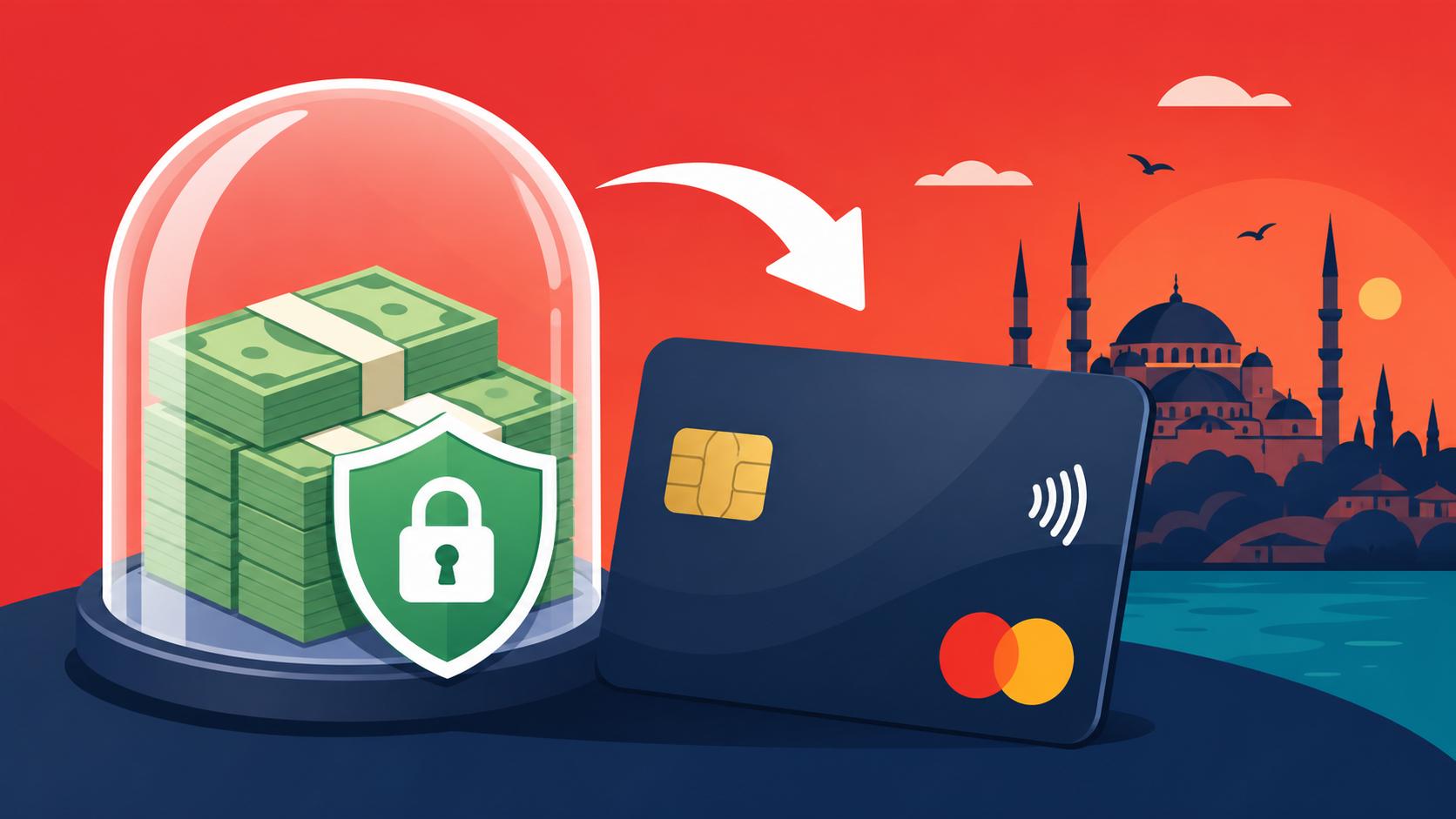
Securing a Credit Card in Turkey by Depositing a Cash Block (Bloke)
Walking into a shiny bank branch in Levent with a pocket full of foreign currency only to be told "no" for a basic credit card is a rite of passage for every new expat in Turkey. I spent my first six months here juggling three different debit cards before I realized the system wasn't broken—I just wasn't playing by the "bloke" rules. This guide breaks down exactly how to secure a Turkish credit card by depositing a cash block, bypassing the credit history barrier entirely.
The Turkish Credit Paradox for Foreigners
If you have lived in the UK, the US, or the EU, you are likely used to a system where a steady salary and a decent history of paying phone bills automatically qualifies you for a line of credit. In Turkey, the logic is inverted. Banks here are notoriously risk-averse when it comes to "Yabancı" (foreigner) clients because, from their perspective, you could pack your bags and leave the country overnight, leaving behind a trail of unpaid Lira debt.
Even if you have successfully completed Opening a Bank Account in Turkey: Rules for Expats, Tourists, and Investors, you will quickly find that a bank account does not equal credit. You can have millions of Lira sitting in a savings account, but when you click "Apply" for a credit card on your mobile app, the system will likely spit out an immediate rejection. This is usually due to the lack of a Findeks score—the Turkish equivalent of a FICO or Experian credit rating. Without a history of local loans or credit card usage, you simply do not exist in the eyes of the credit bureau.
Furthermore, many bank clerks are hesitant to process foreigner applications because the paperwork is more intensive. They might tell you that you need a Turkish guarantor or a work permit, even if you are here on a property-based residency. This is where the cash block, or "bloke," becomes your best friend. It removes the risk for the bank and the administrative headache for the clerk, providing a guaranteed "yes" in a system full of "maybe later."
Why Findeks is Your Biggest Hurdle
The Findeks system tracks every single financial move you make within the Turkish banking ecosystem. It records your debt-to-income ratio, your payment punctuality, and even how often you apply for new credit. For a newcomer, your Findeks report is a blank slate, which the algorithms interpret as "high risk." You cannot build this score without credit, and you cannot get credit without a score. It is the ultimate financial catch-22.
By opting for a cash-blocked card, you are essentially "buying" your way into the Findeks system. Every time you use your blocked card and pay the statement on time, you are generating positive data points. After 6 to 12 months of disciplined usage, your score will finally reach a level where you can ask the bank to "unblock" your deposit or apply for a second, unsecured card at a different institution.
The Resident vs Tourist Barrier
While some banks technically allow tourists to open accounts, securing a credit card usually requires a "Kimlik" number (your 99-series foreigner identification number). If you are still waiting for your residency appointment, you should focus on Getting a Turkish Tax ID (Vergi Numarası) Online via Dijital Vergi Dairesi first, but be prepared for the bank to insist on seeing your physical residence permit (Ikamet) card before they will even discuss a cash-blocked credit limit.
Many expats try to bypass this by showing high-balance statements from foreign banks like Trade Republic or showing their global assets, but Turkish branches generally only care about the liquidity you are willing to lock up within their own vaults. The local branch manager has the final say, and they are much more likely to approve a card for a resident who has a registered address in the neighborhood.
Decoding the Cash Block System
The concept is simple: you provide the bank with a "security deposit" in exchange for a credit limit. If you want a credit card with a 50,000 TL limit, you will likely need to deposit around 55,000 TL to 60,000 TL into a dedicated savings account. The bank then places a "bloke" (block) on this account, meaning you cannot withdraw that money as long as the credit card is active.
This is fundamentally different from a debit card. With a debit card, you are spending your own money instantly. With a cash-blocked credit card, you are using the bank's money on a 30-day cycle, allowing you to take advantage of the "taksit" (installment) system, which is the heartbeat of Turkish consumer culture. Without a local credit card, you will find it nearly impossible to buy a new laptop or furniture in manageable monthly chunks, as most Turkish retailers only offer 0% interest installments to local cardholders.
Collateral vs Credit Limit Ratios
Every bank has a slightly different internal policy regarding the "margin" they require. Because the Turkish Lira can be volatile, banks often ask for a deposit that is 110% or 120% of the requested credit limit. This buffer protects the bank if you max out the card and the Lira's value shifts significantly against the bank's internal benchmarks.
For example, at Ziraat Bankası, I found that they were quite comfortable with a 110% ratio. If I blocked 22,000 TL, I received a card with a 20,000 TL limit. Some private banks like Garanti BBVA or Yapı Kredi might be more stringent, demanding a 130% block for foreigners who don't have a work permit. It is always worth negotiating this with the "Müşteri Temsilcisi" (Customer Representative) at the branch.
Interest Rates on Blocked Funds
One of the biggest questions expats ask is: "Does my blocked money still earn interest?" The answer is usually yes, but you must ensure the bank sets it up as a "Vadeli" (Time Deposit) account rather than a "Vadesiz" (Current) account. If you just leave it in a standard current account, your money will sit idle while inflation eats away at its value.
In the current 2026 economic climate, interest rates in Turkey remain high. You can often negotiate to have your blocked funds placed in a high-yield savings account or even a Money in Turkey for Expats: Banking, Payments, and Finance Guide (2027) style FX-protected account (KKM), though the latter is becoming more restricted for foreigners. If you are blocking a significant amount, say 200,000 TL, the interest earned could actually cover a significant portion of your monthly grocery bills.
The Step-by-Step Branch Strategy
Going to a Turkish bank without a plan is a recipe for a four-hour headache. You need to approach this as a formal negotiation. Start by choosing a branch where you already have an account, or better yet, a branch in an area with a high expat population (like Kağıthane or Kadıköy in Istanbul, or Konyaaltı in Antalya) where the staff is familiar with Choosing a Turkish Bank: Comparing Ziraat, Garanti, İş Bankası, and Akbank.
When you arrive, take a number for "Bireysel İşlemler" (Individual Transactions). When you sit down with the representative, do not just ask for a credit card. Ask specifically for a "Blokeli Kredi Kartı." This tells the clerk you know the system and you aren't asking for an unsecured loan they will have to reject.
Essential Documentation Checklist
Before you leave the house, make sure you have the following in a folder. Turkish bureaucracy loves physical paper:
- Physical Ikamet Card: Your residence permit.
- Passport: Even if you have the permit, they often want to scan the entry stamp.
- Address Certificate: Download your "Yerleşim Yeri Belgesi" from E-Devlet Financial Services: Tracking Taxes, SGK Debts, and Bank Accounts.
- Tax ID Number: The paper printout or a screenshot from the interactive tax office.
- Initial Deposit: Ensure the funds are already in your account or have your Wise app ready to make a transfer.
Using Sending Money to and from Turkey: SWIFT, IBANs, and International Apps is the most efficient way to get your "bloke" funds into the country. I personally used Wise (TransferWise) in Turkey: Changes in Sending TRY Abroad Due to Regulations to move my initial deposit because the exchange rates provided by the bank at the counter are usually abysmal compared to mid-market rates.
Navigating the Customer Representative Conversation
The clerk might still be hesitant. They might say, "Our system doesn't allow this for foreigners." This is often a polite way of saying "I don't know which buttons to click in the software." In this case, stay calm and ask them to check with their "Müdür" (Manager). Mention that you are aware of other foreigners who have "Nakit Karşılığı" (Cash Collateral) cards.
Once they agree, they will ask you to sign a stack of documents. One of these will be the "Rehin Sözleşmesi" (Pledge Agreement), which legally allows the bank to seize your blocked funds if you default on your card payments. Read this carefully—or use a translation app—to ensure there is a clear clause stating how you can cancel the card and retrieve your money in the future.
| Bank Name | Typical Block Ratio | Minimum Deposit (Est.) | Expat Experience |
|---|---|---|---|
| Ziraat Bankası | 110% | 10,000 TL | Very reliable; familiar with foreigners. |
| VakıfBank | 110% | 10,000 TL | Straightforward; often the easiest "yes." |
| Garanti BBVA | 120-130% | 20,000 TL | Great app; English support; stricter ratios. |
| İş Bankası | 110-115% | 15,000 TL | Solid middle-ground; very professional. |
| Akbank | 120% | 20,000 TL | Modern; sometimes prefers work permits. |
Mastering the Taksit (Installment) System
Once your card arrives (usually via PTT courier within 7-10 days), you have just unlocked the secret level of the Turkish economy. The primary reason for having this card isn't just for daily spending—it's for "taksit." When you go to a store like MediaMarkt or IKEA, or even when shopping online via Trendyol, you will see options for "3 Taksit," "6 Taksit," or "9 Taksit."
This allows you to spread the Cost of Living in Turkey 2026: Detailed Budgets for Singles and Families across several months. In a high-inflation environment, this is a massive financial win. You are paying back the debt in future Lira, which is statistically likely to be worth less than today’s Lira. If you buy a phone for 60,000 TL on 6 installments, your last payment of 10,000 TL six months from now will feel "cheaper" than the first payment.
Using Online Banking for Foreign Transactions
Be aware that many Turkish credit cards come with "International Transactions" and "E-commerce" disabled by default for security reasons. You will need to log into your mobile banking app and toggle these on. If you are using your card to pay for global services like NordVPN to keep your browsing secure or to fund your Binance account, you may need to call the bank's English-speaking hotline to authorize "3D Secure" messages for international merchants.
I found that Ziraat's app is quite intuitive for this, but sometimes the "Sanal Kart" (Virtual Card) feature is even better. You can create a virtual card linked to your blocked credit line, set a tiny limit, and use it for one-off purchases on sites you don't fully trust.
Transitioning to Unsecured Credit
The ultimate goal of the cash-blocked card is to eventually get your money back. Most banks will not automatically unblock your funds. You have to be proactive. After a year of perfect payment history, go back to the same branch. Show them your improved Findeks score (which you can check within the bank's app for a small fee) and ask to "Teminat İadesi" (Return of Collateral).
If you have a work permit or have gained citizenship by this point, the process is easy. If you are still on a tourist or property residency, they might suggest keeping a smaller block. If the bank refuses to budge, this is when you take your Findeks score and go to a different bank. Apply for a regular credit card there, and once approved, go back to the first bank, cancel the blocked card, and take your cash.
Risks of Currency Devaluation
While your card limit stays the same, the value of the cash you have blocked is subject to the Lira’s fluctuations. If you blocked $1,000 worth of Lira two years ago, that same amount of Lira might only be worth $600 today. This is the "tax" you pay for local credit. To mitigate this, some banks allow you to block USD or Gold (Altın) instead of Lira. This is much rarer and usually requires a larger deposit, but it protects your underlying capital from devaluation while still giving you a Lira-denominated credit card.
Final Pro-Tips for the Savvy Expat
Don't forget that even with a cash block, the bank can still charge an "Yıllık Aidat" (Annual Fee). Ask for a "Aidatsız" (Fee-free) card if possible, though these often don't come with the best reward points (Bonus or Maxipuan). These points add up quickly; I’ve paid for several flights between Istanbul and London just by using the points earned from my monthly Migros grocery hauls.
Lastly, ensure your address is always up to date in the bank's system via the Nüfus office. If the bank tries to send you a new card or a legal notice and it bounces, they might freeze your blocked account for "security verification," which is a nightmare to resolve over the phone.
Disclaimer
This guide is for informational purposes only and does not constitute financial, legal, or investment advice. Banking regulations in Turkey are subject to frequent changes, and individual branch policies may vary. Always consult with a certified financial advisor or a qualified legal professional before making significant financial commitments in a foreign country.