Required Documents Checklist for a Short-Term Turkish Residence Permit
Nothing triggers a cold sweat for an expat like walking into the Göç İdaresi with an incomplete pink folder. I remember sitting in that plastic chair in Istanbul, realizing I'd left my notarized rental agreement on the kitchen counter, and the sinking feeling was visceral. This guide provides an exhaustive checklist to ensure your Short-Term Turkish Residence Permit application is bulletproof from the start.
The Core Application Bundle
The foundation of your residency application is what I call the "Holy Trinity" of Turkish bureaucracy: your form, your passport, and your photos. If any of these are slightly off, the officer might send you away before you’ve even had a chance to say "Merhaba." It sounds harsh, but when you’re dealing with thousands of applicants, the system relies on precision. Applicants can lose their appointment slot because their biometric photo was too old or their passport didn't have enough blank pages.
The e-Ikamet Application Form
Your journey begins on the official government website. This is where you input every detail of your life, from your parents' names to your specific reason for staying in Turkey. Once you complete the online portion, the system generates a PDF document. You must print this out and sign it. Many expats forget that the digital submission isn't enough; the physical, signed copy is the very first page of your folder.
When filling out The e-Ikamet System: How to Apply, Renew, and Track Your Residence Permit, ensure every single letter matches your passport exactly. If your middle name is on your passport but you leave it off the form, you’re asking for trouble. It is always wise to double-check your entry date into Turkey as well; if the system sees a discrepancy between your reported arrival and the stamp in your passport, it can trigger an immediate red flag.
Passport Requirements and Validities
Your passport is your most precious asset during this process. For a Turkish residence permit, your passport must be valid for at least 60 days beyond the duration of the permit you are requesting. For example, if you are asking for a one-year residency, your passport needs at least 14 months of validity remaining. If it’s shorter, the Göç İdaresi will only grant you a permit up until that 60-day buffer before your passport expires.
You need to provide a high-quality color photocopy of your passport. This isn't just the photo page; you must include the page showing your last entry stamp into Turkey and any visa pages if applicable. If you entered on an e-visa, print that out and include it too. Always have your original passport on your person during the appointment.
Biometric Photos
Turkish biometric photos have very specific requirements that differ from standard passport photos in many Western countries. They must be taken within the last six months, have a plain white background, and be 5×6 cm in size. You usually need four of these. Do not attempt to use a selfie or a cropped photo from a wedding; the scanners at the migration office are incredibly sensitive to shadows and proportions.
When you go to a local Turkish photography studio (fotoğrafçı), just tell them you need "biyometrik fotoğraf" for an "ikametgah." They know exactly what to do. Ensure you don't wear glasses if they cause a glare, and keep a neutral expression. For more specifics on the technical side, check out our guide on What Exact Size and Background is Needed for Turkish Biometric Ikamet Photos to avoid a last-minute dash to a mall photo booth.
Proving Your Financial and Medical Security
Once the identity documents are settled, the Turkish government wants to know two things: will you be a burden on the state healthcare system, and can you actually afford to live here? The scrutiny on these two points has intensified significantly. The days of simply stating "I have money" are long gone; you now need documented proof that satisfies the latest regulations.
Health Insurance Standards
Every foreigner under the age of 65 (and sometimes older, depending on the permit type) must have valid health insurance that covers the entire duration of the requested permit. This is a non-negotiable requirement for your pink folder. The policy must specifically state that it complies with the "Minimum Coverage Limit" set by the migration laws. Most local "Ikamet insurance" policies are quite basic and designed mostly to tick this box for the visa.
However, if you want actual protection, many expats opt for more comprehensive international plans. While you might use a local policy for the application, having a robust plan from a provider like Cigna Global ensures that if something actually happens, you aren't stuck navigating a public hospital with zero language skills. We’ve detailed the nuances of these choices in our post on Health Insurance Requirements: Securing a Policy for First-Time Ikamet Applications, which is essential reading before you buy the cheapest policy you find online.
Financial Sufficiency Evidence
The government needs to see that you have enough funds to support yourself without working illegally in Turkey. Generally, the rule of thumb is that you should have funds equal to the Turkish minimum wage for every month of your stay. However, the exact documentation requested can vary. Some officers are happy with a Turkish bank statement showing a lump sum, while others might ask for a notarized "statement of means" or proof of a monthly pension.
If you are relying on savings, I highly recommend having a Turkish bank account with the funds already converted to Lira or held in a recognizable currency like USD or EUR. For those earning abroad, the process is trickier and often requires translated and notarized proof of income. You can find a deeper dive into the specific math and document types in our guide on Proving Financial Sufficiency for a Turkish Ikamet Application in 2026.
The Receipt of Payment
There are two main fees you must pay: the Residence Permit Fee (Harç) and the Card Fee (Değerli Kağıt Bedeli). The amounts change annually and depend on your nationality. You can often pay these online via the interactive tax office (GİB) website using the reference number from your application form. If the online system is down—which happens more often than we’d like—you can pay at a Ziraat Bank or Halkbank branch.
Crucially, you must include the physical, stamped receipts in your folder. If you pay online, print the "Tahsilat Makbuzu" (collection receipt). Do not just bring a screenshot of the payment confirmation from your banking app. The officer needs to see the official government receipt. Some people have been sent to the nearest tax office mid-appointment because they only had a digital confirmation on their phone.
| Document Category | Item Required | Critical Note |
|---|---|---|
| Identity | Application Form | Must be printed in color and signed |
| Identity | Passport Photocopy | Include photo page and last entry stamp |
| Identity | 4 Biometric Photos | 5×6 cm, white background, recent (6 mo) |
| Health | Insurance Policy | Must state 'compliance with residency laws' |
| Finance | Bank Statement | Suggested amount: Min wage x 12 months |
| Finance | Tax Receipts | Must include both Card Fee and Permit Fee |
| Residence | Notarized Lease | Must be signed in front of a notary |
| Residence | UETS Document | Digital notification address from PTT |
The Critical Role of Your Residential Address
In recent years, the "Address" portion of the application has become the most common reason for rejection. Turkey is very strict about where foreigners live, partly due to the "closed neighborhood" policy and partly to prevent fraudulent addresses. You cannot simply stay at a friend's house or a non-registered Airbnb and expect to get a permit. You need a formal, legal paper trail of where your head hits the pillow every night.
Notarized Rental Contracts
If you are renting an apartment, your lease agreement (Kira Sözleşmesi) must be notarized. This doesn't mean you just sign it at the kitchen table; you and your landlord (or their legal representative) must go to a local notary office. The notary will verify the landlord's ID and the property's earthquake insurance (DASK) before stamping the document. This is one of the most bureaucratic parts of the process, and it’s where a lot of "I've-been-there" frustration stems from.
Finding the right office is key, as some are much busier than others. We have a helpful resource on Where to Find Public Notaries to Authenticate Your Passport and Rental Lease to help you navigate the system. Remember, the landlord’s signature must be notarized; a simple copy of the contract will be rejected immediately by the Göç İdaresi.
Nüfus and Address Registration
If you are renewing your permit, you must already be registered in the national address database (Mernis). This is handled by the Nüfus (Population) Directorate. If you’ve moved since your last permit, you have a strict 20-day window to update your address. The officer at your appointment will check the system to see if your reported address matches what’s in the Nüfus database.
For first-time applicants, the address registration usually happens after you get your permit, but you still need to provide the proof of where you intend to live (like the notarized lease). For a smooth transition, understanding How to Obtain an Official Address Certificate (Yerleşim Yeri Belgesi) on e-Devlet is vital. This digital document is often the "final boss" of Turkish paperwork that proves you are officially "in the system."
Understanding Closed Neighborhoods
This is a big one. Many neighborhoods in cities like Istanbul, Ankara, and Antalya are "closed" (Kapalı) to new foreign residents. This means that even if you have a perfect lease and a great apartment, if that building is in a closed zone, your residency application will be denied. It’s a heartbreaking mistake expats make far too often.
Before you sign any lease or put down a deposit, you must verify the status of the neighborhood. The list changes frequently based on the percentage of foreigners living in the area. You can find the most current info in The List of Closed Neighborhoods in Istanbul, Antalya, and Mersin (2026 Updates) to ensure your dream apartment isn't actually a one-way ticket to a visa rejection.
Specialized Paperwork and Legalities
Beyond the standard documents, there are a few "extra" items that can catch you off guard. Depending on your nationality and the specific reason for your stay (touristic, property ownership, or family), you might need to prove your background with documents from your home country. This is where the world of Apostilles and sworn translations becomes your new reality.
Touristic Intent and Itinerary
If you are applying for a "Short-Term Touristic" permit, the officer may ask for a travel plan. This isn't just saying "I want to see Cappadocia." They want to see hotel bookings, flight receipts, or a written itinerary of what you plan to do for the next year. With the 2026 rules being much stricter on touristic permits, having a well-documented reason for staying is more important than ever.
Some applicants provide museum passes, Turkish language course registrations, or even planned tour bookings to show they are genuine tourists. If your plan looks like you’re actually trying to work remotely or just "hang out" indefinitely, the risk of rejection increases. It is wise to be as detailed as possible—over-prepare, don't under-prepare.
Property Ownership Documents
For those who have purchased a home in Turkey, the "Tapu" (Title Deed) is the center of your universe. To get a residence permit based on property, the property must meet the minimum valuation requirement (currently $200,000 for all cities as of late 2023/early 2024). You will need a "Tapu Kaydı" (Title Deed Registry) document dated within the last week of your appointment.
This document proves that you still own the property and that there are no new liens or issues. You can usually get this from the Land Registry office or sometimes via e-Devlet. If your residency is based on your home, you are in a much more secure position than a standard tourist, but the paperwork must be flawless.
Apostilles and Sworn Translations
Any official document from your home country—like a birth certificate, marriage license, or a police clearance—must be Apostilled in the country where it was issued. An Apostille is an international stamp that authenticates the document for use abroad. Once you have the Apostilled original, it must then be translated into Turkish by a sworn translator (Yeminli Tercüman) and notarized in Turkey.
For high-quality, reliable translations that the Turkish authorities will accept without question, services like RushTranslate are often recommended. They understand the formatting required for international legal documents. Dealing with this from abroad can be a nightmare, so it's best to handle these in our home country before you even move to Turkey. Check our guide on Apostille Treaties: Which Country Actually Needs to Stamp Your Birth Certificate and Sworn Translators (Yeminli Tercüman): Expected Costs for Official Documents for a step-by-step breakdown of this expensive but necessary process.
Organizing for Success
You have all your papers. Now what? The way you present your case to the officer at the Göç İdaresi matters. Think of it as a professional interview where the "employer" is a stressed government official who has seen 50 people before you today. Organization and a little bit of cultural etiquette go a very long way in making the process painless.
Preparing the Pink Folder
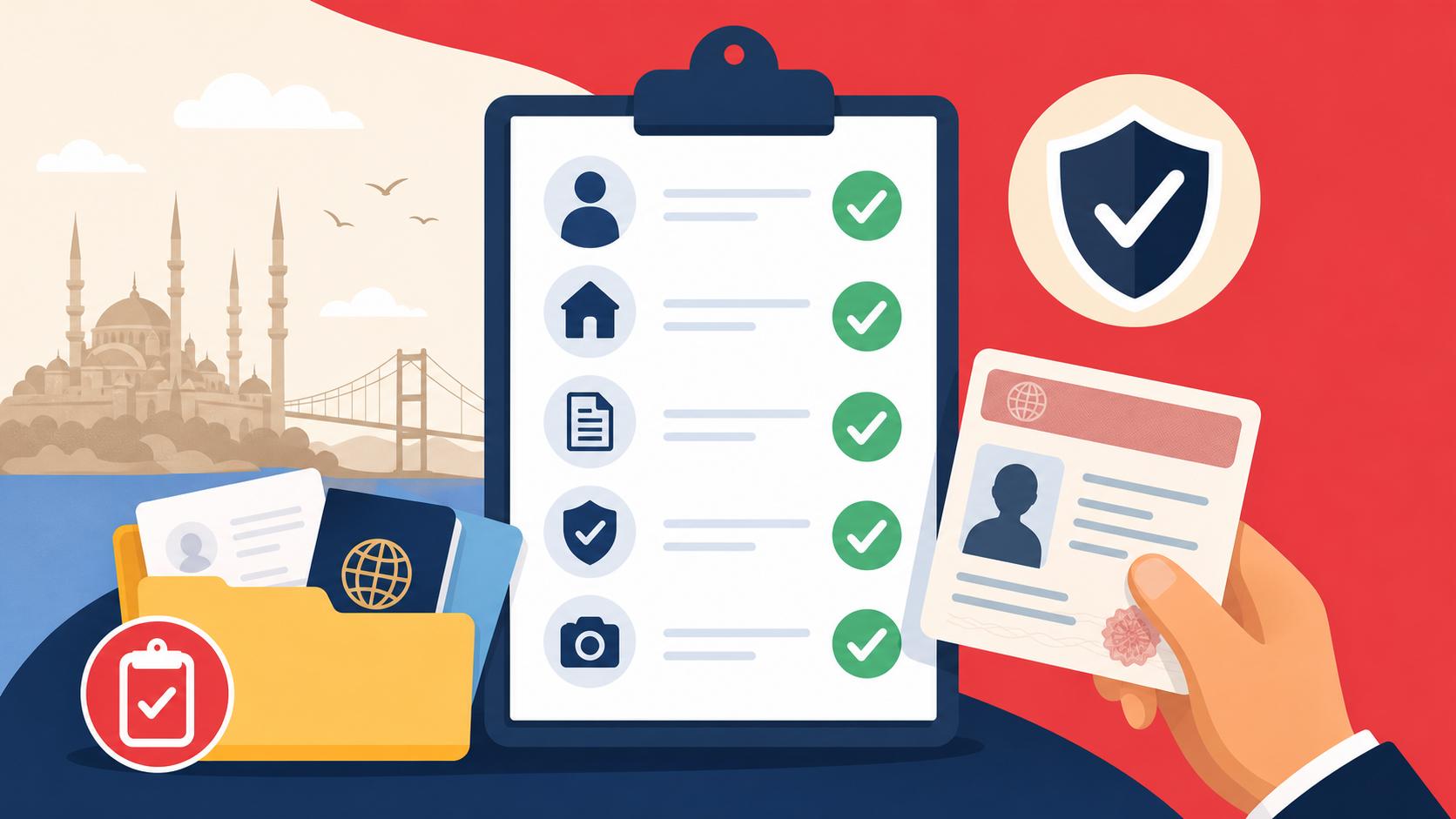
In Turkey, the residency application is synonymous with the "pembe dosya" (pink folder). You can buy these at any stationery store (kırtasiye) near a migration office. It’s a simple cardboard folder, but it’s the standard. Don't use a fancy leather binder or a plastic sleeve; just use the pink folder.
Organize your documents in the order they appear on the checklist generated by the e-Ikamet system. Put the application form on top, followed by your passport copy, photos, insurance, and then your address documents. Having everything organized means the officer doesn't have to hunt for papers, which keeps them in a better mood. Trust me, a happy officer is a helpful officer.
What Happens During the Interview
When your number is called, walk to the desk with a polite "Kolay gelsin" (a common Turkish phrase wishing someone ease in their work). You will hand over your folder and your original passport. The officer will flip through your papers, scan your fingerprints (if it's your first time), and perhaps ask a few basic questions: "What do you do for a living?" or "Why do you want to stay in Turkey?"
Be honest and brief. You don't need perfect Turkish, but knowing a few phrases helps. Most offices in major cities like Istanbul have translators or officers who speak some English, but it’s not guaranteed. If you’ve followed this checklist, the "interview" is usually just a data-entry session for the officer. If something is missing, they will give you a "tebliğ" (notification) giving you 30 days to bring the missing paper.
Post-Appointment Procedures
At the end of your appointment, if everything is okay, you will receive a stamped document called the "İkametgah Müracaat Belgesi" (Residence Permit Application Document). This is your "golden ticket." It allows you to stay in Turkey legally while your card is being printed and mailed. It also allows you to travel outside of Turkey for up to 15 days, provided you have it stamped and meet certain conditions.
Now comes the waiting game. Your card will be sent via PTT (the Turkish postal service) to the address you provided. You also need to ensure you have set up your UETS Setup: Getting Your PTT Electronic Mailbox as a Foreign Resident. This is a digital notification system that the government now uses to send official legal notices. Without it, you might miss important updates about your status. Once that card arrives in its yellow envelope, you are officially a resident!
Disclaimer
The information provided in this guide is for general informational purposes only and does not constitute legal advice. Immigration laws and regulations in Turkey are subject to frequent changes. While we strive to keep this information up to date for 2026, always verify the latest requirements on the official website of the Presidency of Migration Management (Göç İdaresi) or consult with a qualified legal professional before making your application.